In five minutes
The Austro-Prussian War of 1866 was a short war in which Prussia defeated Austria and took over leadership of the German states. It lasted about seven weeks, so it is also called the Seven Weeks' War. The deciding moment was the Battle of Königgrätz on 3 July 1866.
The result redrew the map of central Europe. The German Confederation, the loose union of German states set up in 1815, was dissolved. Austria was shut out of German affairs, and Prussia built a new North German Confederation that it controlled. The war is the middle one of three wars that led to the German Empire of 1871: Denmark in 1864, Austria in 1866 and France in 1870–71. For the wider background, see the hub article 19th-Century Europe: Revolutions, Nationalism and Unification.
- Prussia and its allies: the Kingdom of Italy and several north German states.
- Austria and its allies: Bavaria, Saxony, Hanover, Württemberg and most other German states.
- Main question: which of the two great powers would lead the Germans?
- Winner: Prussia.
Causes: why Prussia and Austria came to blows
Two rivals in one Confederation
After the Congress of Vienna in 1815, the German-speaking lands were grouped into the German Confederation. Austria chaired it, and its assembly met in Frankfurt. But the Confederation was weak: each state kept its own ruler and army, and it could not act without agreement among them.
Prussia slowly pulled ahead in other ways. It led the German customs union, the Zollverein, founded in 1834, which tied most German states into one trading area and left Austria outside. Prussia's coal, iron and railways grew fast, while Austria had to hold together many nationalities, including Hungarians, Czechs and Italians. By the 1860s the question was open: would Germany be united around Prussia, or around Austria?
Bismarck takes charge
In 1862 King Wilhelm I was locked in a fight with the Prussian parliament over army funding. He turned to Otto von Bismarck, who became minister-president. Bismarck believed the German question would be settled by power and diplomacy, not by speeches. You can read more about him in Otto von Bismarck: The Iron Chancellor.
The Schleswig-Holstein quarrel
The immediate spark was the question of Schleswig and Holstein, two duchies tied to the Danish crown. In 1864 Prussia and Austria fought Denmark together and took both duchies. Then they had to decide what to do with them. In the Convention of Gastein (August 1865), Prussia would administer Schleswig and Austria would administer Holstein. It was a poor arrangement, because Holstein lay next to Prussian land and far from Austria. Bismarck could create a dispute there whenever he wished.
Bismarck prepares the ground
Before fighting Austria, Bismarck worked to leave it without friends. Russia, which Prussia had backed during the Polish uprising of 1863, stayed friendly. He met Napoleon III of France at Biarritz in October 1865 and left him hoping for a neutral stance in return for possible gains. On 8 April 1866 Prussia signed an alliance with Italy, which wanted to take Venetia from Austria. Austria would have to fight on two fronts.
In early June 1866, Austria asked the Confederation's assembly to decide the future of Holstein. Prussia said this broke the Gastein agreement and sent troops into Holstein on 7 June. On 14 June the assembly voted to mobilise federal troops against Prussia. Prussia declared the Confederation dissolved and attacked.
What happened
Two armies, two ways of fighting
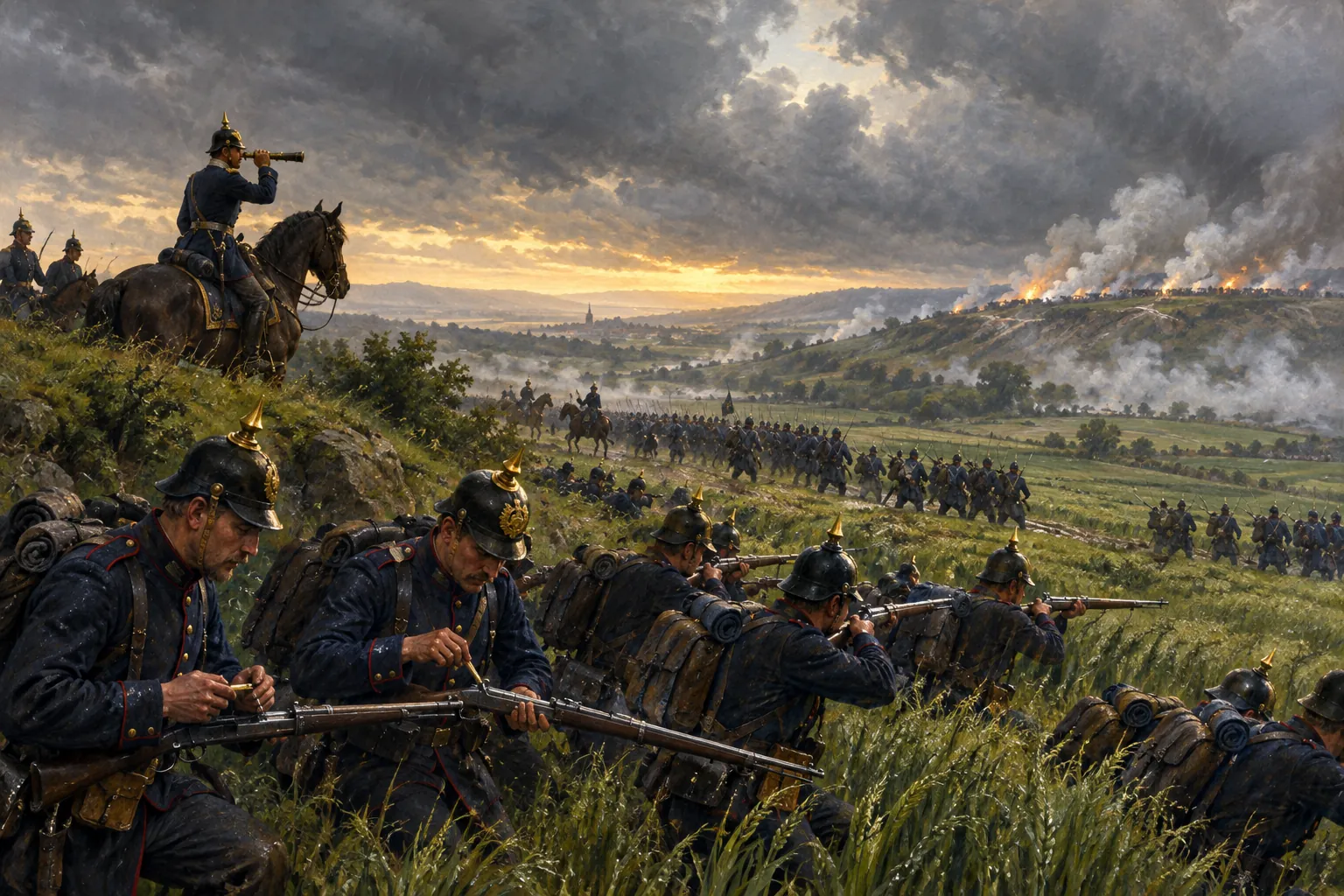
Prussia had a General Staff led by Helmuth von Moltke the Elder. He used railways and the telegraph to move large forces quickly. Most Prussian infantry carried the Dreyse needle gun, a breech-loader that could be loaded while lying down. Austria's infantry still used muzzle-loading rifles and often relied on bayonet charges, which cost many lives against faster fire. Austria's artillery, however, was very good. The Austrian Northern Army was commanded by Ludwig von Benedek.
Quick moves in Germany
In mid-June Prussian forces entered Hanover, Saxony and Hesse-Kassel. The Hanoverian army won a battle at Langensalza on 27 June but was surrounded and surrendered two days later. The Saxon army retreated into Bohemia to join the Austrians. In July a Prussian army in the west beat Bavarian and other south German forces in a series of smaller fights.
Königgrätz, 3 July 1866
The war was decided in Bohemia, in what is now the Czech Republic. Prussia advanced in three separate armies, and Benedek gathered his forces near the fortress of Königgrätz. The battle, also called Sadowa, began on a rainy morning on 3 July. More than 400,000 soldiers were involved, about 220,000 Prussians against about 215,000 Austrians and Saxons, making it one of the largest battles in Europe up to that time.
For several hours the Prussian First Army and the Elbe Army pressed the Austrian centre and left in heavy fighting. In the afternoon the Second Army, under Crown Prince Friedrich Wilhelm, arrived on the Austrian right flank. The Austrian line collapsed and fell back across the Elbe. Austria and Saxony lost about 44,000 men killed, wounded or captured. Prussia lost about 9,000.
The southern front
Austria did better against Italy. It won the land battle of Custoza on 24 June, and an Austrian fleet under Wilhelm von Tegetthoff defeated the larger Italian fleet at Lissa on 20 July. But these successes could not make up for the defeat in Bohemia. Venetia passed to Italy anyway, through French mediation, after the war.
Peace
A preliminary peace was signed at Nikolsburg on 26 July, and the Treaty of Prague followed on 23 August 1866. King Wilhelm and his generals wanted to march on Vienna and take Austrian land. Bismarck argued against it. He wanted Austria humbled but not an enemy for ever, and he already had the next war in mind. Austria lost no territory to Prussia apart from its role in Schleswig-Holstein.
Consequences
- The German Confederation ended. Austria accepted its dissolution and gave up any say in the German states' future.
- Prussia grew. It annexed Hanover, Hesse-Kassel, Nassau, the free city of Frankfurt and Schleswig-Holstein, joining its western and eastern halves into one connected state.
- North German Confederation (1867). The states north of the River Main joined under Prussian leadership. Bismarck served as its Federal Chancellor.
- The southern states stayed independent for now. Bavaria, Württemberg, Baden and southern Hesse remained outside, but they signed military alliances with Prussia.
- Austria changed. Weakened, it reached the Compromise of 1867 with Hungary and became Austria-Hungary.
- Prussian politics. After the victory, the Prussian parliament passed an Indemnity Bill that approved Bismarck's earlier spending, which ended the conflict over the budget. Many liberals who had opposed him now supported him.
- France. Napoleon III received nothing for his neutrality, and many French saw Prussia's rise as a threat. This tension led to the Franco-Prussian War (1870–1871).
What exams ask
- Sequence: Danish war of 1864, Gastein Convention 1865, Austro-Prussian War 1866, North German Confederation 1867, Franco-Prussian War 1870–71, German Empire 1871.
- Significance (AP-style): the war removed Austria from German affairs and established Prussian dominance, a turning point in the move toward a small-German (kleindeutsch) nation-state without Austria.
- Methods: Bismarck's use of diplomacy, isolating the opponent first, and Prussia's use of railways, the telegraph and the needle gun.
- Link to Austria-Hungary: defeat helped push Austria toward the 1867 Compromise.
- Common mix-up: do not confuse this war with the Franco-Prussian War, in which Prussia fought France and the southern German states joined it.
Read next
- Prussia: From Kingdom to Germany's Core: how the state that won in 1866 grew from a small kingdom.
- Otto von Bismarck: The Iron Chancellor: the statesman who planned the war and the peace.
- The Franco-Prussian War (1870–1871): the next step, which completed German unification.