In five minutes: what Ganymede is
Ganymede is the largest moon in the solar system. It circles Jupiter, measures about 5,270 kilometres across, and is wider than the planet Mercury. It is also the only moon known to have its own magnetic field, and several lines of evidence suggest that a deep salty ocean lies hidden beneath its icy shell. That mix of record size and hidden water is why Ganymede keeps turning up in both planetary science and science fiction.
Ganymede is one of the four big Galilean moons, along with Io, Europa and Callisto. You can read about the whole family in our guide to Jupiter's moons. This page covers Ganymede alone: what it is made of, what we really know about its ocean, which spacecraft have visited, and how writers have used it.
A small planet that orbits a big one
The easiest way to picture Ganymede is as a small planet that happens to circle a larger one. Its diameter is about 5,268 kilometres. Mercury measures 4,879 kilometres, and Titan, Saturn's moon and the second-largest moon, measures about 5,150. Mercury is still the heavier of the two, because it is mostly metal and rock. Ganymede is roughly half rock and half water ice, so its mass is only about 45 percent of Mercury's.
Inside, Ganymede is layered like a planet. Most scientists think it has a metal-rich core at the centre, a rocky mantle around that, and a thick shell of ice and water on top. Gravity measurements from the Galileo spacecraft showed that the heavy material has sunk toward the middle. That means Ganymede was once warm enough to separate its ingredients, something few moons have done so completely. Callisto, its neighbour, appears to be sorted much less.
- Orbit: about 1.07 million kilometres from Jupiter, one lap every 7.15 days.
- Rotation: tidally locked, so the same face always points at Jupiter.
- Gravity: about 1.4 metres per second squared, roughly one seventh of Earth's.
- Temperature: an average surface temperature of around minus 160 degrees Celsius.
How it was found and named
Galileo Galilei spotted Ganymede in January 1610. He had pointed an early telescope at Jupiter and noticed small points of light lined up beside it. Over several nights the points shifted position, and he concluded that they were circling Jupiter. That was strong evidence against the old idea that everything in the sky revolves around Earth.
The German astronomer Simon Marius said he had seen the moons at about the same time, and it was Marius who suggested the names Io, Europa, Ganymede and Callisto, in a book published in 1614. The names only became standard in the nineteenth century. Until then astronomers usually called Ganymede simply Jupiter III.
The name comes from Greek myth. Ganymede was a Trojan prince so handsome that Zeus, whom the Romans called Jupiter, carried him off to Olympus to serve as cupbearer to the gods. Among the four Galilean moons it is the only one with a male name.
The real science
Here is what is established by measurements, and what is still an educated guess.
Two kinds of ground
Ganymede's surface is a patchwork. Roughly a third of it is dark, heavily cratered terrain that is probably billions of years old. Galileo Regio is the best-known dark region. The rest is brighter and crossed by long parallel ridges and grooves, where the ice crust has been stretched, cracked and reshaped over time. The surface is mostly water ice mixed with darker dust. Established fact: the pictures from Voyager and Galileo show both terrains clearly.
A magnetic field of its own
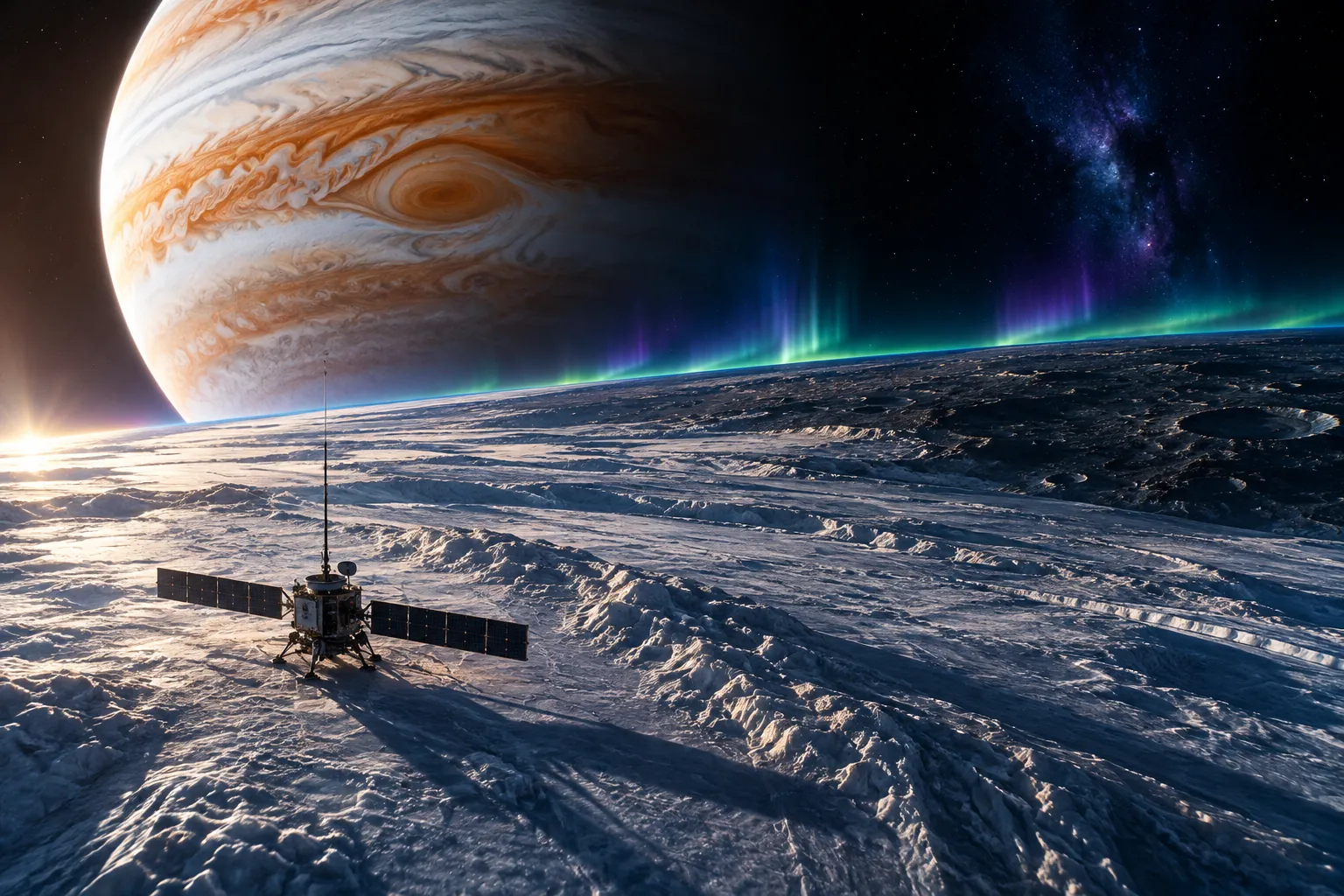
In the mid-1990s the Galileo spacecraft flew past Ganymede and found something unexpected: the moon produces its own magnetic field. No other moon is known to do this. The most likely source is a core of hot, liquid iron that churns and acts like a dynamo, just as Earth's core does. The field carves out a small magnetic bubble inside Jupiter's much larger one, and it makes glowing auroras around Ganymede's poles. Established fact: the field and the auroras have both been measured. The details of the core remain a model.
A hidden ocean
Galileo's magnetic readings also showed that Ganymede's field changes in step with Jupiter's. That pattern is what you would expect if a layer of electrically conducting material, such as salty water, lies under the surface. In 2015 astronomers using the Hubble Space Telescope watched Ganymede's auroras and found that they rocked back and forth less than they would without such a layer. Their analysis suggested an ocean roughly 100 kilometres deep, under about 150 kilometres of ice.
Treat those numbers as estimates. Nobody has seen the ocean directly, and some models describe several layers of ice and water stacked like a sandwich rather than one open sea. Because the ocean is so deep, it may hold more water than all of Earth's oceans put together. Whether it could support life is an open question. Many scientists consider Europa, whose ocean may touch rock, a better candidate. Speculation: life in Ganymede's ocean. Nothing has been found.
Visits so far
Pioneer 10 passed Jupiter in 1973, and the two Voyager probes sent back the first detailed pictures of Ganymede in 1979. The Galileo spacecraft orbited Jupiter from 1995 to 2003 and made several close passes. In June 2021 NASA's Juno flew within about 1,000 kilometres of the surface, the closest look in more than twenty years.
The next visitor is the European Space Agency's JUICE, short for Jupiter Icy Moons Explorer. It launched on 14 April 2023 and is scheduled to reach Jupiter in July 2031. If the plan holds, it will begin orbiting Ganymede in December 2034, making it the first spacecraft to orbit a moon other than our own. Its instruments will map the ice, measure the magnetic field and probe the depth of the ocean.
Where it shows up in fiction
Writers like Ganymede because it is big, icy and close to a source of water, which makes it a natural place for a colony. In Robert A. Heinlein's Farmer in the Sky (1950), families emigrate to Ganymede to turn raw ground into farmland. Isaac Asimov's Lucky Starr and the Moons of Jupiter (1957) sends its hero to Jupiter's moons, including Ganymede. In James S. A. Corey's The Expanse novels, Ganymede is the farming moon that feeds much of the outer solar system, and its fate becomes a turning point in the story.
One thing fiction often softens: Ganymede sits inside Jupiter's radiation belts. The dose at its surface is far lower than at Europa, but it is still well above what people could safely take for long, so a real base would need shielding.
Common misconceptions
- "It is bigger than Mercury, so it should be a planet." Size alone does not decide it. Ganymede orbits Jupiter rather than the Sun, and it has far less mass than Mercury.
- "The ocean is confirmed." The evidence is strong but indirect. It comes from magnetic and auroral measurements, not from a sample or a direct image.
- "It has air you could breathe." Ganymede has only a vanishingly thin oxygen atmosphere, made when radiation breaks up surface ice. It is nowhere near breathable.
- "Europa is the only moon with an ocean." Europa gets the most attention, but Ganymede, Callisto, Saturn's Enceladus and probably Titan are also thought to hide water beneath the surface.
Read next
- Jupiter's moons: the full family, from Io's volcanoes to the smallest outer moons.
- Europa (moon): the icy neighbour whose ocean is the other leading target in the search for life.
- Callisto: the most heavily cratered of the four Galilean moons, and Ganymede's outer neighbour.