In five minutes
The Fermi paradox is a clash between two ideas. The first: the Milky Way is enormous and ancient, and planets are everywhere, so intelligent life should have had plenty of chances to appear. The second: when we look and listen, we find nothing. No signals, no probes, no giant machines. If life is common, where is everybody?
That is the whole puzzle. It is not a claim that aliens do not exist, and it is not a law of physics. It is a question about a mismatch between what we expect and what we see. It also sits at the heart of modern science fiction, which is why it belongs in our History of Science Fiction guide: many of the genre's best novels are attempts to answer it.
Where the question came from
The name comes from the Italian-American physicist Enrico Fermi. In the summer of 1950, Fermi was working at Los Alamos National Laboratory in New Mexico. Over lunch with colleagues, including Edward Teller, Emil Konopinski and Herbert York, the talk turned to flying saucers in the news and a cartoon about aliens. Decades later, those present recalled that Fermi suddenly asked something like, "Where is everybody?"
His point was that the numbers did not add up. If there were many advanced civilizations, some should have reached us by now. The story is known mostly because physicist Eric Jones tracked down the participants in the early 1980s and wrote up what they remembered. The question was casual, but it stuck.
Others made the argument more rigorous. Astronomer Michael Hart published a short paper in 1975 arguing that, if intelligent life were common, Earth should already have been visited, and that the lack of visitors was strong evidence we are alone, or at least early. Sebastian von Hoerner had already explored how fast a civilization could spread across the galaxy in 1961. Since then, "Fermi paradox" has become the standard label for the whole debate.
The reasoning, step by step
- The galaxy is big. The Milky Way is roughly 100,000 light-years across and holds somewhere between 100 and 400 billion stars.
- It is old. The galaxy is more than 13 billion years old, and the Sun is only about 4.6 billion years old. Many stars are billions of years older than ours.
- Planets are common. Since NASA's Kepler telescope launched in 2009, astronomers have confirmed more than 5,000 planets around other stars. Statistically, rocky planets in a star's habitable zone look plentiful.
- Spreading is slow, but time is long. A civilization that sent out slow ships, well below the speed of light, and settled new systems one after another could cross the galaxy in somewhere between a few million and a few tens of millions of years, depending on the assumptions. That is a blink compared with the galaxy's age.
- Yet we see nothing. No confirmed alien signal, probe or engineering has been found.
The Drake equation, written by astronomer Frank Drake in 1961, is a related tool. It multiplies factors such as the rate of star formation, the fraction of stars with planets and the lifetime of a communicating civilization to estimate how many might exist now. It does not give an answer, because several factors are unknown. But it shows how a few optimistic guesses can lead to a crowded galaxy, which makes the silence stranger. See our Drake equation guide for the details.
The real science
It helps to separate what is measured from what is guessed.
Established: the size and age of the galaxy, the abundance of exoplanets, and the fact that decades of searching have found no confirmed technological signal. Radio searches began with Frank Drake's Project Ozma in 1960. In 1977 the Big Ear radio telescope in Ohio recorded the strong "Wow!" signal, but it was never detected again and has no confirmed source.
Not established: how likely life is to start, how likely it is to become intelligent, how long technological civilizations last, and whether they would want to expand. We have one example of life, our own. That makes every estimate shaky, and it means the paradox is only as strong as its assumptions.
Also, our searches have covered a tiny part of the possibilities. Researchers have scanned only a small share of nearby stars, over limited frequencies and for limited time. Not finding anything yet is weaker evidence than it sounds.
The main answers
Writer Stephen Webb collected 75 proposed solutions in his book on the subject. They fall into a few families.
We are alone, or nearly so
The Rare Earth hypothesis, argued by Peter Ward and Donald Brownlee in 2000, holds that complex life needs an unusual mix of conditions, such as a stable star, a large moon and plate tectonics. Simple life may be common, while animals and technology are very rare.
Something stops civilizations: the Great Filter
Economist Robin Hanson proposed the Great Filter in the late 1990s. Somewhere between dead chemistry and a galaxy-spanning civilization, there is a step that almost nothing passes. If the filter is behind us, such as the origin of life, we may be lucky survivors. If it is ahead of us, that is a worrying thought. Read more in our Great Filter guide.
They exist, but we cannot see them
Distances may be too great for travel to be worth the effort. Civilizations might use technology we do not recognize. They might have been quiet or dormant. Or we may simply have looked in the wrong places and the wrong ways.
They are hiding or leaving us alone
The zoo hypothesis, suggested by John Ball in 1973, says advanced beings deliberately avoid contact. A darker version is the dark forest idea made famous by Liu Cixin: every civilization stays silent because broadcasting your position is dangerous. It is a thought experiment from fiction, not an observation. See Dark forest theory.
The paradox may be weaker than it looks
In 2018, Anders Sandberg, Eric Drexler and Toby Ord argued that if you properly include the huge uncertainty in the Drake equation's factors, a quiet galaxy is not surprising. On this view, the paradox mostly dissolves.
Which of these is right? Nobody knows. This is what makes the topic good for thinking: you can disagree without being wrong in any way the data can currently show.
Where it shows up in fiction
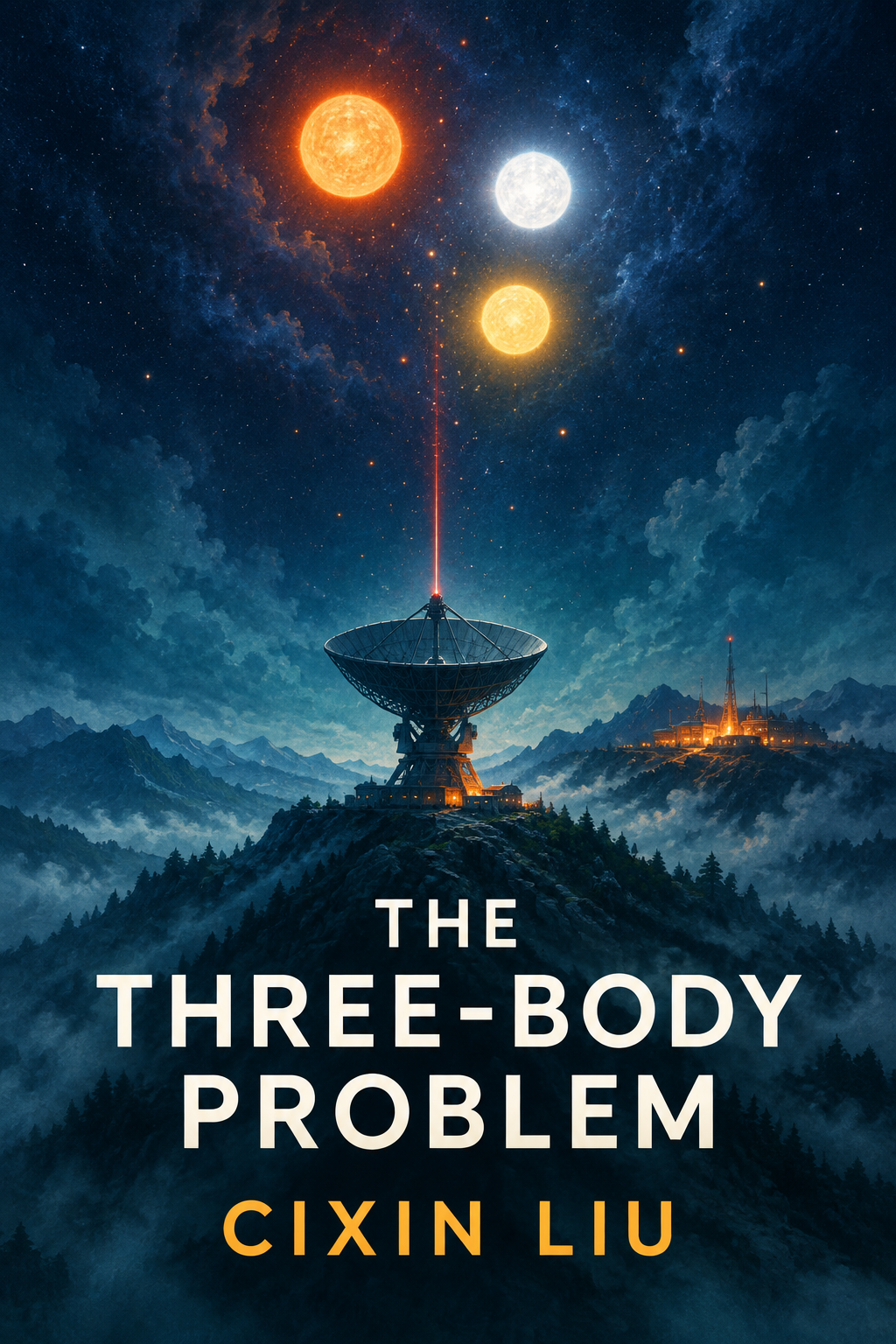
Few ideas have shaped science fiction as much as this one. Liu Cixin's The Three-Body Problem trilogy turns the silence into the starting point of its second book, The Dark Forest, and builds a grim answer from it. You can start with our Three-Body Problem study guide. Andy Weir's Project Hail Mary goes the other way: contact happens, and it changes everything, as in our Project Hail Mary guide. Between those two lie decades of novels that choose a side. The Kardashev scale, which ranks civilizations by the energy they use, often appears in the same discussions. See our Kardashev scale article.
Common misconceptions
- "Fermi proved aliens do not exist." He did not. He asked a question, and the paradox is an argument that something in our assumptions needs checking.
- "Fermi wrote a paper on it." There is no such paper. The idea comes from a conversation, reconstructed later from memory.
- "The paradox is about UFOs." It is about the absence of evidence, not about sightings. The 1950 conversation touched on saucers, but the argument is about galaxy-scale numbers.
- "Scientists agree there is intelligent life out there." Many think microbial life is likely somewhere. Intelligent, technological life is a much more open question.
- "The Drake equation gives the answer." It organizes our ignorance. Its output depends on guesses.
Read next
- Great Filter: the most popular reply to the paradox, and why it can be unsettling.
- Drake equation: the seven-factor formula behind most estimates of alien civilizations.
- Dark forest theory: the fictional answer that says silence is survival.
- Kardashev scale: a way to measure how advanced a civilization could be.