Fahrenheit 451 by Ray Bradbury
by Ray Bradbury
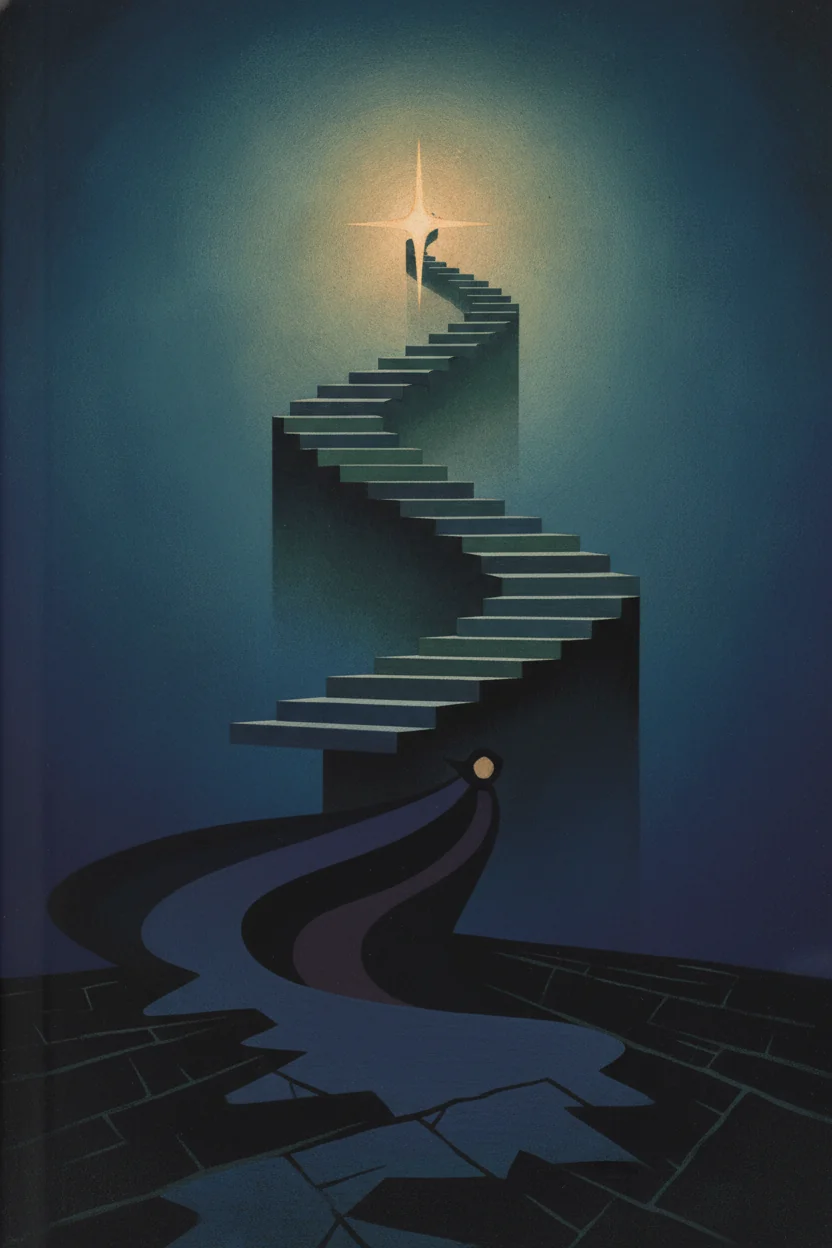
A fireman in a futuristic society where books are banned and burned discovers the emptiness of his life and rebels against the state. After meeting a free-thinking girl and a retired professor, he flees the city to join a secret community dedicated to memorizing literature to save human history.
The Big Idea
"True freedom and humanity are found not in the absence of conflict or pain, but in the pursuit of knowledge and the courage to think critically against the tide of mindless conformity."
Key Insights
The Origin of Censorship
Censorship often begins with a public desire for simplicity and the avoidance of offense rather than government mandates.
Captain Beatty explains that books were phased out because people wanted shorter summaries and didn't want to offend minority groups.
Technology as a Narcotic
Constant stimulation through media can lead to emotional numbness and the erosion of real human relationships.
Mildred's obsession with the 'parlor walls' makes her feel more connected to her fictional 'family' than to her own husband.
The Power of Nature
Nature serves as a mirror to the soul, prompting introspection and a sense of wonder that technology cannot provide.
Clarisse's habit of walking in the rain and smelling the air awakens Montag's dormant curiosity about the world.
Knowledge vs. Information
Having access to data is not the same as having the wisdom to interpret it and the freedom to act on it.
Faber tells Montag that it isn't the books themselves he needs, but the 'quality' of information and the 'right to carry out actions based on what we learn.'
The Role of Memory
When physical records are destroyed, the human mind becomes the final archive and the only hope for cultural rebirth.
The exiles in the woods memorize entire books, transforming themselves into living libraries to preserve knowledge for the future.
Chapter Breakdown
The Dystopian Context of a Burning World
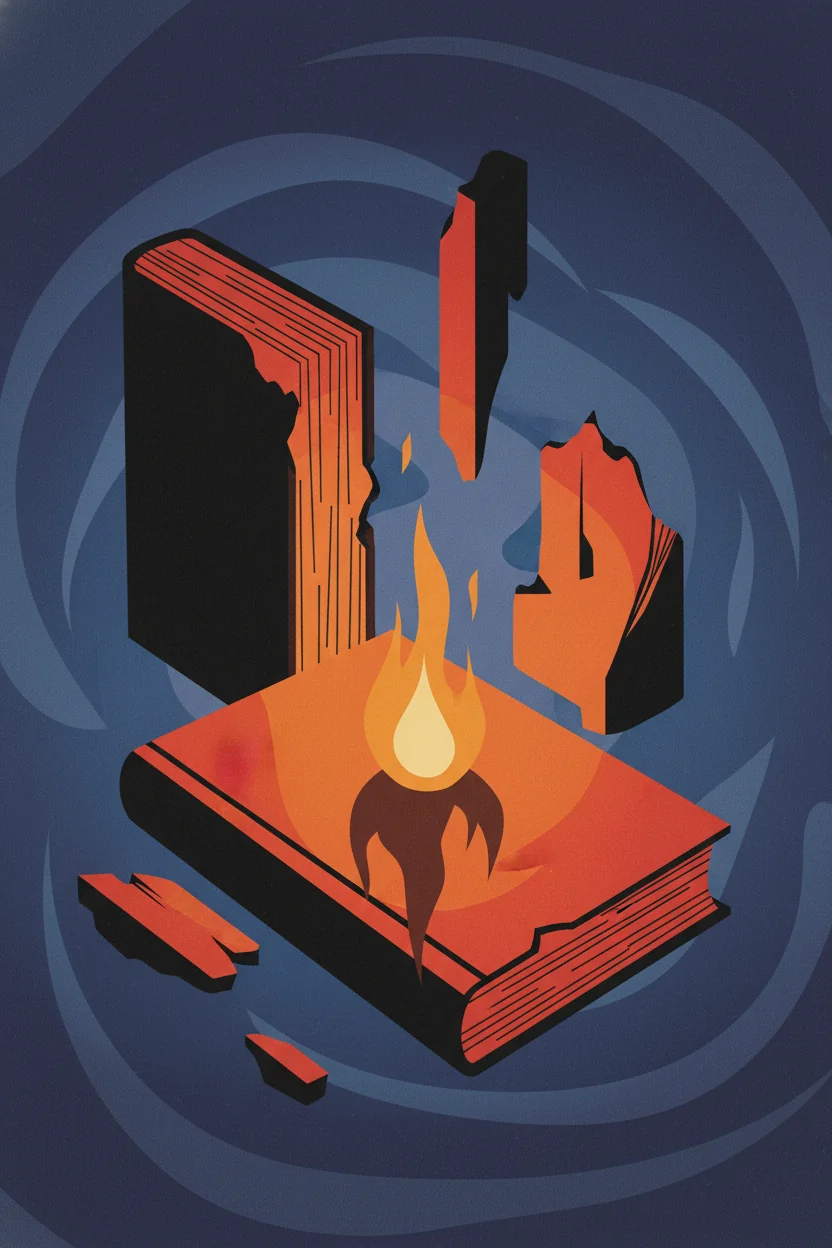
Published in 1953, Ray Bradbury's Fahrenheit 451 is a chilling projection of a future where intellectualism is outlawed and critical thinking is viewed as a social disease. The title refers to the temperature at which book paper catches fire and burns. In this society, the government has replaced literature, art, and deep conversation with shallow, high-speed entertainment and immersive 'parlor walls' (giant televisions). The state employs 'firemen' not to put out fires, but to start them, specifically targeting homes that harbor banned books. This world is designed for maximum comfort and minimum friction; by removing contradictory ideas and challenging texts, the state ensures a compliant, mindless citizenry that is easily controlled through distraction and fear.
Plot Overview: The Awakening of Guy Montag
Guy Montag is a fireman who takes a sadistic pleasure in his work, viewing the destruction of books as a civic duty. His life is a routine of burning and forgetting until he meets Clarisse McClellan, a seventeen-year-old neighbor who is 'anti-social' by the society's standards because she actually enjoys nature and asking 'why' instead of 'how.' Clarisse acts as a catalyst, forcing Montag to realize that he is profoundly unhappy and that his marriage to Mildred, a woman obsessed with her digital walls and sleeping pills, is a hollow shell.
Montag's curiosity grows into rebellion. He begins stealing books from the homes he is supposed to burn, hiding them in his ventilator grill. His internal conflict reaches a breaking point when he is ordered to burn a woman's house, and the woman chooses to die with her library rather than live without it. This act of martyrdom shatters Montag's worldview. He seeks guidance from Faber, a retired English professor, who helps him understand that it is not the books themselves that are missing, but the quality of information and the right to act upon it.
The tension peaks when Captain Beatty, Montag's perceptive and antagonistic boss, discovers his heresy. After a violent confrontation and the murder of Beatty, Montag becomes a fugitive. He escapes the mechanical hound—a terrifying robotic predator—and finds refuge with a group of 'book people' in the wilderness. These exiles have each memorized a different work of literature to preserve human knowledge for a future generation. The novel ends with a devastating nuclear strike that levels the city, leaving the survivors to rebuild a society based on the remembered truths of the past.
Major Themes: Censorship, Alienation, and Technology
The most prominent theme is the danger of censorship. Bradbury argues that censorship does not always start with a government decree; it often begins with the people themselves. In the novel, the public stopped reading because they preferred shorter, faster, and less offensive versions of stories. The government simply stepped in to codify a trend that had already begun. This highlights the relationship between intellectual laziness and authoritarianism.
Alienation is equally central. Despite being constantly connected via screens, the characters are profoundly alone. Mildred represents the peak of this isolation, living in a state of perpetual numbness. Montag's journey is one of breaking this isolation by seeking genuine human connection and intellectual stimulation. Finally, the role of technology is portrayed as a double-edged sword. While the 'parlor walls' provide instant gratification, they strip away the capacity for empathy and introspection, turning humans into passive observers of their own lives.
Key Scenes and Turning Points
One of the most pivotal scenes is the conversation between Montag and Captain Beatty. Beatty provides a historical justification for the burning of books, explaining that literature creates inequality by making some people feel inferior due to their intelligence. This scene is crucial because it shows that the oppressor is often the most well-read person in the room, using knowledge specifically to dismantle it.
Another haunting moment is the encounter with the Mechanical Hound. The Hound symbolizes the perversion of nature through technology—a creature designed solely to track and kill. The scene where Montag is hunted through the city, eventually finding peace in the river, serves as a symbolic baptism, washing away his old identity as a fireman and emerging as a seeker of truth. The final image of the 'book people' walking back toward the ruined city emphasizes the cycle of history and the hope that knowledge can prevent future catastrophes.
Legacy and Why It Matters Today
Fahrenheit 451 remains timeless because its warnings have only become more relevant. In an era of social media algorithms, echo chambers, and dwindling attention spans, Bradbury's fear of a society that prefers 'snippets' over substance is a reality. The book serves as a reminder that literacy is not just about the ability to read, but the willingness to engage with difficult, uncomfortable, and contradictory ideas.
It matters because it challenges the reader to consider what they are willing to sacrifice for comfort. By portraying a world where the absence of pain is mistaken for happiness, Bradbury urges us to embrace the 'friction' of intellectual struggle. The novel is not merely a critique of government censorship, but a plea for the preservation of the human spirit through the act of reading and remembering.
Take Action
Practical steps you can implement today:
-
Cultivate a habit of deep reading to combat the 'snippet' culture of digital distractions.
-
Seek out perspectives and literature that challenge your current beliefs to avoid the trap of the echo chamber.
-
Prioritize face-to-face, meaningful conversations over passive consumption of digital media.
-
Practice mindfulness and spend time in nature to reconnect with your internal emotional state.
-
Question the motivations behind the simplification of information in news and social media.
Notable Quotes
"It was a pleasure to burn."
— Ray Bradbury
"We need not wake it. Let it sleep. Let it sleep for a thousand years and wake up when men decent enough to remember are born."
— Ray Bradbury
"The magic is not in the book, but in the way it makes us think."
— Ray Bradbury
"There is no happiness in a world where everything is smoothed over."
— Ray Bradbury
Who Should Read This
This book is essential for anyone concerned about the influence of mass media, the decline of literacy, or the dangers of authoritarianism. It is a perfect read for students, educators, and tech-weary adults who want to reflect on the importance of critical thinking and the preservation of intellectual freedom in a digital age.
Summary Written By
Software Engineer & Writer
Software engineer with a passion for distilling complex ideas into actionable insights. Writes about finance, investment, entrepreneurship, and technology.
View all summaries →Reviews
No reviews yet. Be the first to share your thoughts!