In five minutes: the Io moon
Io (pronounced “EYE-oh”) is the innermost of Jupiter’s four large moons, and it is the most volcanically active world in the solar system. The io moon is only a little wider than Earth’s Moon, yet it has more than 400 active volcanoes that throw lava and sulfur-rich gas high above a yellow, orange and red surface. It belongs to the family of the four Galilean moons, which we cover in our guide to Jupiter’s moons.
The short answer to “why is Io so violent?” is squeezing. Jupiter’s gravity is enormous, and the neighbouring moons Europa and Ganymede tug on Io in a steady rhythm. Together they flex Io’s body again and again, and that flexing makes heat deep inside the rock. The heat has to go somewhere, so it escapes through volcanoes.
Io is also a good example of how a small, rocky world can stay alive far from the Sun. Sunlight there is weak, and the surface is cold. The energy that drives Io’s volcanoes comes from orbital motion, not from the Sun.
Size, orbit and what Io is made of
Io is about 3,640 kilometres across, which makes it slightly larger than our Moon (about 3,474 kilometres). It circles Jupiter at an average distance of roughly 421,700 kilometres, and one lap takes only 1.77 days, or about 42 hours. Of the four Galilean moons it is the closest to the planet, so Jupiter would look enormous in Io’s sky, and the radiation around it is intense.
Inside, Io is mostly silicate rock wrapped around an iron-rich core. Its average density, about 3.5 grams per cubic centimetre, is the highest of any moon in the solar system. The moons farther out, Europa, Ganymede and Callisto, hold much more water ice, while Io is remarkably dry. Like our Moon, Io is tidally locked, so the same face always points toward Jupiter.
Why Io erupts: tidal heating
The key is a rhythm in the orbits. For every four trips Io makes around Jupiter, Europa makes two and Ganymede makes one. This 4:2:1 pattern is called an orbital resonance. Because the three moons keep pulling on one another at the same points in their orbits, Io’s path is never allowed to settle into a perfect circle. It stays slightly oval.
That small oval matters. As Io swings closer to Jupiter and then farther away, the planet’s pull on it gets stronger and weaker. The solid surface rises and falls by as much as about 100 metres during each lap. Earth’s ocean tides are usually a metre or two, so Io’s rocky tides are on a different scale. Bending rock over and over creates friction, and friction creates heat. This process is called tidal heating, and it is the main reason Io’s interior stays hot enough to melt.
Notice what is missing from the explanation: Io does not erupt because it is close to the Sun or because it is a young world still cooling. It erupts because its orbit never lets the tides rest.
How we found out: from Galileo to Voyager
Galileo Galilei saw Io in January 1610 through an early telescope. At first he noticed small points of light near Jupiter, and over the following nights he realised that four of them moved with the planet. The German astronomer Simon Marius claimed to have seen them at about the same time, and it was Marius who proposed the names we use today, taken from the myths of Jupiter’s (Zeus’s) companions. In the myth, Io was a woman loved by Zeus. For a long time astronomers simply called the moons “Jupiter I” to “Jupiter IV”, and the mythological names only became standard later.
For almost four centuries Io was a bright dot. Pioneer 10 made the first close pass of Jupiter in December 1973 and gave a first look at the system. The big surprise came in March 1979. A few days before Voyager 1 reached Jupiter, scientists Stan Peale, Patrick Cassen and Ray Reynolds published a paper predicting that tidal heating might melt Io’s interior. Then, in March 1979, navigation engineer Linda Morabito noticed an odd crescent-shaped cloud on the edge of Io in a Voyager 1 picture. It was a volcanic plume rising some 300 kilometres. It was the first time anyone had seen an active volcano on another world. Voyager 2 flew by in July 1979 and found most of the plumes still going.
What the surface looks like
Io has almost no visible impact craters. That is a clue: lava and fallout keep covering the surface, burying old scars. Estimates of how fast the ground is renewed are around a centimetre a year, which is quick for a world of this size. The colours, yellows, oranges, whites and reds, come mainly from sulfur and sulfur dioxide frost, with dark patches of fresh lava.
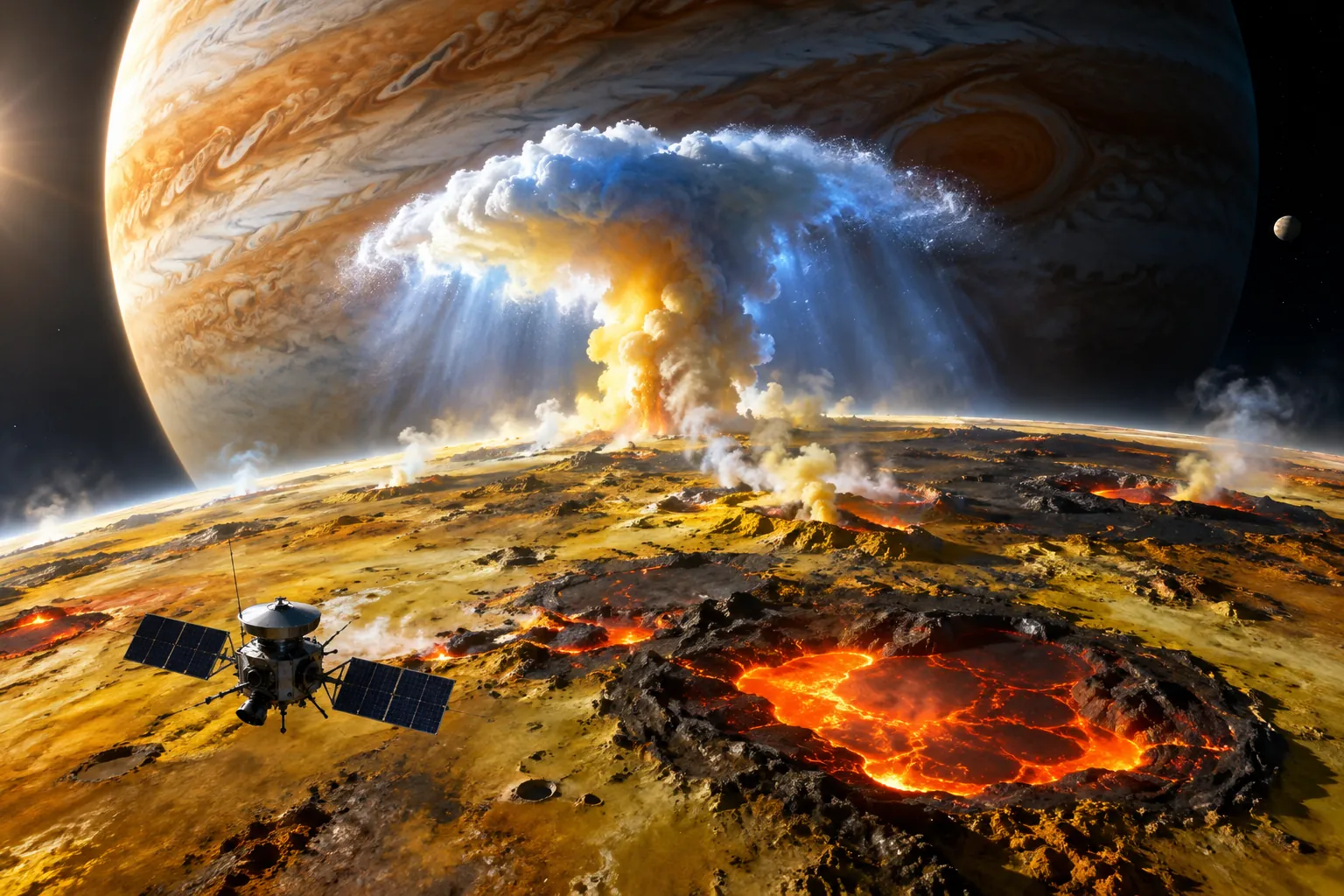
The most striking features are the paterae, irregular volcanic basins. Loki Patera, a dark lava lake about 200 kilometres wide, is one of the brightest heat sources in the whole Jupiter system. Plumes such as Prometheus and Tvashtar throw gas and dust far above the ground. In 2007 the New Horizons spacecraft, passing Jupiter on its way to Pluto, photographed a Tvashtar plume reaching more than 300 kilometres high.
Io also has mountains, some about 17 kilometres tall. They are not volcanoes: they are blocks of crust pushed up as the surface is squeezed. The average surface temperature is around minus 130 °C, yet the hottest lava measured by the Galileo spacecraft was above 1,200 °C. Io’s atmosphere is extremely thin and mostly sulfur dioxide. Gas and particles escape continuously, roughly a tonne every second, and feed a doughnut of charged particles that circles Jupiter.
The real science: what is settled and what is open
The following points are well established by spacecraft measurements: Io is volcanically active now, its heat comes mainly from tidal flexing, the 4:2:1 resonance with Europa and Ganymede keeps its orbit slightly oval, and its crust is dominated by silicate rock and sulfur compounds.
The open question is what lies beneath the surface. In 2011 an analysis of magnetic-field data from the Galileo spacecraft was read as evidence for a global ocean of molten rock under the crust. Then NASA’s Juno spacecraft flew past Io twice, on 30 December 2023 and 3 February 2024, at about 1,500 kilometres. A 2025 analysis of how Io’s shape and gravity respond to tides argued against a shallow, worldwide magma ocean and suggested that molten rock sits in more local pockets within a mostly solid mantle. Researchers are still working through the details, so this is a live debate, not a closed case.
A dedicated Io mission has been proposed but has not been built. For now, our best long-term views come from Galileo, Juno and telescopes on Earth that watch for brightening eruptions.
Where it shows up in fiction
Writers and game designers like Io as a ready-made hellscape: sulfur lakes, lava fountains and a giant planet hanging overhead. The real moon is just as dramatic, but different. Most of the surface is solid, frost-coloured plains, not an ocean of lava, and the dangers are mainly radiation and the sheer energy of the eruptions.
Arthur C. Clarke’s Jupiter-system sequels to 2001 centre their attention on Europa rather than Io, which shows how often Io is the neighbour in these stories rather than the main stage. If you want a story about a world that is alive with heat instead of ice, Io is the real place that fits best.
Common misconceptions
- “Io is covered in lava seas.” Only a small share of the surface is hot lava. Most of it is cold, solid ground coated with sulfur and frost.
- “Io is hot because it is near the Sun.” Io is more than 700 million kilometres from the Sun. Its heat comes from tidal flexing driven by Jupiter.
- “Io is the biggest moon of Jupiter.” Ganymede is the largest moon in the solar system. Io is the fourth largest, just a little bigger than Earth’s Moon.
- “Its volcanoes work like Earth’s.” Io’s eruptions are driven by hot silicate lava and sulfur-rich gas, not by water vapour, and they reach far higher because the gravity is weak and the atmosphere almost absent.
- “Astronauts could walk there.” The radiation near Jupiter would be dangerous within hours, so Io is a place for robots.
Read next
Jupiter’s moons: how Io compares with Europa, Ganymede and Callisto, and what makes each one different.
Tidal locking: why Io, like our Moon, always shows the same face to the planet it circles.