In five minutes
The uncanny valley is the idea that we feel more comfortable with a machine as it looks more human, until it gets very close to human but not quite there. At that point comfort turns into unease. The dip on the graph is the "valley."
Picture the graph. Along the bottom is how human-like something looks. Up the side is how much affinity we feel for it.
- A factory robot arm looks barely human. We feel little either way.
- A toy robot with big round eyes looks a bit more human. We find it charming.
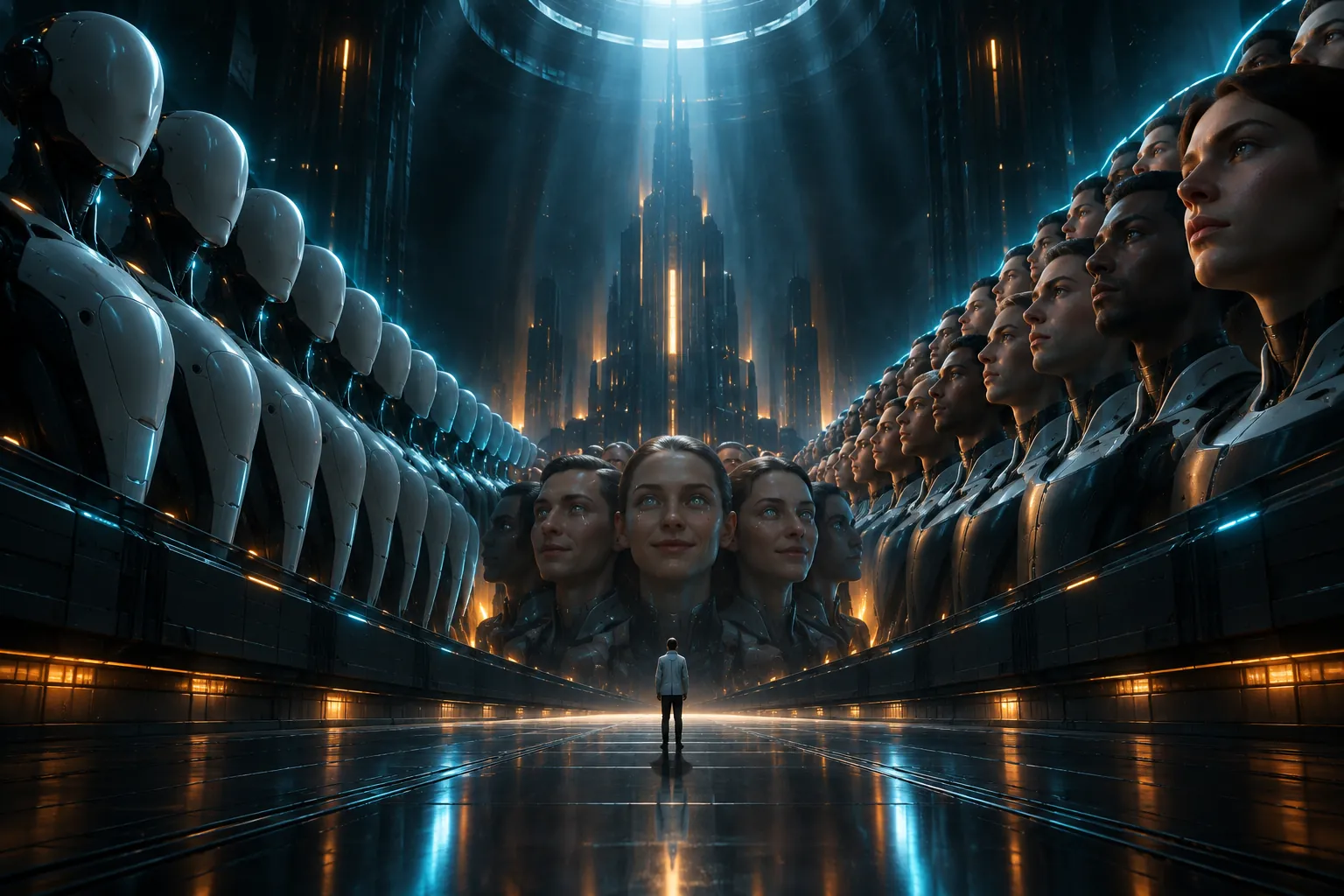
- A very lifelike android with glassy eyes and a stiff smile looks almost human. Here the line falls off a cliff, and the figure feels eerie.
- A healthy, living person sits at the far right, back at the top.
Masahiro Mori added a second point: movement. He argued that a moving figure makes both the rise and the drop stronger. A prosthetic hand that looks real can be a pleasant surprise while it sits still, and a shock when you shake it and find it cold and stiff. Mori placed a corpse and a zombie near the bottom of the valley for the same reason: they look like people, but something essential is wrong.
Mori offered this as a hypothesis, an observation to think with, not a measured law. That matters for everything below. The idea is famous because it names a feeling many people recognise, and it is still debated because the feeling is hard to measure.
It is also one of the ideas that shaped how the history of science fiction pictures artificial people, from clockwork dolls to modern androids.
Where the idea came from
The term comes from a short essay by Masahiro Mori, a Japanese robotics professor, published in 1970 in the Japanese journal Energy. His title was 「不気味の谷」 (bukimi no tani), which is usually rendered in English as "the uncanny valley." Mori was thinking about robots and prosthetic hands. He suggested that engineers should not aim for the most human-looking result. They should aim for the first peak, a design that is friendly and clearly artificial, and avoid the valley altogether.
The feeling itself is older than the name. In 1906 the German psychiatrist Ernst Jentsch wrote about the uncanny as the unease we feel when we cannot tell whether something is alive. His main example was a wax figure or an automaton that might be a person. He also pointed to E. T. A. Hoffmann's story The Sandman (1816), where a young man falls in love with Olimpia, a lifelike mechanical doll. In 1919 Sigmund Freud wrote his own essay on "the uncanny" and used Hoffmann's story too, though he explained the feeling in a different way.
Mori's essay stayed little known outside Japan for years. The English phrase "uncanny valley" appears in print in 1978, in a book on robots by the art writer Jasia Reichardt. A full English translation of the original essay was published in 2012 in an engineering magazine, and by then the idea was already a standard reference in robotics, computer animation and game design.
The real science
This is the part where it helps to separate what is established from what is still speculation.
What is established
Many people do report unease with very human-like robots, wax figures and some computer-animated faces. Studies of faces that were gradually morphed from clearly artificial to human have found that people sometimes rate the in-between faces as less likable or less trustworthy. A 2016 study in the journal Cognition used images of real robot faces and found a dip in liking for faces in the middle range of human likeness. A 2009 study found that macaque monkeys looked less at a very realistic computer-made monkey face than at an obviously artificial one or a real one. So some kind of effect has been measured, in people and in at least one other primate.
What is not settled
Researchers have not agreed on whether there is one smooth valley or several different effects. Reviews of the research have found that results depend a lot on what is tested: still pictures or moving ones, faces or whole bodies, and which flaws are present. Mori's graph was drawn from intuition, so its exact shape has no firm backing. It is also unclear that "human likeness" can be measured on one line at all.
Why it might happen
These are explanations that scientists have proposed. None is proven.
- Category confusion. Our brain cannot decide whether the figure is a person or an object, and that uncertainty feels bad.
- Expectation violation. A human face sets high expectations. A small error, such as a slow blink or a smile that does not reach the eyes, stands out because we expected everything to be right.
- Disease and threat detection. Faces with odd skin, eyes or movement may trigger the same caution we feel toward someone who looks ill.
- Reminders of death. A body that looks alive but is not may bring up thoughts about mortality. This is the explanation Mori hinted at with his corpse example.
In practice, animation studios and robot makers often take the safe route: stylised characters with simple, expressive faces, or social robots that look friendly without trying to pass as human.
Where it shows up in fiction
Science fiction was writing about the uncanny long before the term existed, and it keeps coming back to it.
- Hoffmann's The Sandman (1816) is an early case. Olimpia is charming at first, and only slowly do her stiff movements and blank gaze alarm the people around her.
- Philip K. Dick's Do Androids Dream of Electric Sheep? (1968) is built around telling androids from humans by tiny emotional responses, not by appearance. The unease comes from not being sure who is who.
- Isaac Asimov's robot stories usually avoid the valley by design. His early robots are plainly mechanical, and the later humanlike robot Daneel is accepted by the humans around him. For the rules that govern his robots, see the Three Laws of Robotics.
- Films have used the effect on purpose. Blade Runner (1982) and Ex Machina (2014) both put near-human machines at the centre. Critics also used the term about the animated film The Polar Express (2004), whose realistic characters were often described as eerie.
The uncanny valley also connects to bigger questions about what counts as human. If a machine behaves so well that we cannot tell it apart from a person, that is the question behind the Turing test. If a human body is mixed with machine parts, we get the figure explained in the cyborg.
Common misconceptions
- "It is a proven scientific law." It is a hypothesis. Some studies support a dip in liking, others find weak or mixed results.
- "More realistic always means creepier." No. The claim is about a narrow zone close to human. A clearly artificial robot or a truly lifelike figure falls outside the valley.
- "It only applies to robots." It is also discussed for computer animation, video game characters, dolls, wax figures, prosthetics and even digitally recreated actors.
- "Mori said robots should never look human." His advice was to avoid the risky zone by designing for the first peak. He did not claim it is impossible to climb out of the valley.
- "Everyone feels it the same way." Reactions vary with the person, the culture and the context. Some people feel strong unease and others feel none.
Read next
- Turing test: what it means for a machine to pass as a person, and why looks are not the point.
- Cyborg: where the human body ends and the machine begins.
- Three Laws of Robotics: the rules that made Asimov's fictional robots safe to live with.