In five minutes: Mary Shelley
Mary Shelley was an English writer who, at 18, began Frankenstein; or, The Modern Prometheus, the story of a young scientist who builds a living being and then abandons it. The book appeared anonymously on 1 January 1818. It is often called the first great science fiction novel, though critics still argue about that label. What is not in doubt is its reach: it asked what responsibility inventors owe to what they create, a question that fits steam engines, electricity and today's technology alike.
Her own life was as dramatic as her book. She lost her mother days after she was born, ran away with a married poet at 16, and buried three of her four children. She turned that grief, her reading and the science of her time into one of the most lasting stories in English.
Who was Mary Shelley?
Mary Wollstonecraft Godwin was born in London on 30 August 1797. Her mother, Mary Wollstonecraft, wrote A Vindication of the Rights of Woman (1792) and died of complications from the birth only days later. Her father, William Godwin, was a political philosopher and novelist. Mary had little formal schooling, but she grew up among books, and visitors to the house included writers such as the poet Samuel Taylor Coleridge. She learned to think for herself in a home shaped by the radical hopes of the age of revolutions. For the wider picture of those hopes, see Ideas That Shaped the 19th Century.
In 1814 she met the poet Percy Bysshe Shelley, an admirer of her father. Percy was already married to Harriet Westbrook. Mary and Percy fell in love, and in July 1814 they left England together, taking Mary's stepsister Claire Clairmont with them. Mary was 16. Their families were shocked, money was short, and their first child, born early in 1815, lived only a few days.
The summer of 1816 by Lake Geneva
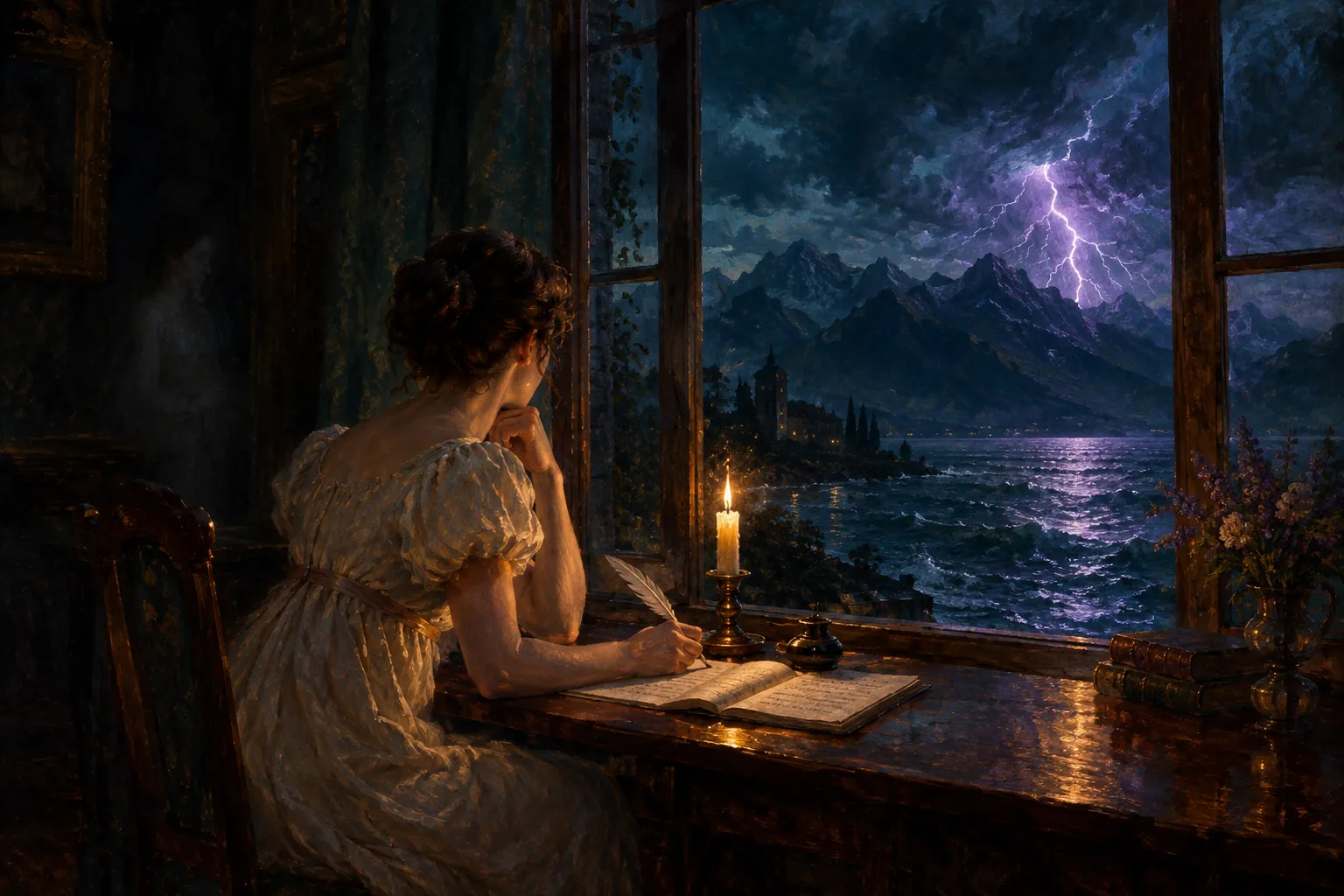
In May 1816 Mary, Percy and Claire travelled to Switzerland to meet Lord Byron, the most famous poet in Europe. Byron had rented the Villa Diodati near Geneva, and his doctor, John Polidori, was with him. The weather was dreadful. The huge eruption of Mount Tambora in Indonesia in April 1815 had filled the sky with ash and gas, and 1816 became known as the “year without a summer”, with cold and rain across Europe.
Kept indoors, the group read German ghost stories and talked late into the night about science, electricity and whether life could ever be made. Byron suggested that each of them write a ghost story. Mary could think of nothing for days. Then, after one long conversation, she lay awake and saw in her mind a pale student kneeling beside the thing he had made as it began to stir. She later said that this image was the start of her tale. Byron's and Percy's attempts faded, Polidori went on to write The Vampyre (1819), and Mary's short story grew into a novel.
Writing and publishing Frankenstein
Mary returned to England in September 1816 and kept writing through the next year, with Percy reading drafts and suggesting changes. Those months were painful. Her half-sister Fanny Imlay died by suicide in October, and in December Percy's wife Harriet was found drowned. Mary and Percy married on 30 December 1816.
Frankenstein was published in London on 1 January 1818 in three volumes, without an author's name and with a preface by Percy. Only about 500 copies were printed, and many readers guessed that Percy had written it. Reviews were mixed, but Walter Scott wrote a largely favourable one. Mary's name first appeared on the second edition in 1823. In 1831 she published a revised edition with a new introduction telling how the story began. Students today still compare the 1818 and 1831 texts.
The science behind Frankenstein
The novel grew out of real debates. In the 1780s the Italian scientist Luigi Galvani showed that electric current made a dead frog's leg twitch, which led many people to ask whether electricity had something to do with life. In 1803 his nephew Giovanni Aldini ran electric current through the body of the executed murderer George Forster in London, making the face and limbs move in front of a shocked audience. Mary's journals show that she read the chemist Humphry Davy, and talk of Erasmus Darwin's ideas about life was part of the conversations at Villa Diodati.
Yet Victor Frankenstein never explains how he makes his creature. The book is not about technique; it is about what comes after. Its subtitle points to Prometheus, the Titan of Greek myth who stole fire from the gods and gave it to humans, and who was punished for it.
What the novel is about
The story is told in layers. Captain Robert Walton, an explorer heading for the Arctic, writes letters to his sister and rescues an exhausted man on the ice: Victor Frankenstein. Victor tells Walton his story. A young man from Geneva, he studies at Ingolstadt and brings a being to life, but is so horrified by its appearance that he runs away.
The creature is left nameless and alone. He teaches himself language by watching a family in a cottage and longs to belong, but everyone who sees him recoils. Bitter, he kills Victor's young brother William and demands a companion like himself. Victor begins to make one and then destroys it. The creature's revenge takes his friend Henry Clerval and his bride Elizabeth. Victor chases the creature north and dies on Walton's ship, and the creature says he will end his own life in the Arctic.
Three themes stand out. The first is responsibility: many readers see Victor's real crime not in making life but in refusing to care for it. The second is loneliness and rejection: the creature turns cruel because he is shunned, not because he was born that way. The third is the price of ambition, when the wish to know becomes blind to the people around you.
After Frankenstein
The Shelleys moved to Italy. Their daughter Clara died in September 1818 and their son William in June 1819. Only Percy Florence, born in November 1819, grew up. In July 1822 Percy Shelley drowned at 29 when his boat was caught in a storm off the Italian coast. Mary was 24. She returned to England in 1823 and supported herself and her son by writing.
Her later books include Valperga (1823), The Last Man (1826), which imagines a plague wiping out humanity, and Perkin Warbeck (1830). In 1839 she edited Percy's poems, helping to build his reputation. She died in London on 1 February 1851, aged 53, and was later buried with her parents at St Peter's Church in Bournemouth.
Legacy: why Frankenstein still matters
The first stage version appeared in 1823, and the story has been retold ever since. The 1931 Hollywood film with Boris Karloff fixed the image of a flat-headed monster with bolts in his neck. The book's creature is quite different: he speaks eloquently and thinks hard about right and wrong. Another common mix-up is the name. Frankenstein is the scientist's surname, not the creature's.
Some critics, including the writer Brian Aldiss, call the novel the first work of science fiction. Whatever label you choose, whenever people debate artificial intelligence or genetic engineering, this story is quoted as a warning about power without responsibility. That is why a book written by a teenager in 1816 is still read in schools around the world.
What exams ask
- Dates and editions: born 1797, died 1851; Frankenstein published anonymously in 1818, with her name in 1823 and in a revised version in 1831.
- Context: Romanticism and the Gothic novel; the Industrial Revolution; early research into electricity (Galvani, Aldini).
- The Villa Diodati summer: Byron, Percy Shelley, Polidori and the “year without a summer” after the Tambora eruption.
- Structure: a frame story told through Walton's letters, with Victor's and the creature's narratives nested inside.
- Essay angles: a scientist's responsibility for his work; why the creature turns violent (nature or nurture); what “The Modern Prometheus” means; how Gothic writing reflects fears about science.
Read next
- Ideas That Shaped the 19th Century: the political and scientific ideas that formed Mary Shelley's world.
- Nikola Tesla and the War of the Currents: the story of electricity in the generation after her.
- Thomas Edison and the Age of Invention: how invention turned into an industry.