In five minutes: the Wright brothers and the first flight
Wilbur and Orville Wright, two bicycle makers from Dayton, Ohio, made the first controlled, powered, sustained flight of a heavier-than-air machine on December 17, 1903. It happened on the sandy dunes of Kill Devil Hills, near Kitty Hawk, North Carolina. The longest of their four flights that morning lasted 59 seconds and covered about 260 metres (852 feet). That sounds small, but it was the first time a person had taken off under engine power, steered the machine in the air and landed it at a point as high as the take-off.
The Wrights were part of the age of invention described in Ideas That Shaped the 19th Century, when science, workshops and patents were starting to change daily life. Three ideas are enough to remember the story:
- Control came first. Other inventors chased bigger engines. The Wrights worked out how a pilot can steer.
- They tested, then built. Kites, gliders and a home-made wind tunnel came before the engine.
- The first flight was only the start. It took until 1905 to fly for more than half an hour, and until 1908 for the world to believe it.
Two brothers from Dayton
Wilbur Wright was born in 1867 and Orville in 1871. Their father, Milton Wright, was a bishop in the Church of the United Brethren in Christ, and their sister Katharine stayed close to both brothers all their lives. Neither had a college degree. In the 1890s they ran a printing business and then a bicycle shop, the Wright Cycle Company, in Dayton.
The bicycle mattered more than it seems. A bicycle is unstable on purpose: the rider keeps it upright by making constant small corrections. The brothers came to see flying the same way. A plane would not be held steady by its design alone; a pilot would have to balance it.
In 1896 the German glider pioneer Otto Lilienthal died in a crash. The news pushed Wilbur to read about flight, and in 1899 he wrote to the Smithsonian Institution in Washington asking for books and papers on the subject. He found that many people had studied lift and power, but almost nobody had solved the problem of steering.
The problem they solved: control
An aircraft can turn three ways. It can pitch its nose up or down, roll one wing down, and yaw left or right. The Wrights realised that a pilot needs to command all three. Their answer for rolling was wing warping: the pilot twisted the tips of the wings by pulling cables, so one side gained lift and the other lost it. Wilbur is said to have had the idea while twisting a long cardboard box in the bicycle shop, and he had watched how birds tilt their wings in the air.
They went step by step:
- 1899: a small biplane kite tested wing warping.
- 1900: a first piloted glider at Kitty Hawk, a remote spot chosen for its steady wind and soft sand.
- 1901: a larger glider that produced less lift than the published tables promised. In Dayton they built a small wind tunnel and tested about 200 wing shapes to get their own numbers.
- 1902: a glider with a movable rear rudder joined to the wing-warping system. They made hundreds of glides, and the aircraft finally turned and held its balance.
By the end of 1902 the Wrights had what no one else had: a machine that a trained pilot could actually steer. They still needed power.
Building the 1903 Flyer
No engine maker offered a motor that was light and strong enough, so the brothers had their shop mechanic, Charlie Taylor, build one. It was a four-cylinder engine of about 12 horsepower. The brothers also worked out their own propellers, treating each blade as a small rotating wing, and two of them drove the machine through bicycle-style chains.
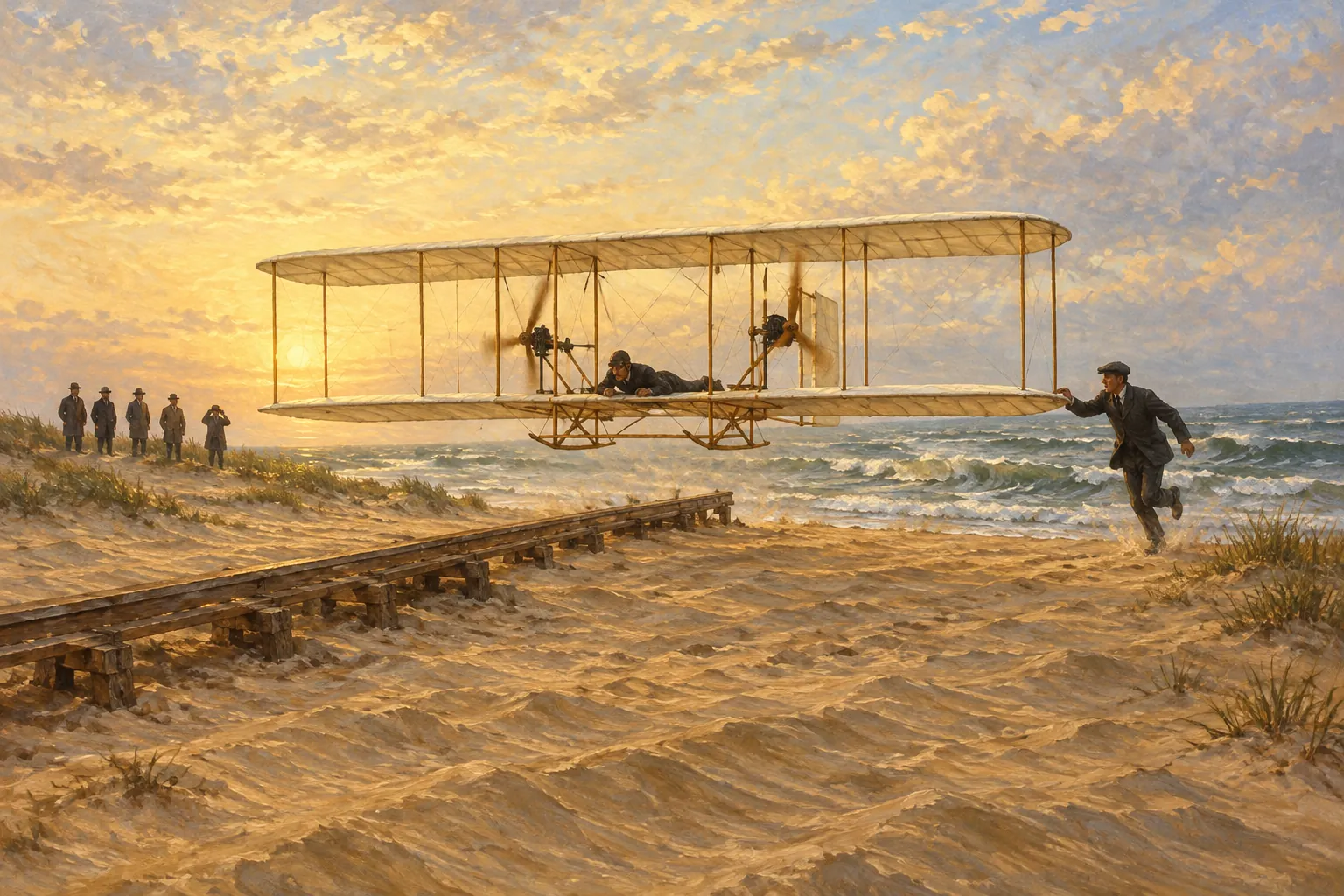
The finished Wright Flyer had a wingspan of about 12.3 metres (40 feet 4 inches) and weighed roughly 275 kilograms (605 pounds) without the pilot. The pilot lay face down on the lower wing, moving his hips to pull the warping cables. The machine ran along a wooden rail about 18 metres (60 feet) long that was laid on the sand.
They were not alone in the race. On December 8, 1903, nine days before the Wrights flew, the government-funded Langley Aerodrome, built by Samuel Langley of the Smithsonian, fell into the Potomac River on its launch. It had strong power but no real system of control.
December 17, 1903 at Kitty Hawk
On December 14 the brothers tossed a coin to decide who would try first. Wilbur won, but his attempt stalled and slightly damaged the Flyer. Repairs took three days.
The morning of December 17 was cold, with a strong wind of roughly 20 miles per hour or more. The brothers raised a signal to the nearby lifesaving station, and five local people came to watch. At about 10:35 a.m. Orville lay on the lower wing and the Flyer left the rail. John T. Daniels of the lifesaving crew took the famous photograph with the brothers' camera: Orville in the air, Wilbur on the sand beside the machine.
- Flight 1 (Orville): about 12 seconds, 120 feet (37 metres).
- Flight 2 (Wilbur): a little farther, with better control.
- Flight 3 (Orville): farther again, about 200 feet.
- Flight 4 (Wilbur), around noon: 59 seconds, 852 feet (260 metres).
These distances are measured over the ground, against a strong headwind, so the Flyer's real distance through the air was much longer. After the fourth flight a gust flipped the machine and broke it, and it never flew again. The brothers sent a telegram to their father in Dayton and asked him to share the news. Many newspapers did not believe it, or ignored it.
Making it practical, 1904 to 1909
The Wrights spent 1904 and 1905 improving the design on a field called Huffman Prairie, near Dayton. In 1905 their third aircraft, Flyer III, turned, circled and stayed up for more than half an hour. By then they could say they had a practical flying machine.
They tried to protect it. A patent for their control system was granted in 1906, and the brothers later fought long court battles with rivals such as Glenn Curtiss. They also kept their designs private while they looked for a buyer, which is partly why the public saw so little of them for years.
That changed in 1908. In August Wilbur gave public demonstrations near Le Mans, France, and European pilots were amazed by his tight, smooth turns. In September Orville flew trials for the US Army at Fort Myer, Virginia. On September 17 a propeller broke, the aircraft crashed, Orville was badly hurt and his passenger, Lieutenant Thomas Selfridge, died: the first death in a powered aeroplane crash. The Army still bought a Wright aircraft in 1909, and the brothers formed the Wright Company that year.
Legacy
Wilbur died of typhoid fever on May 30, 1912, at the age of 45. Orville lived until January 30, 1948. For years he argued with the Smithsonian, which had supported Langley, and he sent the original Flyer to the Science Museum in London in 1928. It came home to the Smithsonian in 1948.
Modern aircraft use flaps on the wings, called ailerons, instead of wing warping, but the principle is the one the Wrights found: a pilot controls pitch, roll and yaw. Within about a decade aircraft became military tools in the First World War, and passenger flight followed. In Japan, the first powered flights took place in December 1910 at Yoyogi in Tokyo.
What exams ask
- Date and place: December 17, 1903, Kitty Hawk, North Carolina.
- Precise claim: the first controlled, powered, sustained flight of a heavier-than-air craft. Balloons and gliders flew earlier, so a bare "first to fly" answer loses marks.
- Significance: the Second Industrial Revolution produced practical machines through systematic testing; the Wrights show trial, measurement and improvement replacing guesswork.
- Consequences: new warfare and transport, new industries and patent disputes.
- Common mix-up: Langley's failed Aerodrome (December 8, 1903) was not a Wright aircraft.
Read next
- Ideas That Shaped the 19th Century: the wider story of science, industry and new ideas that made inventors like the Wrights possible.
- Thomas Edison and the Age of Invention: how another famous inventor turned a workshop into a research laboratory.
- Nikola Tesla and the War of the Currents: the electrical rivalry that powered the same age of invention.