In five minutes
Thomas Edison was an American inventor who gave the world the phonograph, a practical electric light bulb and one of the first public power networks. He also helped develop early motion-picture equipment and a long-lasting storage battery, and he held more than 1,000 US patents. His biggest innovation, though, was a method: a team-based laboratory that turned invention into steady, organised work.
Edison worked in the years when electricity, steel and chemistry were reshaping industry, a period often called the Second Industrial Revolution. For the wider story of how ideas and technology changed that century, see our hub article, Ideas That Shaped the 19th Century. Edison stands on the technology side of that story.
Three points to remember:
- He did not invent the first electric light, but he made one that ordinary homes could use, together with the power system to run it.
- He invented the phonograph, the first machine to record sound and play it back.
- He lost the "war of the currents": alternating current, not his direct current, became the standard for long-distance power.
Early life: from newsboy to telegraph operator
Thomas Alva Edison was born on 11 February 1847 in Milan, Ohio, and grew up in Port Huron, Michigan. He spent only a short time in school. His mother, Nancy, taught him at home, and he read widely and ran experiments on his own.
As a boy he sold newspapers and snacks on trains. He even printed a small newspaper on board and kept chemicals there for his experiments. In his teens he became a telegraph operator and moved from town to town. The telegraph was the high technology of the day, and the job taught him how electrical circuits and machines work.
His first patent, granted in 1869, was for an electric vote recorder. The legislators it was meant for showed no interest, and Edison took away a lesson he kept for life: invent only what people will actually buy. He then improved the stock ticker, a machine that sends share prices over telegraph lines, and sold his rights for about $40,000. That money paid for his own workshop in Newark, New Jersey.
Menlo Park: the invention factory
In 1876 Edison opened a larger laboratory at Menlo Park, New Jersey. It put a machine shop, a chemistry lab and a library in one place, and it is often described as one of the first true industrial research laboratories. Newspapers soon called him "the Wizard of Menlo Park."
The wizardry was mostly teamwork. Edison hired skilled machinists and scientists, among them the experimenter Charles Batchelor and the trained physicist Francis Upton. They tried idea after idea, kept detailed notebooks and improved each design step by step. Edison chose the problems, pushed the pace and handled the business side.
The method is what mattered. A company could pay a team to invent on purpose, and later firms copied the model in their own research departments. That is why historians often rate Edison's laboratory above any single machine he made.
The phonograph (1877)
The first world-famous invention from Menlo Park was the phonograph. A needle attached to a thin diaphragm cut grooves into tin foil wrapped around a hand-cranked cylinder. When the needle later followed the grooves, the sound came back. The first words recorded were from the nursery rhyme "Mary Had a Little Lamb." Edison announced the machine in late 1877 and received a patent in early 1878.
People were astonished. Edison first pictured it mainly for office dictation and for keeping voices, not for music. Later improvements, including wax cylinders and, from 1887, Emile Berliner's flat-disc gramophone, turned recorded sound into a music industry.
The light bulb and the power system
"Edison invented the light bulb" is a common claim, and it is only half right. Arc lamps and early bulbs existed before him, and the British inventor Joseph Swan was working on a bulb at the same time. Edison's achievement was to make a lamp that lasted long enough, and used little enough current, for ordinary homes, and to build the whole system around it.
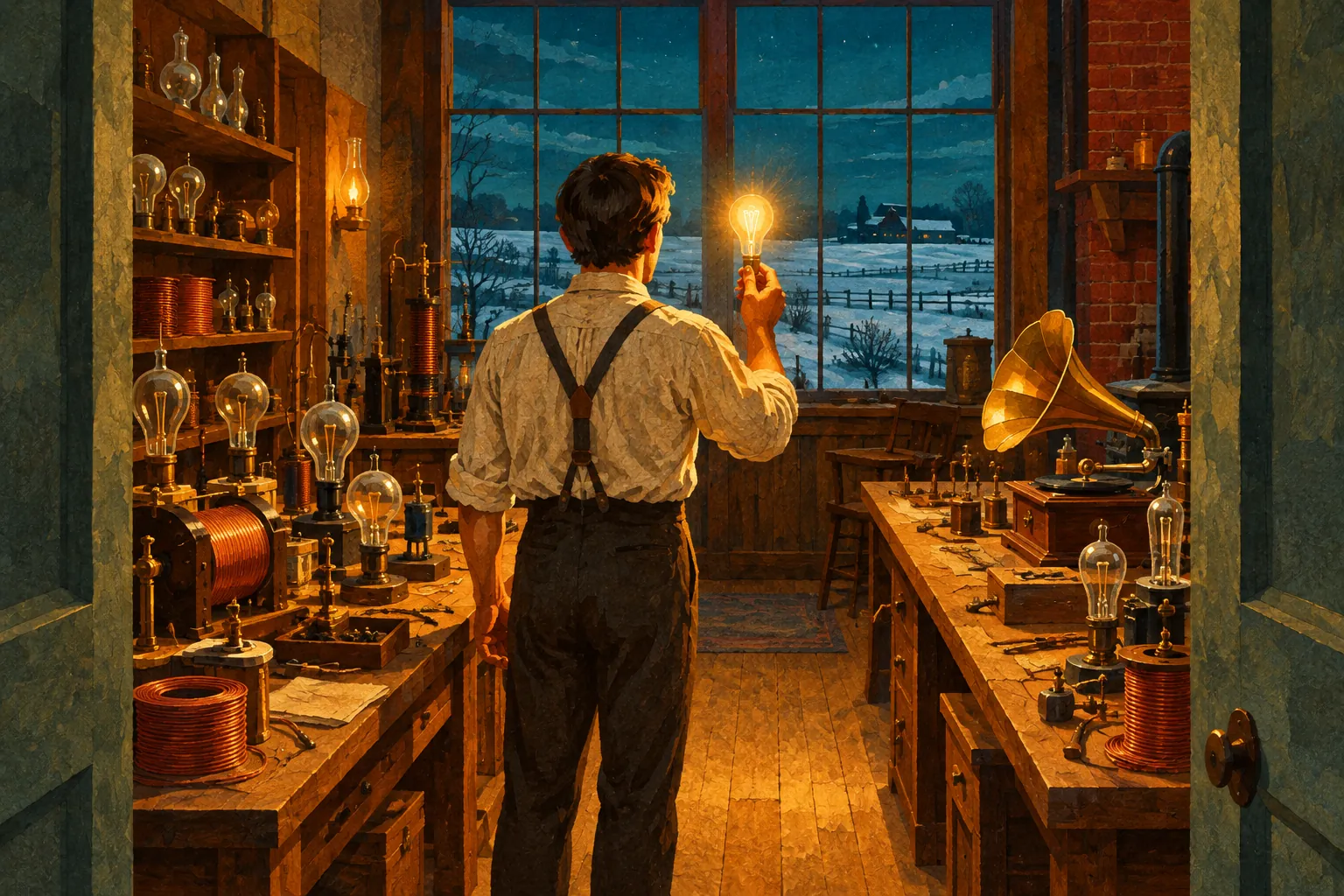
The key idea was a thin, high-resistance filament inside a glass bulb with most of the air pumped out. High resistance meant each lamp drew little current, so thin and cheap copper wires could carry electricity to many lamps. In October 1879 Edison's team lit a bulb with a carbonised cotton thread. Over the following year they tested many materials and found that carbonised bamboo lasted far longer, more than 1,000 hours in tests. Bamboo from Japan, grown near Yawata in Kyoto, was among the kinds used.
A bulb alone could not be sold. So Edison's companies also built generators, underground cables, fuses, sockets and meters to measure use. On 4 September 1882 the Pearl Street Station in lower Manhattan began sending direct current to customers. It was small, but it showed that electricity could be sold as a public service, like water or gas.
The war of the currents
Edison's system used direct current (DC), which flows in one direction. DC loses a lot of energy over long wires, so one power station could serve only a short distance, roughly a mile or so, and a city would need many stations. Alternating current (AC) could be raised to high voltage with a transformer, sent far, and lowered again for use.
George Westinghouse backed AC, and in 1888 he acquired patents from Nikola Tesla, who had worked briefly for Edison in 1884. Edison and his allies argued that AC was dangerous and promoted that view in public. In 1890 New York carried out the first execution by electric chair, using AC. Even so, the advantages of AC were hard to beat. The 1893 World's Columbian Exposition in Chicago was lit with Westinghouse AC, and the Niagara Falls hydroelectric project of the mid-1890s relied on it.
Edison's business changed too. In 1892 his electric companies merged with a rival, Thomson-Houston, to form General Electric, and his name left the company title. The new company supplied AC as well. The other side of the story is told in Nikola Tesla and the War of the Currents.
Later work: film, batteries and West Orange
In 1887 Edison opened an even larger laboratory in West Orange, New Jersey. There his team, with William K. L. Dickson leading the film work, developed the Kinetoscope, a cabinet in which one viewer at a time looked through a peephole at moving pictures. A film studio called the Black Maria was built in 1893, and the first Kinetoscope parlour opened in New York in April 1894. Other inventors, including the Lumière brothers in France, soon projected films on a screen for a whole audience, and Edison's company followed with projectors.
Edison also worked on an alkaline storage battery, aimed mainly at electric vehicles, and on cement and iron-ore processing. Not every project paid off, and his ore venture lost money. He died at West Orange on 18 October 1931, aged 84.
What exams ask
- Second Industrial Revolution (from about the 1870s): electricity, oil, steel and chemicals drove growth, especially in the United States and Germany. Edison (electric light, power station), Alexander Graham Bell (telephone, 1876) and Alfred Nobel (dynamite, 1867) are standard examples.
- Edison versus Tesla and Westinghouse: DC against AC. AC won because transformers allowed cheap long-distance transmission.
- The industrial research laboratory: a standard example of how invention became organised and corporate in the Gilded Age United States.
- Common mistake: saying Edison invented the first light bulb. Credit him with the practical, long-lasting lamp and the system that powered it.
For an AP-style answer on significance, link three things: new technology, big business and a new way of organising research. Edison shows all three.
Read next
- Ideas That Shaped the 19th Century: the hub for this topic, placing Edison's technology beside the political and scientific ideas of his age.
- Nikola Tesla and the War of the Currents: the rival story, and why alternating current won.
- What Is Nationalism?: in the same decades, industrial strength became a measure of national power.