Nikola Tesla in five minutes
Nikola Tesla (1856–1943) was a Serbian-American engineer who helped make alternating current (AC) practical: the motor that runs on it and the multi-phase system that carries it over long distances. His patents were licensed to George Westinghouse, and the AC network built on them beat Thomas Edison's direct-current (DC) system. The business and publicity fight between the two camps in the late 1880s and early 1890s is called the War of the Currents.
Tesla did not win the war alone, and he did not get rich from it. Westinghouse, General Electric and many engineers built the grid. Tesla's later dream of sending power through the air never worked, and he died in a New York hotel room. Yet almost every wall socket today is fed by a kind of system he helped design. This page is part of our guide to Ideas That Shaped the 19th Century: the century produced new ideas about government and society, and also a new way of using energy that changed daily life.
Early life: a priest's son from Smiljan
Tesla was born on 10 July 1856 in the village of Smiljan, in the Military Frontier of the Austrian Empire, today part of Croatia. His family was Serbian Orthodox. His father, Milutin, was a priest, and his mother, Đuka, ran the household and made small tools for it. Tesla later said he owed his memory and his inventive streak to her. Today both Serbia and Croatia honour him as their own, a small example of how nationalism claims people (see What Is Nationalism?).
From 1875 he studied engineering at the Austrian Polytechnic in Graz, where he began to ask whether the sparking commutator in a direct-current motor was really necessary. He left without a degree. In 1881 he worked at the new telephone exchange in Budapest, and in 1882 he moved to Paris to work for the Continental Edison Company, which built Edison-style lighting equipment in Europe.
He later recalled that the idea of a motor driven by a rotating magnetic field came to him on a walk in Budapest around 1882. In June 1884 he sailed to New York with very little money and a letter of introduction to Edison.
Edison's DC and why AC mattered
Electric current comes in two basic kinds. Direct current flows one way all the time. Alternating current reverses direction many times a second. In 1882 Edison's company opened the Pearl Street station in lower Manhattan and began selling direct current. DC at low voltage loses a lot of power in long wires, so each station could serve only a district about a mile across, and a big city needed many stations.
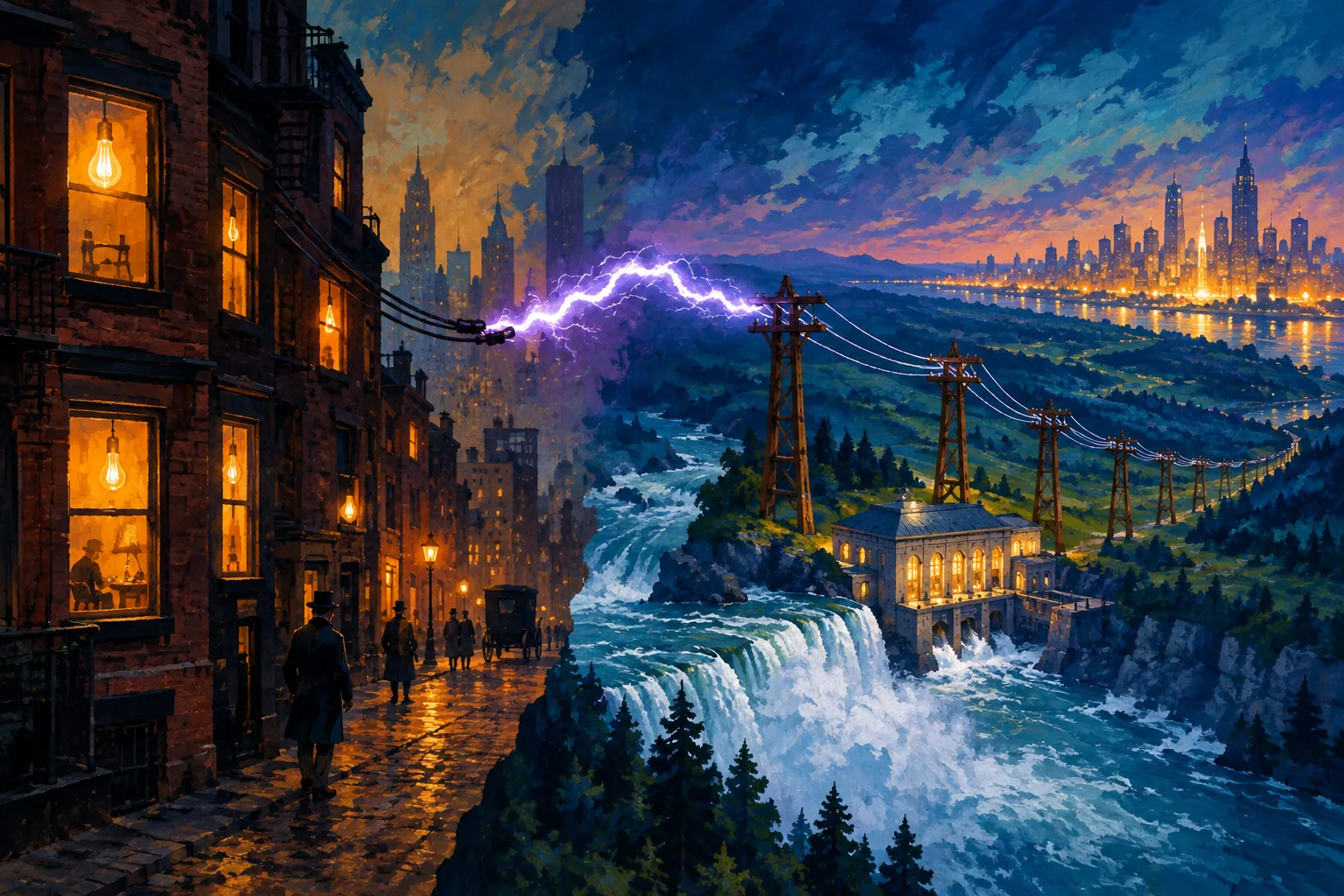
AC can be stepped up to high voltage by a transformer, sent a long way with far less loss, and stepped down again near the customer. In 1886 Westinghouse's company tested this in Great Barrington, Massachusetts, using a transformer design by William Stanley.
But early AC had a gap. It could light lamps, yet there was no good AC motor, and factories needed motors. Tesla's work filled that gap.
The motor and the deal with Westinghouse
Tesla worked for Edison's company in New York for about a year and left in 1885 after a falling-out. Money was tight, and by 1886 he was taking labouring jobs. In 1887 he found backers and set up his own company, where he built working induction motors.
His motor sends two or more alternating currents, slightly out of step with each other, through separate coils. Together they create a magnetic field that rotates, and it drags the rotor around. There are no brushes and no commutator, so the machine is simple and lasts. His US patents were granted in May 1888, and the same month he lectured to the American Institute of Electrical Engineers, which brought him to the attention of leading engineers.
Westinghouse licensed the patents in 1888. Tesla spent about a year in Pittsburgh helping adapt the motor to Westinghouse equipment. Making it a product took the work of the company's own engineers too, such as Benjamin Lamme.
The War of the Currents (1888–1893)
Edison's side argued that high-voltage AC was a deadly danger. Harold P. Brown, an electrical engineer, began a campaign around 1888 with public demonstrations in which animals were electrocuted. Edison himself criticised AC publicly on safety grounds.
On 6 August 1890 New York State used its new electric chair for the first time, on William Kemmler, with alternating current. The execution went badly, and public worry about AC grew. Westinghouse answered in the newspapers: AC could carry power farther and more cheaply.
In the end cost and distance decided the contest, not the safety campaign. In 1892 Edison's companies merged with Thomson-Houston to form General Electric, and Edison left the centre of management. GE soon began building AC equipment itself.
Meanwhile Tesla was a public draw. In 1891 he built the high-frequency transformer now called the Tesla coil, and in his lectures he lit lamps without wires. The show made AC look modern.
Chicago 1893 and Niagara: AC wins
At the 1893 World's Columbian Exposition in Chicago, Westinghouse supplied the lighting with alternating current. A vast number of lamps glowing at night showed that AC could work at scale.
The same year, the company building a power station at Niagara Falls chose AC for its design. Westinghouse built the generators, and Tesla's patents were used. Electricity began to flow in 1895, and in November 1896 power travelled about 25 miles to the city of Buffalo.
By then the outcome was clear. DC did not disappear, though. It is still used in batteries, solar cells, electronics and some long high-voltage lines.
Three reasons AC won
The War of the Currents was not decided by one invention. Three things mattered most.
- Transformers. Voltage could be raised for transmission and lowered for use, so power reached distant towns with little loss.
- Motors. Tesla-type induction motors ran factory machines, and rotary converters could turn AC into DC, so the old DC equipment could be connected to the new grid.
- Cost. Fewer power stations and less copper made supplying a wide area cheaper.
AC won because an invention, well-funded companies and field engineers came together. Tesla was an important part of that, not the whole of it.
Wireless dreams: Colorado Springs and Wardenclyffe
From about 1893 Tesla showed experiments in wireless signalling, and in 1898 he demonstrated a radio-controlled model boat in New York. In 1899 he built a laboratory at Colorado Springs, produced huge electrical discharges, and became convinced that the Earth itself could carry power.
In 1901 he began building the Wardenclyffe tower on Long Island, New York. The banker J. P. Morgan put in $150,000. Then, in December 1901, Marconi announced a wireless signal across the Atlantic, and Morgan would not add more money. The project never operated, and the tower was demolished in 1917.
Wireless power on a world scale has never been shown to work. Even so, Tesla's work on resonant circuits fed into the development of radio technology.
Last years and legacy
Tesla became a US citizen in 1891, but in later life he lived in New York hotels and carried debts. He died on 7 January 1943, aged 86, in his room at the Hotel New Yorker. In 1960 the unit of magnetic flux density was named the tesla (T).
Popular culture often tells a simple story in which Tesla is the genius who invented electricity and Edison is the villain. The facts are less tidy. The grid was built by Westinghouse, GE and thousands of engineers, and Edison had opened the first big power stations. Tesla's real achievement is the induction motor and the multi-phase AC idea, which sit at the base of modern power systems.
What exams ask
In AP-style questions, Tesla appears inside the larger topic of the Second Industrial Revolution. Know that from about 1870 electricity, oil, steel and chemicals drove industry, and that Germany and the United States overtook Britain in output. Edison (the light bulb, power stations), Bell (the telephone) and Tesla and Westinghouse (AC) are typical examples. A strong answer explains the significance: long-distance AC power allowed large factories and electrified cities. Useful dates: 1882 (Pearl Street), 1893 (Chicago fair) and 1895 (Niagara).
Read next
- Ideas That Shaped the 19th Century: the wider picture of the age Tesla worked in.
- Who Was Karl Marx?: he wrote about factories and machines just as electricity was about to remake them.
- What Is Nationalism?: why several countries claim people like Tesla.