In five minutes
Vincent van Gogh (1853–1890) was a Dutch painter and one of the best-known figures of Post-Impressionism, a loose group of artists who built on Impressionism but used colour and form to express feeling, not only to record light. He painted for about ten years, left roughly 2,100 artworks, sold almost nothing while he lived, and died at 37. This page belongs to the topic 19th-Century Art and Culture.
Three ideas explain him. First, he taught himself and worked at great speed, and his younger brother Theo paid for much of his paint and rent. Second, in Paris he met Impressionist colour and Japanese woodblock prints and turned them into a style of his own. Third, the pictures the world loves today (Sunflowers, The Night Café, The Starry Night) were painted in the last two and a half years of his life, in Arles, in a hospital at Saint-Rémy and in the village of Auvers.
An unsettled start (1853–1885)
Van Gogh was born on 30 March 1853 in Zundert, in the south of the Netherlands, the son of a Protestant minister. At 16 he began work for the art dealer Goupil & Cie, the firm where Theo would later work as well. He left it in 1876 and tried teaching, bookselling and theology. In 1878 he went to the coal-mining Borinage region of Belgium as a lay preacher among the miners, and the church there did not renew his post.
Around 1880, at about 27, he decided to become an artist. He had almost no formal training, only short periods of lessons and advice, including from the painter Anton Mauve in The Hague. His early work is dark and earthy: peasants, weavers, miners. It reaches a peak in The Potato Eaters (1885), painted in Nuenen. Five peasants sit round a lamp, and he wanted the viewer to see the rough hands that had dug the food they were eating. The browns and dull greens look nothing like the Van Gogh most people picture.
Paris, 1886–1888: colour arrives
In March 1886 he moved to Paris and shared Theo's flat. In two years he met Henri de Toulouse-Lautrec, Émile Bernard, Camille Pissarro and, later, Paul Gauguin. He saw Impressionist paintings and the dotted technique of Georges Seurat and Paul Signac, and he learned that colours set side by side make each other glow, especially opposite pairs such as blue and orange or red and green.
He also discovered Japanese ukiyo-e prints and collected hundreds of them. In 1887 he copied Hiroshige's Sudden Shower over Shin-Ōhashi Bridge and Atake in oils. From such prints he took flat areas of colour, strong outlines and cropped, unexpected viewpoints. His palette brightened and his brushwork broke into short, separate strokes. Paris also wore him out, and in February 1888 he left for the south of France.
Arles, 1888: the Yellow House
In Arles he found strong light and strong colour. He rented part of a yellow house on the Place Lamartine and dreamed of founding a community of artists there. In a burst of work he painted the Sunflowers series (to decorate a room for Gauguin), The Night Café, Café Terrace at Night, Starry Night over the Rhône and The Bedroom. His letters to Theo show how deliberately he chose colour for mood rather than for accuracy.
Gauguin arrived on 23 October 1888, and the two men painted side by side. They quarrelled often. On 23 December Van Gogh suffered a breakdown and cut off part of his left ear. Gauguin left Arles, and Van Gogh was treated in the local hospital. The shared studio he had imagined was over after about two months.
Saint-Rémy and Auvers: the last two years
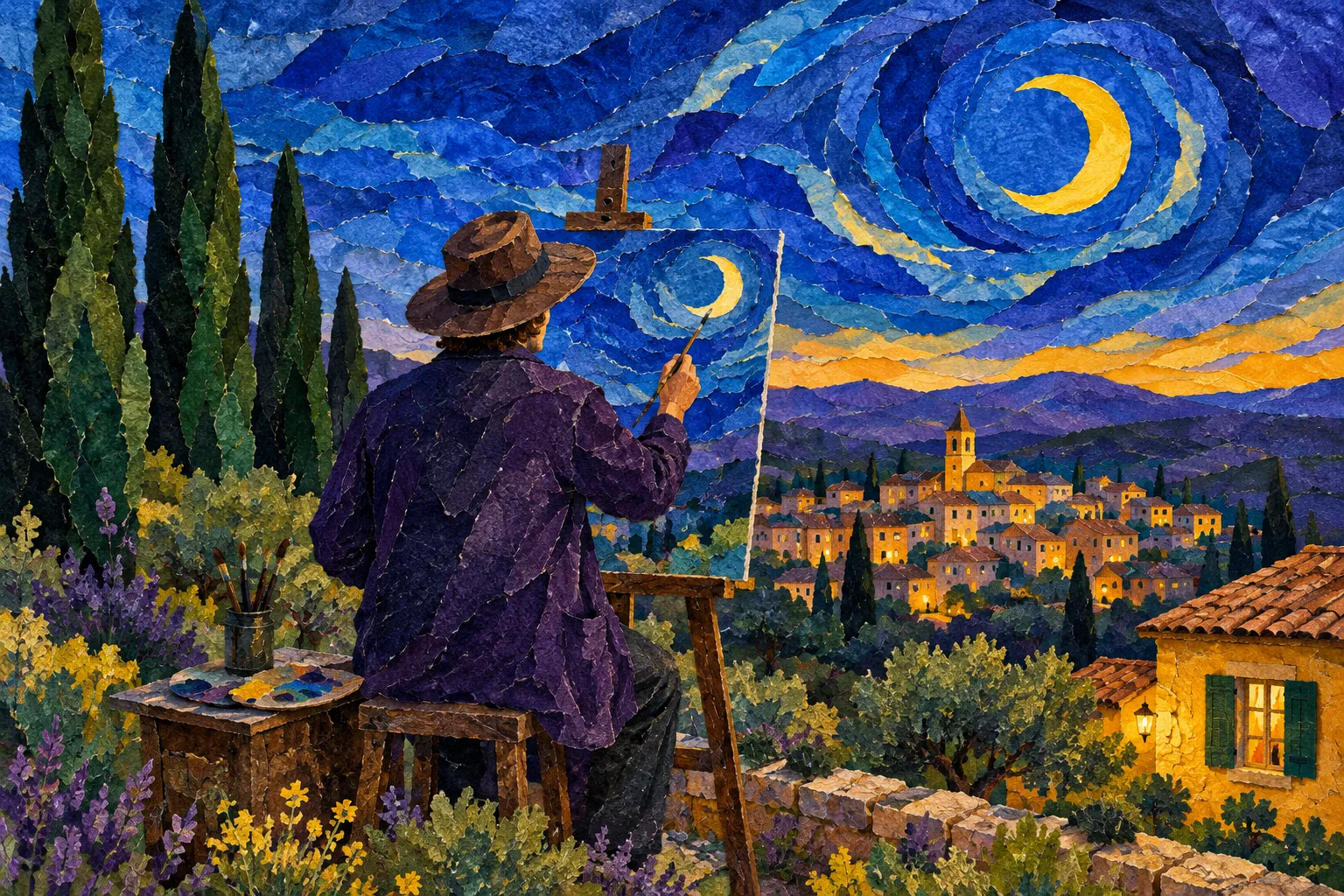
In May 1889 Van Gogh entered the asylum of Saint-Paul-de-Mausole at Saint-Rémy-de-Provence of his own choice. Between attacks he kept painting: the garden, irises, olive trees, cypresses, wheat fields. In June 1889 he painted The Starry Night from memory and imagination, working from the view out of his window with the village added from elsewhere. The swirling sky is the most famous result of his years in the south.
In May 1890 he moved north to Auvers-sur-Oise, near Paris, under the eye of Dr Paul Gachet. He painted about 70 works there in roughly 70 days, including the portrait of Dr Gachet and wheat fields under heavy skies. On 27 July 1890 he shot himself in the chest and died two days later, on 29 July, aged 37. Theo died in January 1891, only six months after his brother.
What is Post-Impressionism?
The name was coined by the English critic Roger Fry for the exhibition "Manet and the Post-Impressionists" in London in late 1910. It covers painters who came after Impressionism and went in different directions: Paul Cézanne built solid structure out of colour, Seurat worked with scientific dots of colour, Gauguin used flat, symbolic colour, and Van Gogh used colour and brushwork to carry emotion. It is not a single school with a manifesto. What they share is that each moved away from simply recording a passing moment of light, which was the aim of Impressionism, and gave more weight to personal vision. That step opened the way for Fauvism and Expressionism. The Impressionists in turn had broken away from the earlier mood of Romanticism in some ways, and in others carried its interest in feeling forward.
How to look at a Van Gogh painting
Three habits make his paintings easier to read. Look at the paint itself: he often laid it on thickly (a technique called impasto), so you can see each stroke. Look at the direction of the strokes, which curl in the sky of The Starry Night and run in rows in his wheat fields, giving movement to the whole surface. And look at the colour: the yellow of his sunflowers and the blue night sky are chosen to push against each other. Reproductions flatten all of this, which is why seeing a real canvas in Amsterdam, New York or Tokyo feels different.
From unsold to world famous
In his lifetime he sold very little. A painting called The Red Vineyard is the one sale usually named, bought in Brussels in 1890. Early praise came from the critic Albert Aurier in a January 1890 article. After the deaths of the brothers, Theo's widow Johanna van Gogh-Bonger kept the works together, lent them to exhibitions and published the brothers' letters, more than 800 of which from Vincent survive. The Van Gogh Museum in Amsterdam, opened in 1973, now holds the largest collection.
Prices later turned his life into a legend. His portrait of Dr Gachet sold in 1990 for about 82 million US dollars, then a record for a painting. Japan has a special link: the Japanese insurer Yasuda Fire and Marine bought a version of Sunflowers at auction in 1987, and it can be seen today at the SOMPO Museum of Art in Tokyo.
What exams ask
- Definition: Post-Impressionism covers Cézanne, Gauguin, Van Gogh and Seurat, who came after the Impressionists and valued personal expression, structure or symbolism over a record of light.
- Name: the term was coined by Roger Fry in 1910.
- Japanese influence: ukiyo-e prints (Hiroshige, Hokusai) shaped Van Gogh and other European artists, an effect known as Japonisme.
- Key works: The Potato Eaters (1885), Sunflowers, The Night Café and The Bedroom (1888), The Starry Night (1889).
- Key people: Theo van Gogh (brother and supporter) and Paul Gauguin (Arles, 1888).
- Significance (AP-style): his work prepared the ground for Fauvism and German Expressionism and shows how art in the late nineteenth century moved from depicting the world toward expressing inner experience.
Read next
What Is Impressionism? explains the movement Van Gogh learned from in Paris. What Is Romanticism? covers the earlier celebration of emotion and nature. 19th-Century Art and Culture places all of these movements in one timeline.