In five minutes
Marie Curie (1867–1934) was a Polish-born physicist and chemist who spent her working life in France. She coined the word “radioactivity”, discovered the elements polonium and radium together with her husband Pierre, and won the Nobel Prize in Physics in 1903 and the Nobel Prize in Chemistry in 1911. No one else has won Nobel Prizes in two different sciences.
Her story is part of the wider scientific shift described in Ideas That Shaped the 19th Century: Liberalism, Socialism, Nationalism, Darwin: the belief that nature follows laws that careful measurement can uncover. Curie’s measurements showed that atoms, long treated as unchangeable, could send out energy from the inside. That opened the way to nuclear physics and to radiation treatment for cancer.
Early life: from Warsaw to Paris
She was born Maria Skłodowska in Warsaw on 7 November 1867, in a part of Poland ruled by the Russian Empire. Both of her parents were teachers, and her father taught mathematics and physics. Russian authorities limited Polish-language schooling, and women could not enrol at the university in Warsaw, even though Maria finished school at the top of her class.
So she made a deal with her older sister Bronisława. Maria would work as a governess and pay for Bronisława’s medical studies in Paris; later Bronisława would help her in return. In 1891 Maria arrived in Paris, started using the French form Marie, and enrolled at the Sorbonne. She lived in a tiny rented room and often ate very little. She still earned a degree in physics in 1893 and one in mathematics in 1894.
In 1894 she met Pierre Curie, a physicist at the city’s School of Physics and Chemistry. They married on 26 July 1895, and their first daughter, Irène, was born in 1897.
Causes: a puzzle about uranium rays
Two discoveries set the stage. In 1895 Wilhelm Röntgen announced X-rays. In 1896 Henri Becquerel found that uranium salts gave off rays that fogged photographic plates, even when kept in the dark. Few scientists followed it up.
Marie Curie chose it as the subject of her doctoral research in late 1897. Her main instrument was an electrometer built with the piezoelectric technique developed by Pierre and his brother Jacques. It measured the very weak electric current that the rays created in the air. She found that the strength of the rays depended only on how much uranium was present, not on its chemical form, on light or on temperature. That pointed to a striking conclusion: the rays came from inside the atom itself.
She then tested other materials and found that thorium behaved in the same way. She gave the property a name, radioactivity. Next she noticed something odd: pitchblende, an ore containing uranium, was more radioactive than the uranium in it could explain. Something stronger had to be hiding in the rock.
What happened: the hunt for polonium and radium
Pierre put aside his own work on crystals to join her. In July 1898 they announced a new element in pitchblende and named it polonium, after Marie’s homeland. In December 1898, together with Gustave Bémont, they announced a second and far more radioactive element, radium, named from the Latin word for ray.
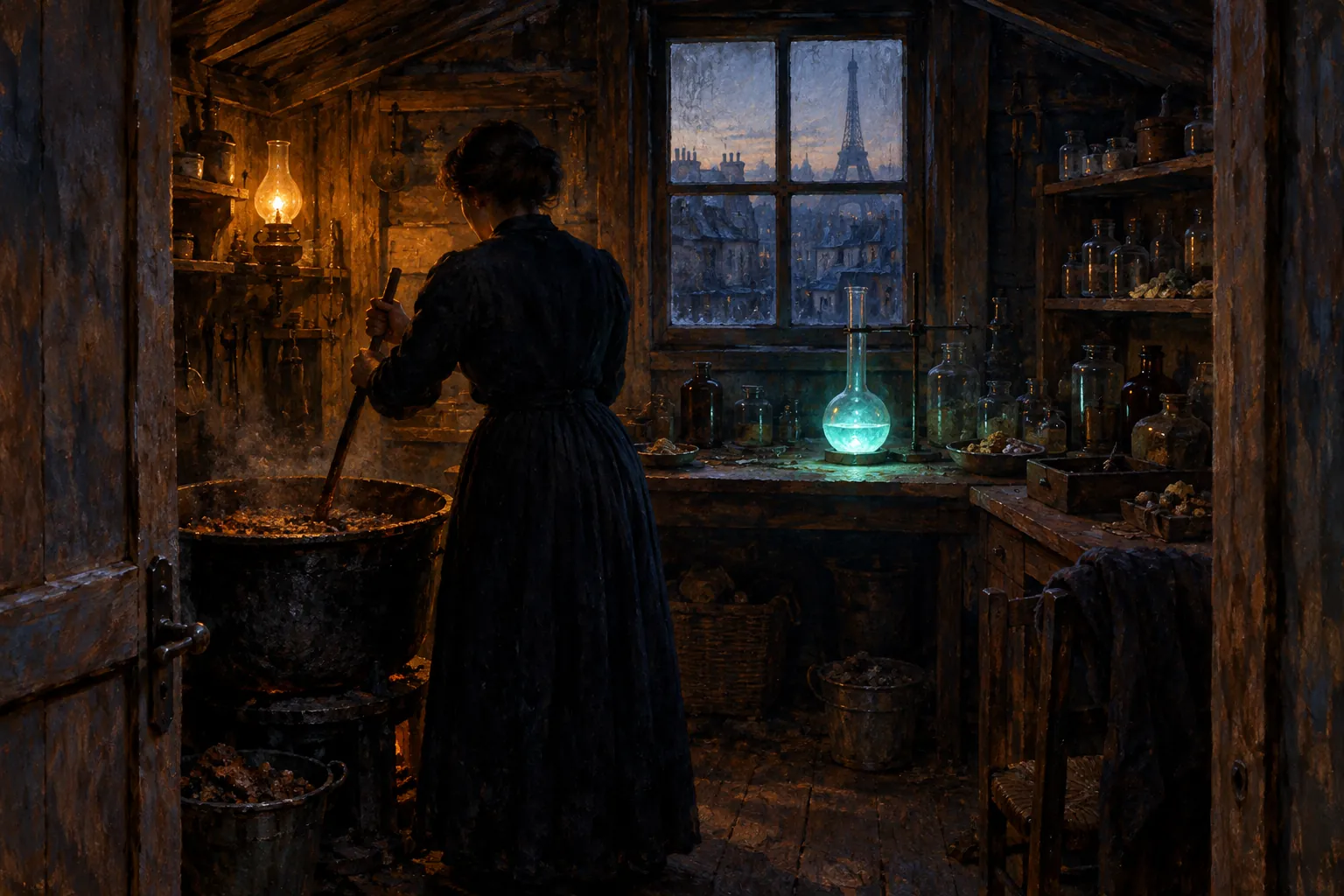
Chemists would not accept new elements until they could be separated and weighed. So began about four years of heavy labour in an old shed belonging to the School of Physics and Chemistry, which was cold in winter and leaked in the rain. The ore residues came from the mines at Joachimsthal in Bohemia, supplied through the Austrian government. Marie dissolved, separated and crystallised tonnes of material, over and over again.
In 1902 she succeeded in isolating about a tenth of a gram of radium chloride and showed that radium’s atomic weight was about 225. Radium glowed faintly in the dark, and she later recalled that she and Pierre sometimes returned to the laboratory in the evening just to look at the glowing tubes.
The first Nobel Prize and the loss of Pierre
In June 1903 Curie defended her doctoral thesis. In December of that year the Nobel Prize in Physics was shared by Becquerel, Pierre Curie and Marie Curie for their work on radioactivity. She was the first woman to win a Nobel Prize.
A second daughter, Ève, was born in 1904. Then, on 19 April 1906, Pierre was killed in a street accident in Paris, run over by a horse-drawn wagon. Marie kept working. The Sorbonne asked her to take over his teaching post, and on 5 November 1906 she gave her first lecture there, becoming the first woman to teach at the university.
1911 and the First World War
Around 1910, with André Debierne, Curie isolated radium as a pure metal. In 1911 she won the Nobel Prize in Chemistry on her own, for the discovery of polonium and radium and for the isolation and study of radium. That same year the French press attacked her over her private life. She travelled to Stockholm to accept the prize anyway.
The Radium Institute in Paris was completed in 1914, just as the First World War began. Curie turned her skills to the wounded. Surgeons needed X-rays to find bullets and broken bones, but few hospitals near the front had the equipment. She helped equip cars with X-ray machines, which soldiers nicknamed “petites Curies” (little Curies). About twenty such vehicles and around two hundred fixed X-ray rooms were set up, and Curie and her teenage daughter Irène helped train the women who ran them.
Consequences and legacy
After the war Curie led the Radium Institute and trained researchers from many countries. In 1921 she visited the United States, where American women who had raised money presented her with a gram of radium, handed over by President Warren Harding, to support her laboratory.
The dangers of radiation were not yet well understood. For years she handled radioactive material with bare hands and carried samples in her pockets. She died on 4 July 1934 in a sanatorium in the French Alps, of aplastic anaemia, which was probably caused by long exposure to radiation. Her notebooks are still radioactive and are kept in lead-lined boxes.
Her work lived on in several ways:
- Medicine: radium treatment became one of the first forms of radiation therapy for cancer.
- Family: her daughter Irène and son-in-law Frédéric Joliot-Curie won the Nobel Prize in Chemistry in 1935.
- Names: the “curie” was used as a unit of radioactivity, and element 96 is called curium.
- Memory: in 1995 her remains were moved to the Panthéon in Paris beside Pierre’s, making her the first woman placed there for her own achievements.
What exams ask
Questions on Curie usually test three things. First, the order of discoveries: X-rays (1895), Becquerel’s uranium rays (1896), then the Curies’ polonium and radium (1898). Second, significance: radioactivity showed that atoms are not indivisible and unchanging, which helped launch modern physics. Third, her place in history: the first woman Nobel laureate, the only person with prizes in two sciences, and a leader of wartime medical X-ray services. Be ready to explain how her success challenged barriers to women in higher education.
Read next
- Ideas That Shaped the 19th Century: the wider currents of science and politics that formed the world Curie worked in.
- Nikola Tesla and the War of the Currents: another scientist who left home for a new country, this time to build the electric age.
- Thomas Edison and the Age of Invention: how invention became a business, a useful contrast to Curie’s laboratory science.