This article is part of the wider story of imperialism and its legacy.
The Panama Canal in five minutes
The Panama Canal is a waterway about 50 miles (80 km) long that cuts across the narrow land bridge of Panama. It lets ships pass between the Atlantic and Pacific without sailing around the tip of South America, a saving of nearly 8,000 miles on a trip from New York to San Francisco. The United States built it between 1904 and 1914 and opened it on 15 August 1914. Construction cost roughly $375 million and more than 5,000 lives under the Americans, after a French company had already lost about 22,000 workers and its money in the 1880s.
The canal is more than a feat of engineering. Panama was part of Colombia until 1903, and the way the United States gained the right to build, by backing a Panamanian break from Colombia, is a textbook example of early twentieth-century imperialism.
Why a canal across Panama?
Before the canal, a ship going from the US East Coast to the West Coast had to sail about 13,000 miles around Cape Horn. People had dreamed of a shortcut since the Spanish era. The need grew sharply after the California Gold Rush of 1849, when thousands of travellers crossed Panama by land, and after a railway across the isthmus opened in 1855.
The Spanish-American War of 1898 made the point clear to Americans. The battleship USS Oregon had to steam about 14,000 miles from San Francisco around South America to join the fleet off Cuba, taking over two months. Navy planners such as Alfred Thayer Mahan argued that a canal would let a single fleet defend both coasts. The US had also just taken Puerto Rico, the Philippines and Guam, and wanted quick links to its new possessions.
The French attempt, 1881–1889
The first builder was France. Ferdinand de Lesseps, who had finished the Suez Canal in 1869, formed a company and began digging in 1881. Suez was a flat desert cut at sea level. Panama was a mountainous, rainy jungle with a flood-prone river, and de Lesseps insisted on a sea-level canal with no locks.
The project failed for three reasons. First, the terrain: landslides kept refilling the cuttings, and the Chagres River flooded. Second, disease: yellow fever and malaria swept through the camps, and nobody yet knew that mosquitoes carried them. Third, money: costs ballooned and the company went bankrupt in 1889. About 22,000 workers died, many of them labourers from the Caribbean. The collapse led to the Panama scandal in France in the early 1890s, when it emerged that officials and journalists had been bribed to keep investors confident.
How the United States got the right to build
President Theodore Roosevelt made the canal a priority. Congress passed the Spooner Act in 1902, and a commission first looked at a route through Nicaragua before choosing Panama and buying the rights of the failed French company for $40 million.
Panama belonged to Colombia, and in January 1903 the two countries signed the Hay–Herrán Treaty. In August 1903 the Colombian Senate rejected it, hoping for better terms. Roosevelt was furious. A group of Panamanian leaders, helped by Philippe Bunau-Varilla, a French engineer who had worked on the French canal, planned a revolt. On 3 November 1903 Panama declared independence. US warships, including the USS Nashville, were off the coast, and Colombian forces were unable to put down the uprising. The US recognised Panama within days.
On 18 November 1903 the Hay–Bunau-Varilla Treaty gave the US a Canal Zone about ten miles wide across the country. In return Panama received $10 million and a yearly payment of $250,000. Bunau-Varilla signed for Panama, and no Panamanian delegate was present at the signing. Many Panamanians resented the treaty for decades. In 1921 the US paid Colombia $25 million under the Thomson–Urrutia Treaty to settle the matter between those two countries.
Building the canal, 1904–1914
The Americans took over the project in May 1904. The early months were chaotic. The first chief engineer, John Findley Wallace, resigned in 1905. His successor, John Stevens, rebuilt the railway, housing and supply systems before pushing the digging. He also won the argument for a canal with locks instead of the French sea-level plan. In 1907 the army engineer George Goethals took charge and ran the work until the end.
Three tasks defined the job.
- Fighting disease. The physician William Gorgas led a campaign against mosquitoes: draining standing water, screening buildings and spraying. Yellow fever was wiped out in the Canal Zone by about 1906, and malaria deaths fell sharply.
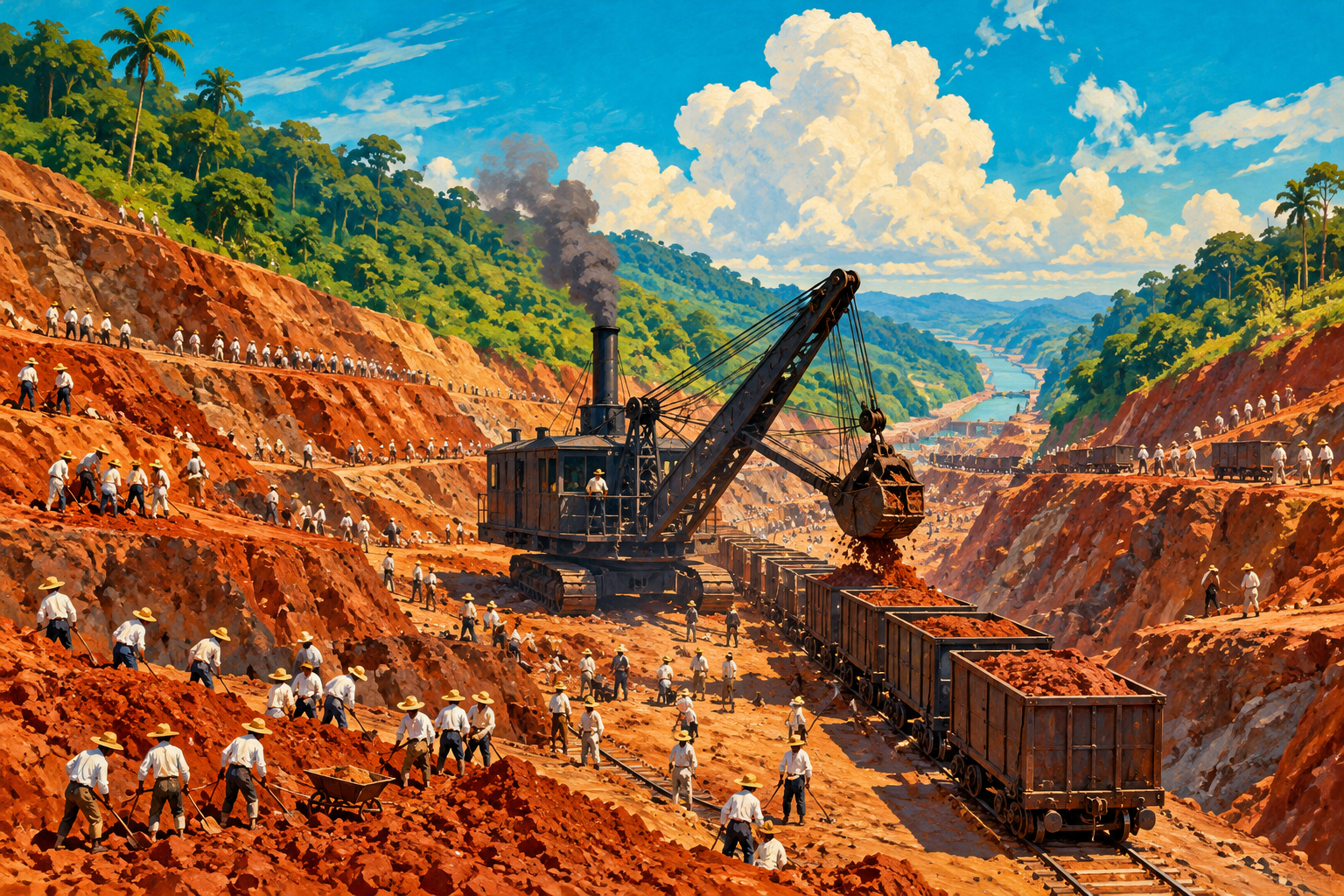
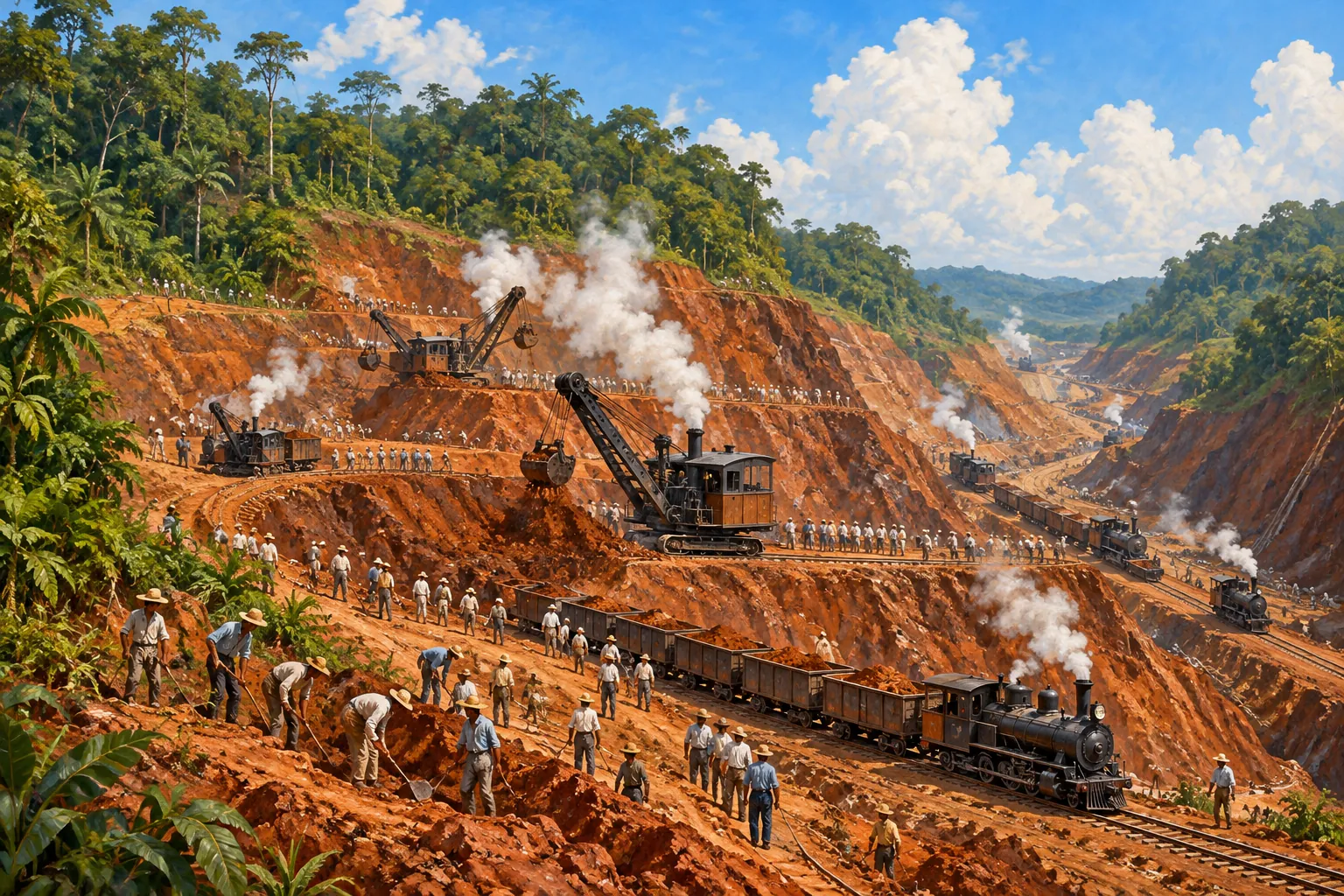
- Cutting through the hills. The Culebra Cut, later called the Gaillard Cut, ran about nine miles through the continental divide. Steam shovels loaded earth onto trains day and night. Landslides were a constant problem, and the total excavation for the canal was over 200 million cubic yards.
- Raising the water. The Chagres River was dammed at Gatún to form Gatún Lake, then the largest artificial lake in the world. Ships are lifted about 85 feet by three sets of locks, Gatún, Pedro Miguel and Miraflores, whose chambers are 1,000 feet long and 110 feet wide.
At the peak, around 40,000 people worked on the canal. Many came from Barbados and other Caribbean islands. The Americans split workers into a "gold roll", mostly white Americans paid in gold-backed currency with better housing and food, and a "silver roll", mostly Black and Caribbean workers paid in silver-based Panamanian currency with worse conditions. This pay and housing divide shaped Panamanian society for generations. Deaths among workers in the American period are usually put at over 5,000, mostly from accidents and disease, which is far fewer than under the French.
Opening and what changed
The first ship to pass through, the SS Ancon, made the crossing on 15 August 1914. World War I had begun a few weeks earlier, so the opening had little ceremony. Traffic grew steadily, and the canal turned Panama into a world shipping hub.
For the United States, the canal was an economic and military asset and a symbol of American power. It also shaped US policy in Latin America. In 1904 Roosevelt announced what became known as the Roosevelt Corollary to the Monroe Doctrine, claiming a right to intervene in the region, and protecting the canal was one of the reasons for later interventions in Central America and the Caribbean.
In Panama the Canal Zone became a point of anger. A strip of the country was run by a foreign government, with its own police, schools and flag. Riots broke out in January 1964 over the flying of flags in the Zone, and Panama's government demanded a new deal. In 1977 President Jimmy Carter and General Omar Torrijos signed treaties that handed the canal to Panama. The US kept a right to defend its neutrality, and Panama took full control at noon on 31 December 1999. A third set of locks, designed for larger ships, opened in June 2016.
Timeline summary
French digging began in 1881, collapsed in 1889, and the US took over in 1904. The canal opened in 1914, the 1977 treaties set the handover, and Panama has run the canal since 1999.
What exams ask
- Causes: the Spanish-American War, naval strategy, and trade between the two US coasts. Link them to the idea of the US as a rising imperial power.
- Methods: support for Panamanian independence, the Hay–Bunau-Varilla Treaty and the Canal Zone. Know that this is often described as an example of the "big stick" approach of Roosevelt.
- Engineering and health: the control of yellow fever and malaria, the locks and Gatún Lake, and why the sea-level plan was dropped.
- Labour: the gold and silver rolls and the role of Caribbean workers.
- Consequences: US influence in Latin America, the 1964 riots, the 1977 treaties and the 1999 handover.
Read next
- Imperialism: What It Was, Why It Happened, What It Left Behind: the big picture of why powers like the US, Britain and France competed for territory and trade routes.
- The Triangular Trades: Atlantic and Asian: the older trading networks that tied the Caribbean to Europe and Africa, and shaped the world the canal workers came from.
- The Decline of the Mughal Empire: how European trading powers gained ground in South Asia, the same pattern of commerce and force seen in Panama.