In five minutes
Frederick Douglass was born into slavery in Maryland, escaped when he was about twenty, and spent the next fifty-seven years arguing that the United States must end slavery and treat Black Americans as full citizens. He is one of the central figures of 19th-century America, and few people did more to turn private suffering into public argument.
His life fits into four steps. First, he taught himself to read, and learned that slavery depended on keeping people ignorant. Second, he escaped north in 1838. Third, he became the best-known speaker and newspaper editor of the abolition movement. Fourth, after emancipation, he fought for the vote and against the violence that followed the war.
Born into slavery in Maryland
Douglass was born Frederick Augustus Washington Bailey, probably in February 1818, in Talbot County on Maryland's Eastern Shore. Like many enslaved people, he was given no record of his birth. He later chose 14 February as his birthday. His mother, Harriet Bailey, was hired out to work on a different farm when he was a baby, so he saw her only a handful of times. He never knew his father, though he believed his father was a white man.
As a child he was moved between farms and households. In 1826, at about eight years old, he was sent to Baltimore to live with Hugh and Sophia Auld. That move shaped the rest of his life.
Learning to read
In Baltimore, Sophia Auld began teaching the boy the alphabet. Her husband soon ordered her to stop, saying an enslaved person who could read would become impossible to control. Douglass later wrote that this was a lesson in itself: if the slaveholder feared reading so much, then reading was the road to freedom.
He kept learning on his own. He traded bread to poor white boys in return for reading help and practised with any printed page he could find. He also bought a schoolbook of speeches and dialogues, The Columbian Orator, which gave him arguments about liberty and human rights that he would use for the rest of his life.
As a teenager he was sent back to rural Maryland. In 1834 he was hired out to Edward Covey, a farmer with a reputation for breaking the spirit of enslaved workers. After months of beatings, Douglass fought back in a long struggle, and Covey did not strike him again. Douglass described it as the moment he decided he would never again accept slavery in his mind, whatever the law said. He tried to escape with friends in 1836, but the plan was discovered.
The escape of 1838
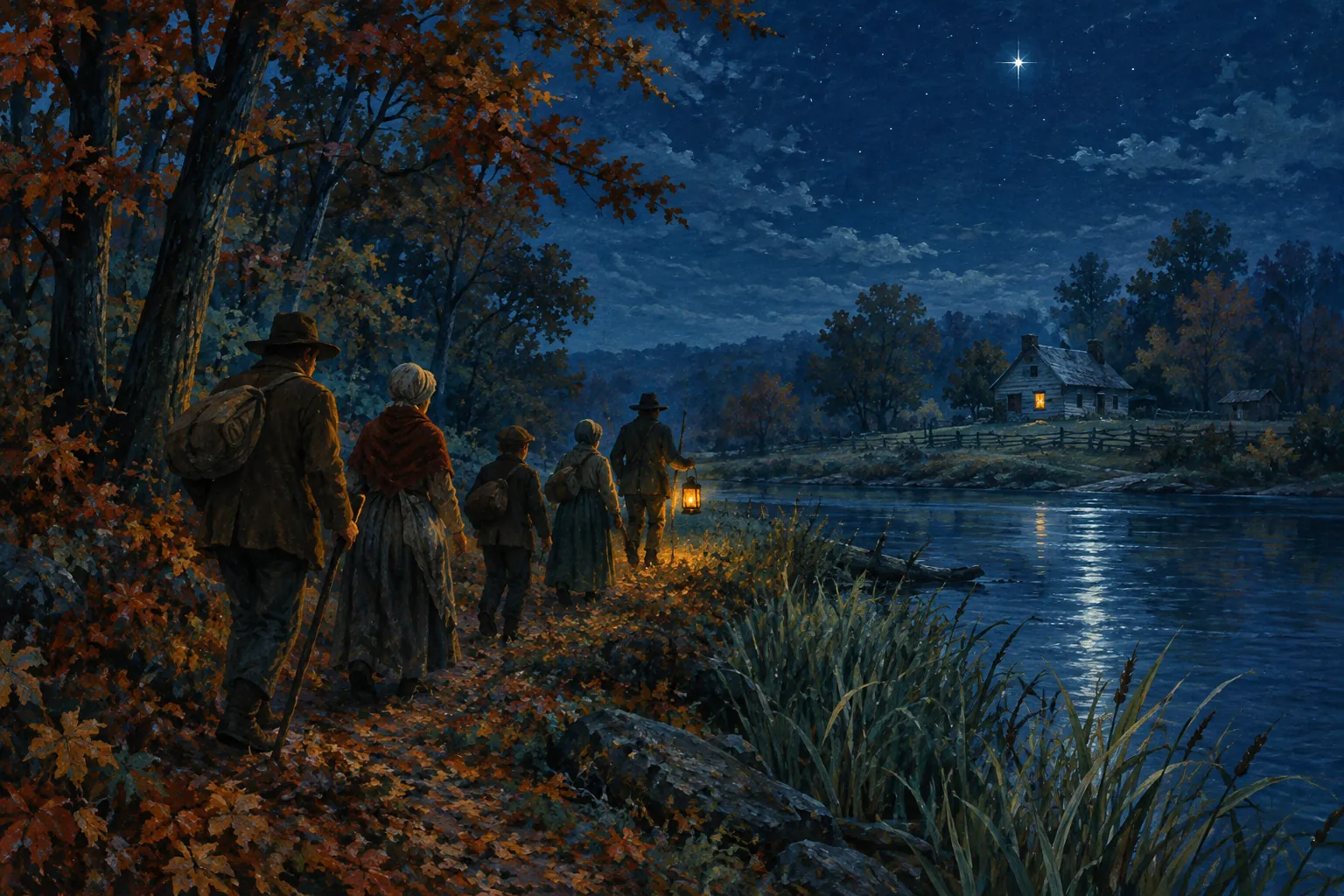
By 1838 Douglass was back in Baltimore, working as a ship caulker. On 3 September he escaped north. He wore a sailor's clothes and carried papers lent by a free Black seaman. He travelled by train, ferry and steamboat to Philadelphia and then on to New York, a journey of about a day.
In New York he was joined by Anna Murray, a free Black woman from Baltimore who had helped pay for his escape. They married and settled in New Bedford, Massachusetts. To avoid slave catchers he dropped the name Bailey and chose Douglass, a name taken from a character in a poem by Walter Scott.
Becoming the voice of abolition
In 1841 Douglass stood up at an anti-slavery meeting on Nantucket and spoke about his life. The audience was so moved that William Lloyd Garrison's Massachusetts Anti-Slavery Society hired him as a lecturer. Many Northerners had never heard a man who had been enslaved speak with such skill. Some even doubted that he could really have been a slave.
His answer was a book. Narrative of the Life of Frederick Douglass, an American Slave appeared in 1845 and named the places, the people and the slaveholders. It was a bestseller. It also made him a target for recapture, so he travelled to Britain and Ireland from 1845 to 1847, giving speeches to large crowds. While he was there, British supporters raised about 150 pounds to buy his legal freedom from Hugh Auld, which was completed in 1846.
The North Star and a changing view
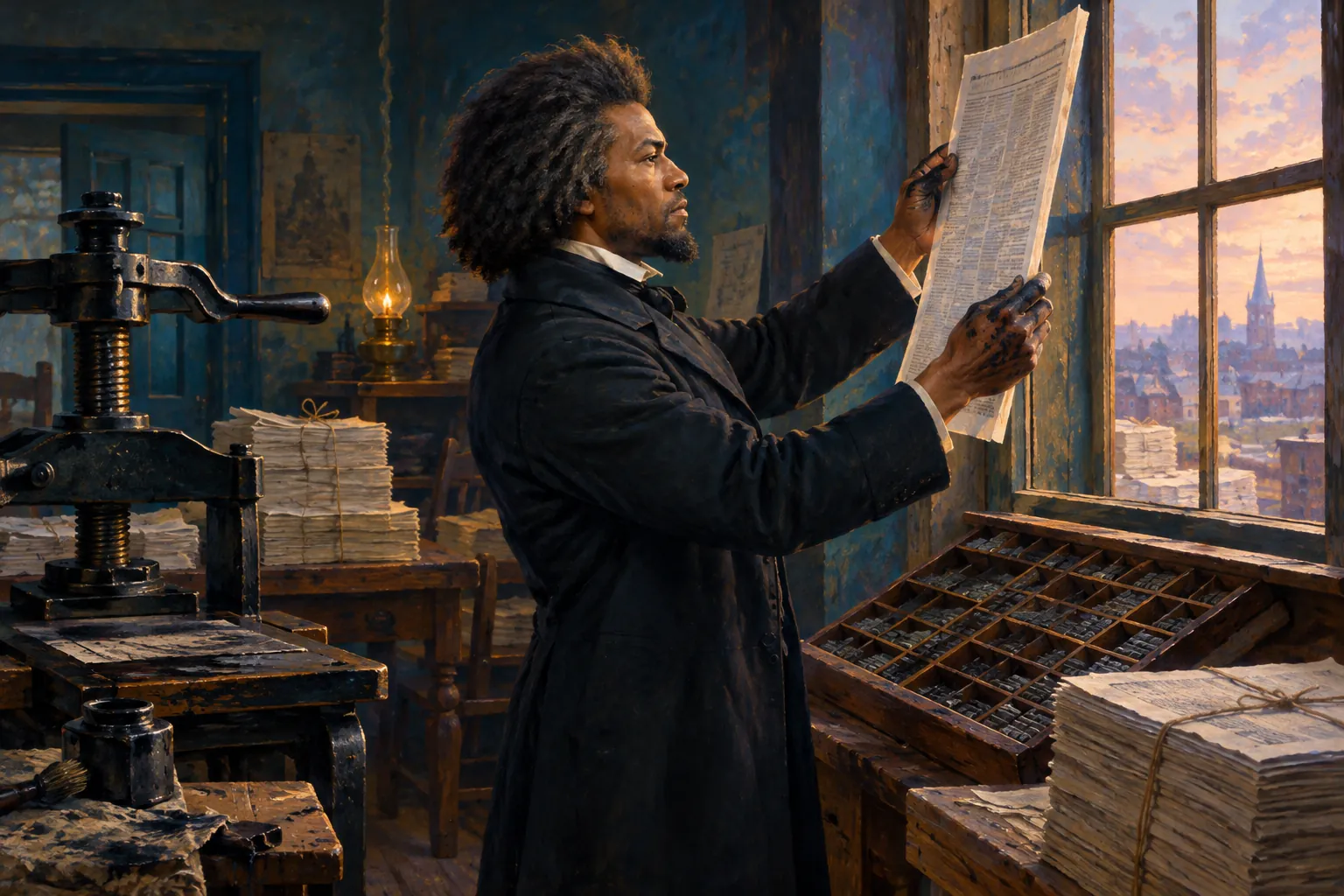
Back in the United States, Douglass settled in Rochester, New York, and in December 1847 began publishing a newspaper, The North Star. The name pointed to the star that guided people escaping north. The paper later became Frederick Douglass' Paper, and it gave him an independent platform.
That independence led to a break with Garrison. Garrison called the Constitution a pro-slavery document and wanted the North to leave the Union. Douglass came to the opposite view: the Constitution could be read as an anti-slavery text, and the right path was to win elections and change the law. In 1848 he also attended the Seneca Falls Convention, the first women's rights convention in the United States, and spoke in favour of a resolution for women's right to vote.
"What to the Slave Is the Fourth of July?"
On 5 July 1852 in Rochester, Douglass gave the most famous speech of his career. Invited to speak at a public Independence Day event, he asked what the holiday meant to enslaved people. His answer was blunt: a day of celebration for the nation was a day of injustice for them. He pointed to the Fugitive Slave Act of 1850, which required Northern officials to help return people who had escaped.
Yet the speech did not end in despair. He praised the ideals of the Declaration of Independence and said he still had hope that the nation would live up to them. That mix of anger and faith runs through almost everything he wrote.
The Civil War and Abraham Lincoln
In 1859 Douglass met the radical abolitionist John Brown, who asked him to join a planned raid on the federal arsenal at Harpers Ferry. Douglass refused, thinking it would fail. After the raid, he left the country briefly because he feared being arrested.
When the Civil War began in 1861, Douglass argued that the war had to become a war to end slavery. He urged the government to accept Black men as soldiers. When the Emancipation Proclamation took effect on 1 January 1863, it allowed Black men to enlist, and Douglass travelled the North recruiting for regiments such as the 54th Massachusetts. Two of his sons, Lewis and Charles, served in the army.
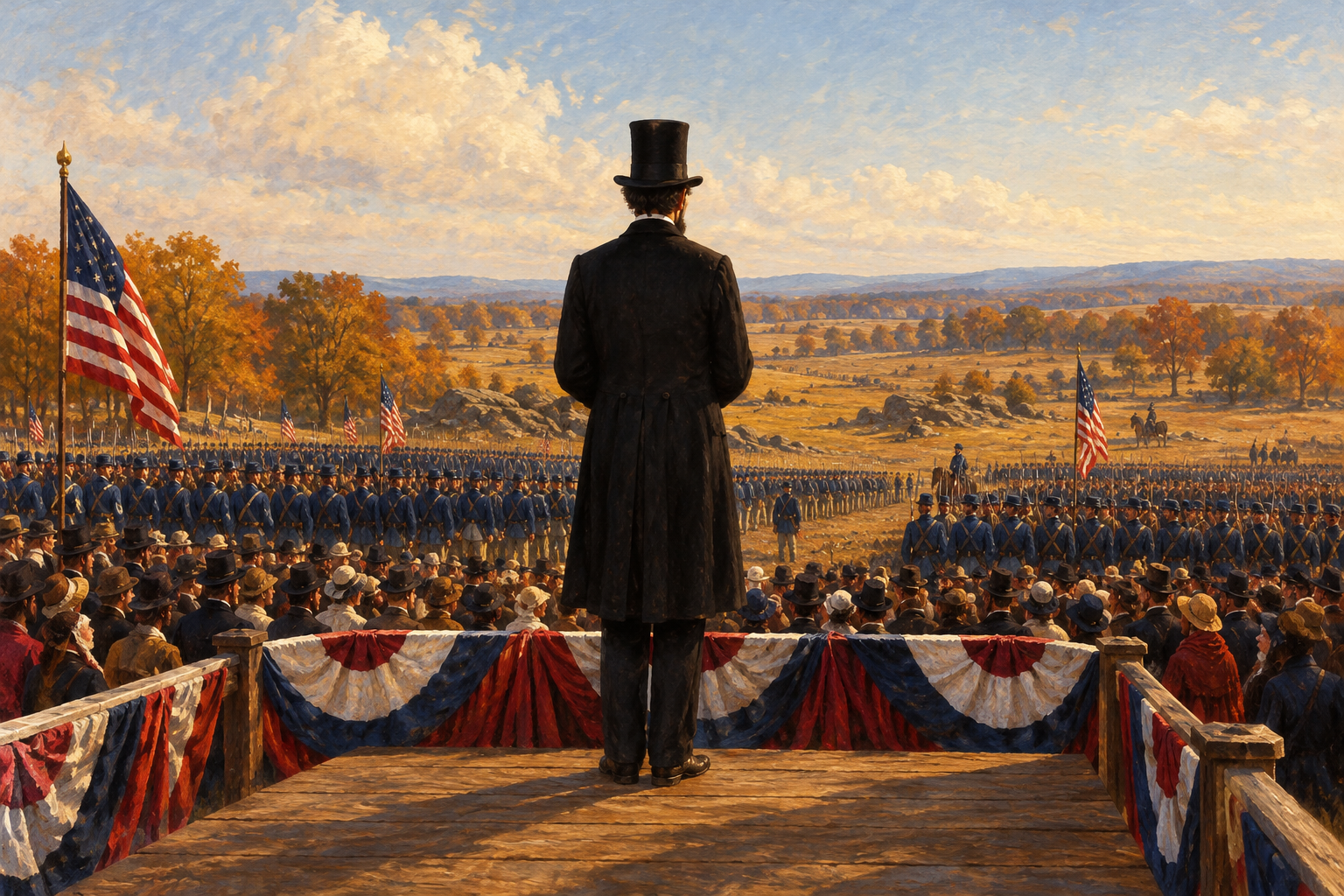
He also pushed for fair treatment. Black soldiers were first paid less than white soldiers, and Douglass complained about it directly to Lincoln at the White House in 1863. They met again in August 1864, when Lincoln asked for his advice on how to help more enslaved people reach Union lines. After Lincoln's second inauguration in March 1865, Douglass attended the White House reception, and Lincoln welcomed him and asked what he thought of the address. You can read more about the president in Who Was Abraham Lincoln?.
Reconstruction and later life
After the war, the 13th Amendment (1865) ended slavery, the 14th (1868) defined citizenship, and the 15th (1870) barred states from denying the vote on the basis of race. Douglass strongly backed the 15th Amendment. That put him at odds with former allies such as Elizabeth Cady Stanton and Susan B. Anthony, who objected that it did not include women. The disagreement split the suffrage movement for years.
He held several public posts, including U.S. Marshal for the District of Columbia (1877), Recorder of Deeds for the District (1881) and U.S. Minister to Haiti (1889–1891). In 1872 the Equal Rights Party named him as its vice-presidential candidate without asking him. He published his last autobiography, Life and Times of Frederick Douglass, in 1881. His first wife, Anna, died in 1882; in 1884 he married Helen Pitts, a white women's rights activist, which drew harsh criticism from some people.
In his final years he lived at Cedar Hill in Washington, D.C., and spoke out against lynching and for equal rights as Reconstruction collapsed. Douglass died on 20 February 1895 at home, after attending a meeting of the National Council of Women. He was buried in Rochester, New York.
Why he matters
Douglass showed that the testimony of one person who had lived under slavery could change the argument. He was also among the most photographed Americans of his century, and he used the new medium deliberately, to present Black Americans as dignified citizens. His speeches and writing are still read in schools, and his home at Cedar Hill is now a national historic site.
What exams ask
Courses on American history often return to a few points. First, Douglass is a standard example of a former slave who became an abolitionist leader, and his Narrative belongs to the genre of slave narratives. Second, know the difference between Garrison's view of the Constitution and Douglass's. Third, he linked abolition and women's rights at Seneca Falls, then disagreed with Stanton and Anthony over the 15th Amendment. Fourth, he pressed Lincoln to enlist Black soldiers, and the 54th Massachusetts is the regiment most often tied to that push. Be ready to explain how the 13th, 14th and 15th Amendments fit together.
Read next
- 19th-Century America: Expansion, Civil War and the Gilded Age: the big picture of the decades Douglass lived through.
- Who Was Abraham Lincoln?: the president Douglass pressed, criticised and finally admired.
- The American Civil War (1861–1865): the war that turned his argument into law.