Part of: 19th-Century America: Expansion, Civil War and the Gilded Age
In five minutes: Andrew Jackson
Andrew Jackson was the seventh president of the United States and the first to come from the frontier rather than from the Virginia or Massachusetts elite. He won fame as a general, then won the White House in 1828 on a promise to speak for ordinary voters. His years in office (1829–1837) are the core of what historians call Jacksonian democracy: more white men voting, a stronger presidency, and a party built to win elections.
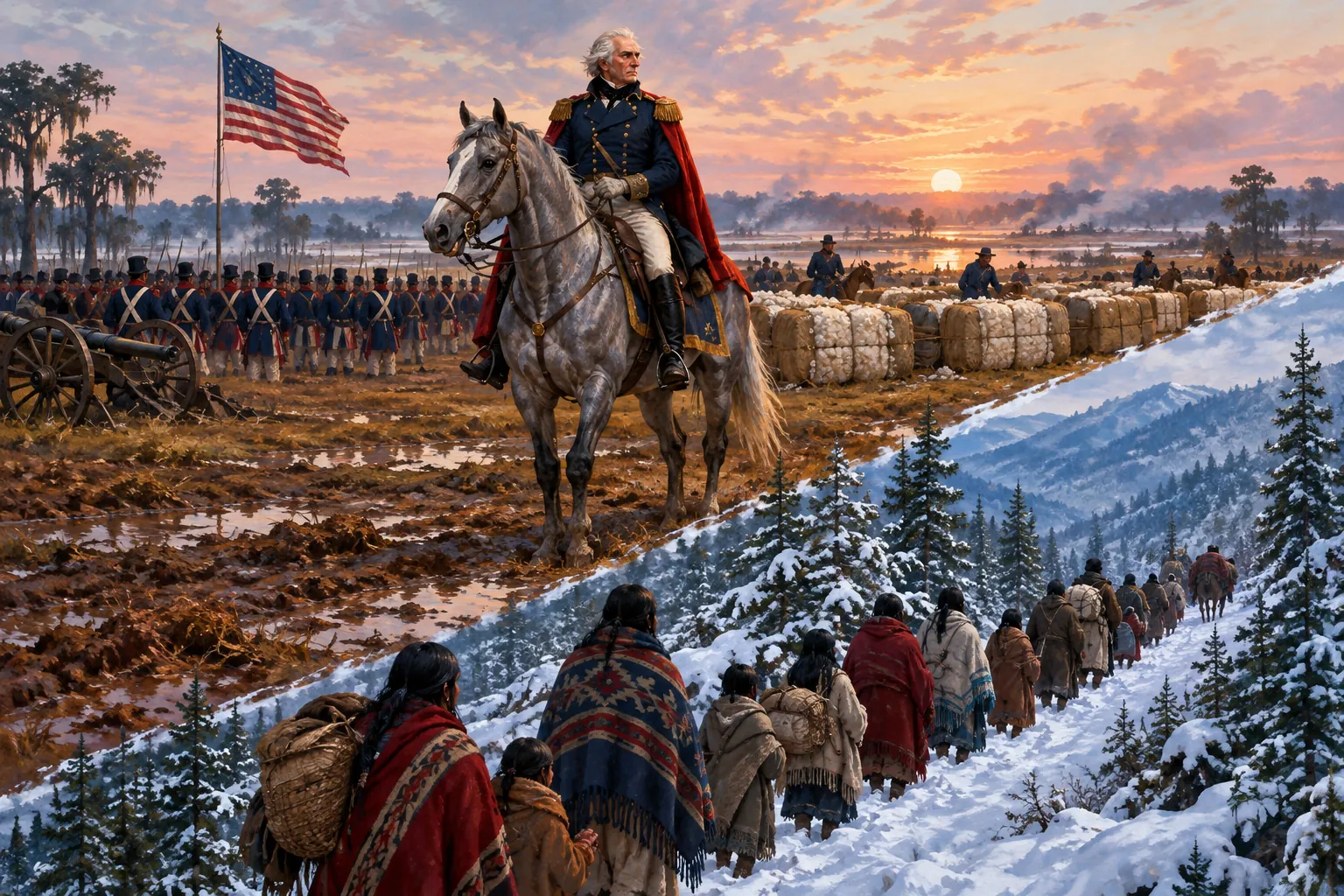
That democracy had hard limits. It was designed for white men. Jackson owned enslaved people, and in 1830 he signed the Indian Removal Act, the law behind the forced movement of tens of thousands of Native Americans out of the Southeast. To understand Jackson, you have to hold both facts at once: the expansion of political voice and the removal of people who were never given one.
Early life and the road to fame
Jackson was born on 15 March 1767 in the Waxhaws, a frontier region on the border of North and South Carolina. His father died before he was born, and during the Revolutionary War he lost his brothers and his mother. At 13 he was captured by British troops and slashed with a sword after refusing to clean an officer's boots, leaving a scar and a lasting hatred of Britain.
He studied law, moved west to Tennessee, and became a prosecutor, a judge, a congressman, a senator and a major general of the state militia. In the Creek War he led a force that crushed Creek fighters at Horseshoe Bend on 27 March 1814, and the Treaty of Fort Jackson that followed took about 20 million acres from the Creek, including from Creek bands who had fought on his side. On 8 January 1815 his army beat a British attack at New Orleans. The peace treaty had already been signed in Europe, but news travelled slowly, and the victory made Jackson a national hero nicknamed “Old Hickory”. In 1818 he invaded Spanish Florida in the First Seminole War, which helped push Spain to sell the territory in the Adams–Onís Treaty.
The elections of 1824 and 1828
In 1824 Jackson won more popular and electoral votes than any of his three rivals, but no one had a majority of electors. The House of Representatives chose John Quincy Adams. When Adams then named Henry Clay, who had helped him win, as secretary of state, Jackson's supporters cried “corrupt bargain”. They spent four years turning that anger into a national organisation.
The 1828 campaign was loud, personal and heavily organised, with newspapers, rallies and local committees. Jackson won clearly. About 1.1 million men voted, compared with roughly 360,000 in 1824, partly because more states had dropped property requirements for white male voters and partly because the contest felt like a real choice. Jackson's wife Rachel died in December 1828, before he took office on 4 March 1829, and he blamed his enemies' attacks on her for her death.
What Jacksonian democracy meant
Jacksonian democracy is not one law. It is a set of changes and beliefs that grew in the 1820s and 1830s:
- More voters. Most states ended property tests for white men. Voting rights were narrowed for free Black men in several states, and women could not vote anywhere.
- A strong, popular presidency. Jackson said the president, elected by the whole people, spoke for them more directly than Congress. He used the veto far more than earlier presidents.
- The spoils system. He replaced many federal officeholders with loyal supporters, arguing that government jobs should rotate. Critics said it rewarded loyalty over skill.
- A party machine. His allies, led by Martin Van Buren, built what became the Democratic Party. His opponents, who called him “King Andrew”, formed the Whig Party.
- Hostility to privilege. Jackson cast himself as the defender of farmers and workers against banks and monopolies.
The Bank War
The Second Bank of the United States held federal money and issued much of the country's paper currency. Jackson saw it as a private institution with too much power over ordinary people. In July 1832 he vetoed the bill to renew its charter, and his veto message argued that the government should not hand special advantages to the rich. Later that year he beat Henry Clay and won re-election.
In 1833 he ordered federal deposits moved to selected state banks, which critics called “pet banks”. The Senate formally censured him in 1834, though the vote was later expunged. In 1836 the Specie Circular required gold or silver for public land purchases. A boom turned into the Panic of 1837, just after Jackson left office, and the economic damage fell on his successor, Van Buren.
The nullification crisis
South Carolina leaders, guided by John C. Calhoun, claimed that a state could declare a federal law void. Their target was the high tariff of 1828, called the “Tariff of Abominations” in the South, and its 1832 successor. In November 1832 a South Carolina convention passed an Ordinance of Nullification. Jackson answered in December with a proclamation that the Union was perpetual and nullification was treason in practice, and Congress passed the Force Bill in 1833 allowing the use of troops. At the same time Clay brought a compromise tariff that lowered rates over several years. South Carolina backed down. The crisis ended, but it left an open question about state power that returned in 1861.
Indian removal and the Trail of Tears
Jackson had long believed that Native nations in the Southeast, the Cherokee, Choctaw, Chickasaw, Creek and Seminole, could not remain inside the states. Georgia, Alabama and Mississippi were pressing to take their land, and white settlers wanted it for cotton farming. The Indian Removal Act, signed on 28 May 1830, let the president offer land west of the Mississippi in exchange for land in the East. It said exchanges should be voluntary, but in practice pressure, fraud and threats of state law left little choice.
The Choctaw signed the Treaty of Dancing Rabbit Creek in 1830 and were the first to be moved, in terrible winter conditions. The Cherokee fought in court. In Worcester v. Georgia (1832), the Supreme Court under John Marshall ruled that Georgia had no authority over Cherokee land. Jackson did not enforce the decision, and Georgia carried on. In 1835 a small Cherokee faction signed the Treaty of New Echota; most Cherokee, led by Principal Chief John Ross, rejected it as illegitimate. The Senate approved it in 1836 by a single vote.
Jackson had left office by the time of the forced march. In 1838, under Van Buren, troops commanded by General Winfield Scott rounded up about 16,000 Cherokee and sent them west through the winter of 1838–39. Historians estimate that around 4,000 died of cold, hunger and disease. This is the event remembered as the Trail of Tears, although the same name is also used for the removal of other nations. The policy that made it possible was Jackson's.
Slavery and the limits of Jacksonian democracy
Jackson owned enslaved people on his Tennessee plantation, the Hermitage, where well over a hundred were held by the end of his life. His administration backed the interests of slaveholders, and in 1835 it supported efforts to stop abolitionist mail from being delivered in the South. For women, free Black Americans and Native Americans, the democracy of the Jackson years offered little or nothing. That is why many historians now describe the era as one of both expansion and exclusion.
Legacy
Jackson left office in March 1837 and died at the Hermitage on 8 June 1845. He survived an assassination attempt on 30 January 1835, when both pistols fired by Richard Lawrence misfired. He strengthened the presidency, helped create modern party politics and held the Union together in 1832–33. He also set a pattern of removing Native peoples by force. Both parts of that record are now taught side by side.
What exams ask
- Define Jacksonian democracy and explain why it is both an expansion and a limit on democracy.
- Explain the causes of the “corrupt bargain” charge in 1824 and why Jackson won in 1828.
- Describe the Bank War and its link to the Panic of 1837.
- Compare the nullification crisis with later sectional conflict.
- Evaluate the Indian Removal Act and the Cherokee response (Worcester v. Georgia, New Echota, the Trail of Tears).
Read next
- 19th-Century America: Expansion, Civil War and the Gilded Age: the big picture that puts Jackson's presidency in order.
- Who Was Abraham Lincoln?: a very different president who inherited the questions about the Union that Jackson faced in 1832.
- The American Civil War (1861–1865): the conflict over state power and slavery that nullification foreshadowed.