Leo Tolstoy in five minutes
Leo Tolstoy (1828–1910) was a Russian count who became one of the most widely read novelists in the world. He is best known for War and Peace, a huge novel about how Napoleon's invasion of Russia in 1812 changed the lives of a circle of noble families, and for Anna Karenina. He was born sixteen years after the invasion, so he never saw it. He rebuilt it from archives, memoirs and the stories of older relatives.
Late in life he turned away from literary fame and wrote about faith, nonviolence and the harm done by state power. That second career made him a moral voice in Russia and abroad, and it set him against both the Orthodox Church and the tsarist state. This page belongs to our guide to The Russian Empire (1721–1917).
Early life: a count in the countryside
Tolstoy was born on 9 September 1828 (28 August in the old Russian calendar) at Yasnaya Polyana, the family estate in Tula province, south of Moscow. Both of his parents died before he was ten, and relatives raised him. He entered Kazan University but left without a degree, then drifted through Moscow society and ran up gambling debts.
In 1851 he went to the Caucasus to join his brother in the army, and there he began to write seriously. His first book, Childhood, appeared in 1852. He later served in the Crimean War and was at the siege of Sevastopol in 1854–55. His Sevastopol Sketches described ordinary soldiers under fire without glory or speeches, a plain way of writing about war that he would use again in his great novel.
Why 1812 mattered: the background to the novel
By 1812 Napoleon had defeated Austria and Prussia. Russia and France had fallen out over trade restrictions against Britain (the Continental System) and over Poland. On 24 June 1812 the French Grande Armée crossed the Niemen river into Russian territory. It was a multinational force, usually estimated at several hundred thousand men.
The Russian armies pulled back rather than risk being destroyed, and Smolensk was badly damaged in August. General Mikhail Kutuzov took overall command. On 7 September the two sides fought at Borodino, a single day of fighting with total losses usually put at around 70,000 or more killed and wounded. Neither side won clearly, but the Russians withdrew and Napoleon entered Moscow in mid-September. Fires broke out in the city, and Tsar Alexander I refused to negotiate.
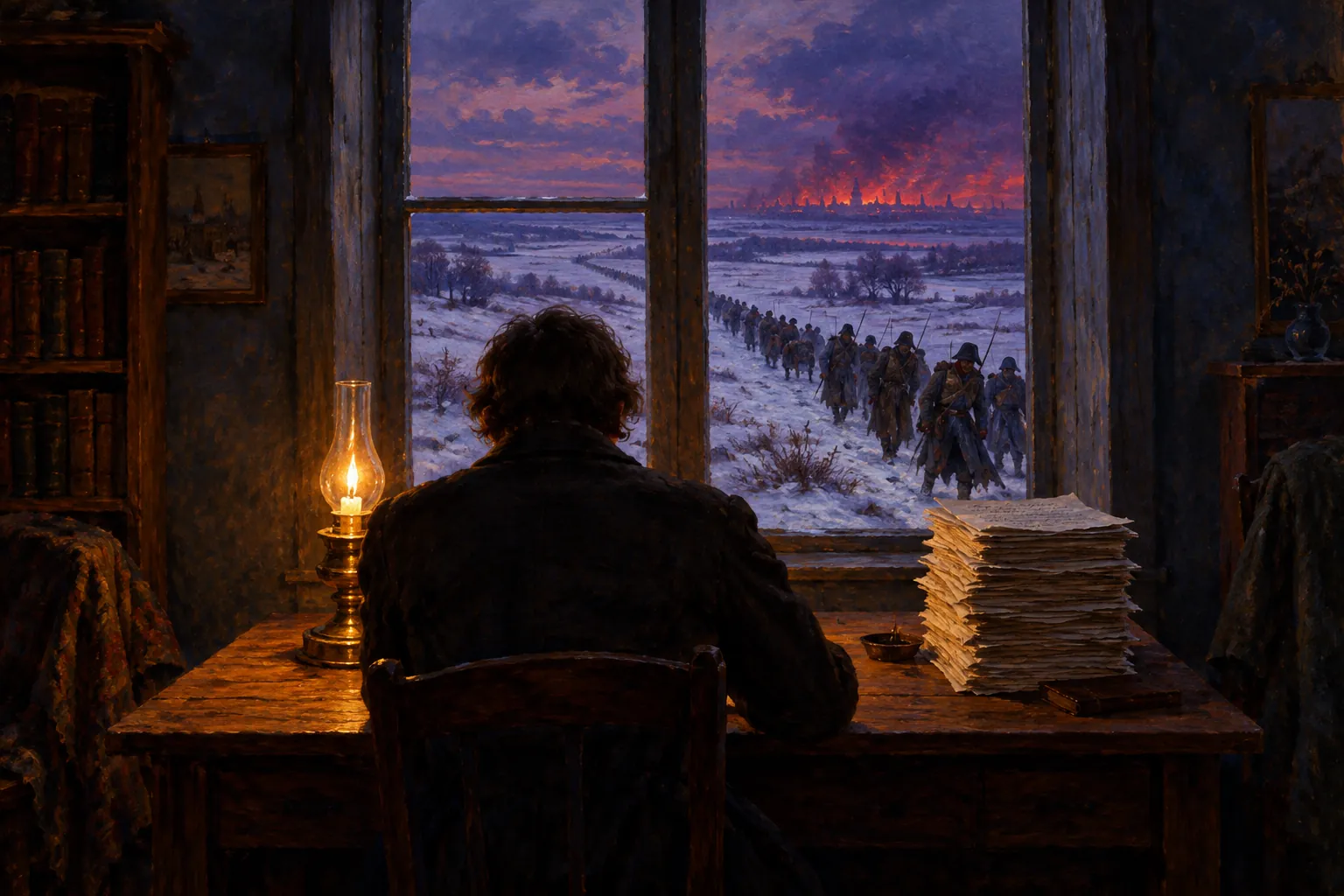
Napoleon left Moscow on 19 October. Cold, hunger and constant attacks broke up his army on the retreat, and only a fraction of the men who crossed in June made it back over the border by December. Russians call this the Patriotic War of 1812. It was the national memory that Tolstoy drew on.
How Tolstoy wrote War and Peace
Tolstoy began the work in the early 1860s, after he married Sophia Behrs in 1862 and settled at Yasnaya Polyana. He first planned a novel about a returning exile of the 1820s, then kept moving the story further back in time until it began in 1805. The first part appeared in the magazine The Russian Messenger in 1865 under the title 1805, and the complete novel was published in 1869.
He read memoirs, letters and official histories, talked with veterans and relatives, and visited the Borodino battlefield in 1867. Sophia copied out his drafts by hand, more than once. The result mixes invented people, such as Pierre Bezukhov, Prince Andrei Bolkonsky and Natasha Rostova, with real ones, such as Kutuzov, Napoleon and Alexander I. In all, the book has hundreds of named characters.
What the book argues
War and Peace is not only a war story. Half of it takes place at balls, hunts, family dinners and country houses, and it follows its characters as they search for a way to live. Tolstoy also distrusted the idea that great men steer history. In his view, a battle is decided by thousands of small choices and moods that no commander can control. Napoleon appears as vain and out of touch, while Kutuzov looks wise because he waits and accepts how little he can command.
Tolstoy even said the book did not fit the usual labels of novel or chronicle. Some readers find the essays on history in the later chapters heavy going, while others see them as the key to the whole work.
Anna Karenina and the spiritual crisis
Anna Karenina was serialised from 1873 to 1877, and it made him even more famous. Yet in the late 1870s he fell into a deep crisis about the meaning of life. He described it in A Confession (written around 1879–82).
He came to a personal form of Christianity built on the Sermon on the Mount: do not return violence, live simply and reject the authority of church doctrine, private wealth and the military. People who followed these ideas were called Tolstoyans. He kept writing fiction, including Resurrection (1899), but he now judged art by its moral use. In 1901 the Holy Synod of the Russian Orthodox Church declared him excommunicated. In 1904 he wrote an essay against the Russo-Japanese War, and in 1909–1910 he exchanged letters with the young Mohandas Gandhi.
Last years and death
His wish to give up the rights to his works and his property caused painful conflict at home, especially with Sophia. In early November 1910 (late October in the old calendar), at the age of 82, he left Yasnaya Polyana secretly. He fell ill on the journey and died on 20 November 1910 (7 November in the old calendar) at the small railway station of Astapovo. Large crowds came to his funeral, and he was buried in the woods of his estate in a simple grave with no monument.
Legacy
In 1908 Lenin called Tolstoy the "mirror of the Russian revolution" because his writing reflected the anger of the peasantry, even though Tolstoy rejected violent revolt. His ideas about nonviolence travelled to India through Gandhi. In Japan, writers of the Shirakaba group in the early twentieth century were among those who read him closely. Today War and Peace is often named among the greatest novels ever written.
What exams ask
For AP-style questions, remember three points. First, Tolstoy is a leading figure of nineteenth-century Russian realism, alongside Dostoevsky and Turgenev. Second, War and Peace (1869) is set in the Napoleonic Wars and the 1812 invasion, and it questions the role of great leaders. Third, his later pacifism and his excommunication show tension between reform-minded thinkers and the Church and the autocracy. Be ready to link him to the emancipation of the serfs in 1861, which he lived through as a landowner.
Read next
- The Russian Empire (1721–1917): the long background to Tolstoy's world, from Peter the Great's successors to the last tsar.
- The Russian Revolution of 1917: what happened seven years after Tolstoy's death and why his writing was read as a warning.
- Who Was Rasputin?: another figure who stood between the church, the court and ordinary Russians.