Tchaikovsky in five minutes
Pyotr Ilyich Tchaikovsky (1840–1893) is the Russian composer most people mean when they say "Russian music". He wrote three of the best-loved ballets ever staged (Swan Lake, The Sleeping Beauty and The Nutcracker), six numbered symphonies, the opera Eugene Onegin, a famous piano concerto and a violin concerto, and the cannon-filled 1812 Overture. His music is tuneful, emotional and carefully built. That combination is why concert halls and theatres still fill for it more than a century after his death.
His story is also a story about Russia. He belonged to the first generation of Russians who could study music as a profession, and he spent his life balancing Western European craft against Russian song and feeling. This page belongs to the cluster on 19th-century art and culture, where Romanticism travels from Paris and Vienna to Moscow and St Petersburg.
Russian music before Tchaikovsky
For much of the 1700s and early 1800s, music in Russia meant church singing, folk song and imported Italian, French and German taste at court. There was no school where a Russian could train as a composer. Mikhail Glinka changed that mood. His operas A Life for the Tsar (1836) and Ruslan and Lyudmila (1842) showed that Russian stories and tunes could carry serious music, and later composers called him the father of the Russian school.
In 1859 the pianist Anton Rubinstein helped found the Russian Musical Society, and in 1862 he opened the St Petersburg Conservatory. His brother Nikolai opened the Moscow Conservatory in 1866. These two schools gave Russia trained professionals for the first time. Meanwhile a group of amateurs in St Petersburg, Mily Balakirev, César Cui, Modest Mussorgsky, Nikolai Rimsky-Korsakov and Alexander Borodin, known as "The Five" or the "Mighty Handful", argued that Russian music should grow from Russian folk song, not from German textbooks. Tchaikovsky stood between the two camps.
From law clerk to composer
Tchaikovsky was born on 7 May 1840 (25 April in the old Russian calendar) in Votkinsk, a mining town in the Urals, where his father managed an ironworks. His family chose a safe career for him. He studied at the Imperial School of Jurisprudence in St Petersburg and took a clerk's post at the Ministry of Justice in 1859. His mother had died of cholera in 1854, when he was fourteen, a loss that stayed with him all his life.
Music kept pulling at him. When the St Petersburg Conservatory opened in 1862, he enrolled, studying under Anton Rubinstein, and graduated in 1865. The next year Nikolai Rubinstein invited him to teach harmony at the new Moscow Conservatory. He wrote his First Symphony, "Winter Daydreams", in 1866, and in 1869 the fantasy-overture Romeo and Juliet, whose love theme is still one of the most recognisable melodies in classical music.
Tchaikovsky did not reject Russian folk music. His Second Symphony (1872) is built on Ukrainian songs, and Russian tunes appear in many of his works. What set him apart from The Five was his belief that a composer needed full professional technique, and that Russian material could be set in the large forms of Western music.
The great works
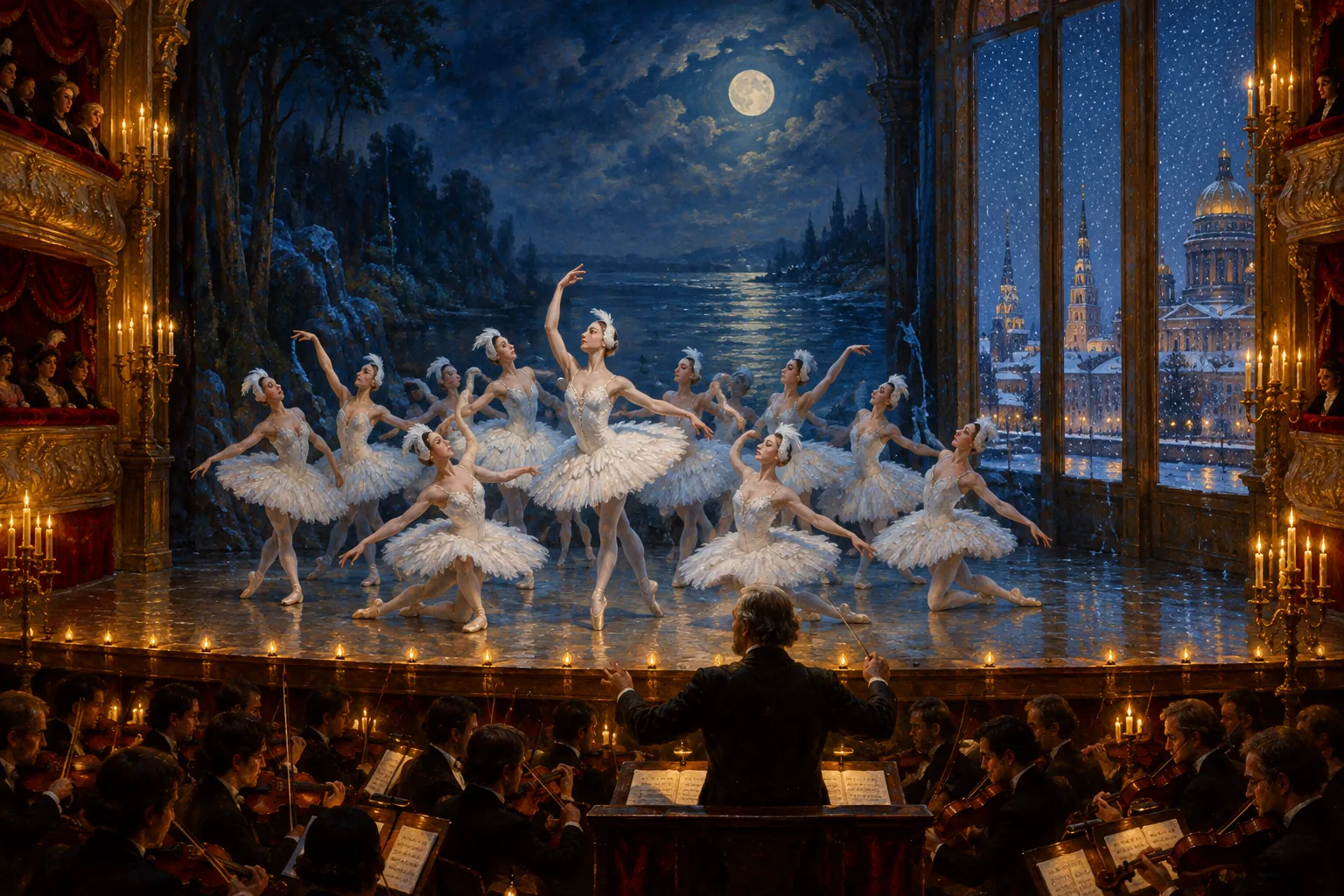
The First Piano Concerto (1874–75) opens with one of the most famous themes in the repertoire. Nikolai Rubinstein criticised it harshly, so Tchaikovsky dedicated it to the pianist Hans von Bülow, who gave the premiere in Boston in October 1875. Swan Lake, written in 1875–76, was first staged at the Bolshoi Theatre in Moscow in March 1877. The first production was not a success, and the ballet only became a classic after a new staging at the Mariinsky Theatre in 1895, two years after the composer's death.
The year 1877 was also a personal crisis. Tchaikovsky married a former student, Antonina Milyukova, and the marriage collapsed within weeks. That same year the wealthy widow Nadezhda von Meck began to support him with a regular allowance. They wrote hundreds of letters but, by agreement, almost never met. Her help let him leave teaching and compose full-time. He dedicated his Fourth Symphony to her without naming her.
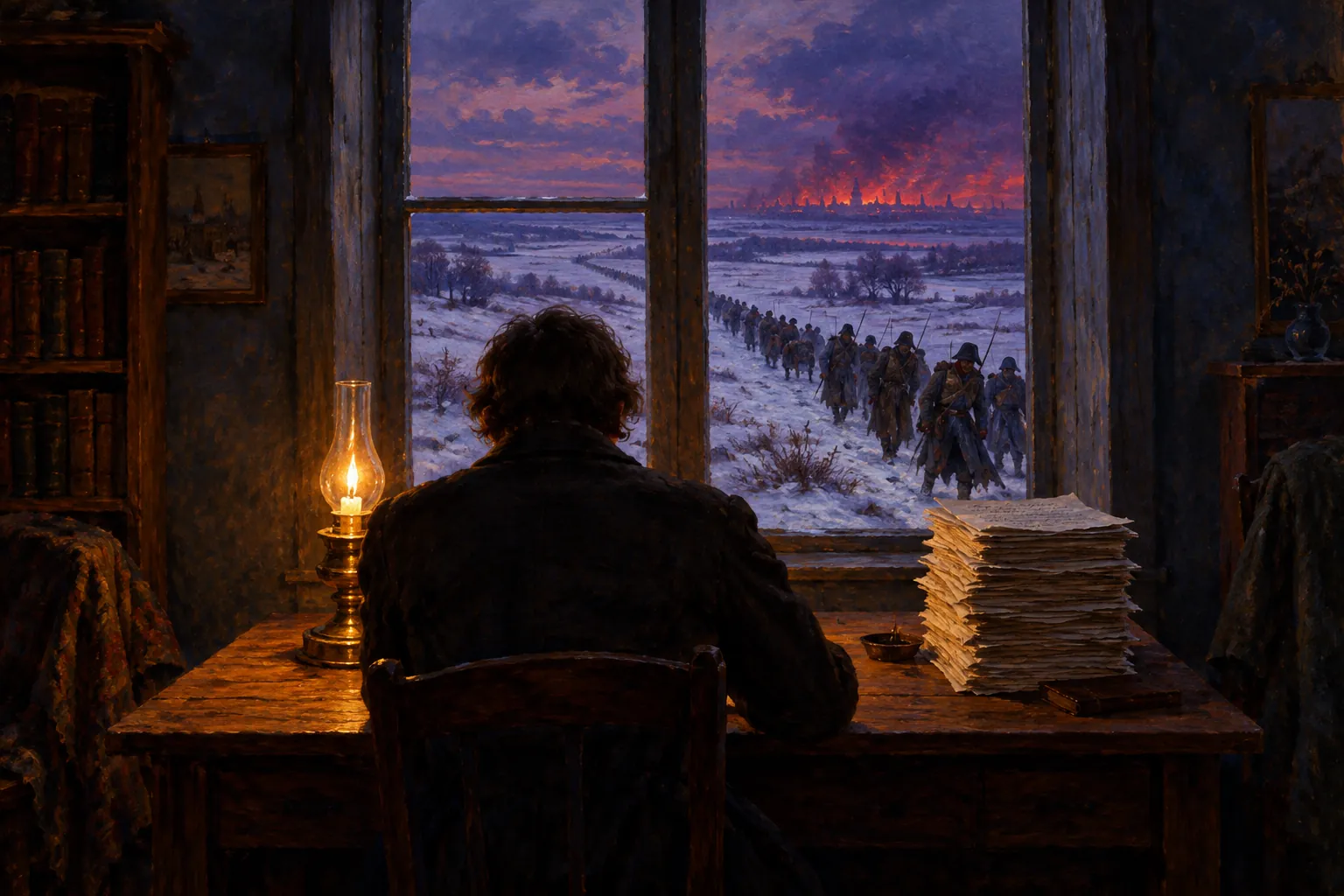
Soon after came the opera Eugene Onegin (1879), based on Alexander Pushkin's verse novel, and the Violin Concerto (1878), first performed in Vienna in 1881 by Adolf Brodsky. The 1812 Overture (1880) was written for a Moscow occasion linked to the Cathedral of Christ the Saviour, which marked Russia's defence against Napoleon in 1812. It was first played in 1882.
His last great period brought the ballets The Sleeping Beauty (January 1890) and The Nutcracker (December 1892) for the Mariinsky Theatre, working with the choreographer Marius Petipa and, for The Nutcracker, Lev Ivanov. In between came the opera The Queen of Spades (1890), also from Pushkin. By then he was famous abroad. He toured Europe as a conductor from 1888, and in May 1891 he conducted at the opening of Carnegie Hall in New York.
The Pathétique and his death
Tchaikovsky conducted the premiere of his Sixth Symphony, the "Pathétique", in St Petersburg on 28 October 1893 (new style). Its quiet, fading last movement was unusual for a symphony, which traditionally ended in triumph. He died in St Petersburg on 6 November 1893, nine days later, at the age of 53. The cause given at the time was cholera. He had received an honorary doctorate from Cambridge University only months before.
Why Tchaikovsky matters
Tchaikovsky showed that a Russian could stand beside Beethoven and Brahms in the concert hall. Later composers such as Rachmaninoff and Stravinsky grew up in a country whose music already had international standing, and Stravinsky openly admired him. Ballet changed as well: before Tchaikovsky, ballet music was mostly background for dancers, and after him a ballet score could be a major work of music in its own right.
His popularity has outlasted every change of fashion. The Nutcracker is staged around the world each December, and Swan Lake is a symbol of ballet itself. At the same time, the contrast between The Five and Tchaikovsky is still a handy way to understand how nineteenth-century Russia argued over its identity: should it learn from Europe, or build on its own roots? Tchaikovsky answered that it could do both.
What exams ask
- Dates and places: born 1840 in Votkinsk, died 1893 in St Petersburg; studied at the St Petersburg Conservatory (opened 1862) and taught at the Moscow Conservatory.
- Works to match with their form: Swan Lake, The Sleeping Beauty and The Nutcracker (ballets); Eugene Onegin and The Queen of Spades (operas); Symphony No. 6 "Pathétique" (symphony); 1812 Overture (concert overture).
- Significance: he combined Western European technique with Russian melody and is a central figure of Russian Romanticism. Contrast him with The Five, who favoured a more strictly nationalist approach.
- Context: the founding of the conservatories reflects the wider modernisation of Russian culture in the reign of Alexander II.
Read next
- 19th-Century Art and Culture: From Romanticism to the Belle Époque: the wider picture of how the arts changed across Europe in this century.
- Mozart: Music of the Enlightenment: the classical tradition that Tchaikovsky admired and borrowed from.
- Vincent van Gogh and Post-Impressionism: a contemporary painter who was working in France in the 1880s, as Tchaikovsky was becoming famous abroad.