Mozart in five minutes
Wolfgang Amadeus Mozart (1756–1791) was an Austrian composer who wrote masterpieces in almost every form of his day: symphonies, piano concertos, string quartets, church music and opera. He was a child prodigy who, in his mid-twenties, tried something unusual. Instead of serving one court or one church for life, he settled in Vienna and made a living from concerts, commissions, publishing and teaching.
His music belongs to the Classical style, which prized clarity, balance and melodies that sing. It also belongs to the Enlightenment, the eighteenth-century movement that put reason, fairness and public debate at the centre of thinking. Mozart's best-known operas put servants, townspeople and questions about power on stage. He died in Vienna at 35, leaving the Requiem unfinished. If you want the wider story of how art changed in the following century, the hub page 19th-Century Art and Culture: From Romanticism to the Belle Époque picks up where Mozart's world ends.
A child prodigy in Salzburg
Mozart was born on 27 January 1756 in Salzburg, then the capital of a small church-ruled state within the Holy Roman Empire. His father, Leopold, was a violinist in the court orchestra and the author of a well-known violin teaching book published the year his son was born. His sister Maria Anna, nicknamed Nannerl, was five years older and also a gifted keyboard player.
Leopold taught both children and soon saw that his son was exceptional. Mozart played the keyboard and violin as a small child and began composing at about five. From 1762 Leopold took the children on tours. They played for the imperial family in Vienna, then travelled through Germany to Paris and London between 1763 and 1766. In London the young Mozart met Johann Christian Bach, a son of J. S. Bach, whose graceful style left a mark on him, and he wrote his first symphonies there.
Between 1769 and 1773 Mozart made three journeys to Italy, the home of opera. In Milan in 1770, aged 14, he produced the opera Mitridate, re di Ponto. These trips taught him the Italian way of writing for singers, which he would later blend with German and Austrian instrumental traditions.
Breaking away from Salzburg
Back in Salzburg, Mozart worked in the court orchestra. From 1772 his employer was Prince-Archbishop Hieronymus Colloredo, who expected strict service and had little interest in a restless young composer. Mozart wanted a post in a larger city and a stage for opera. A long job-hunting trip to Mannheim and Paris in 1777–78 brought no permanent position, and his mother died in Paris during it.
The turning point came in 1781. After the premiere of his opera Idomeneo in Munich, Mozart was summoned to Vienna with the archbishop's party. He quarrelled with Colloredo, and the break became final that summer. Mozart stayed in Vienna. It was a risky choice, because almost every musician of the time depended on a fixed post with a salary.
Vienna and the freelance life
The Vienna of the 1780s was the capital of Emperor Joseph II, who ruled as sole monarch from 1780 to 1790. Joseph is often described as an enlightened despot: a ruler who used absolute power to push through reforms inspired by Enlightenment thinking. His Edict of Tolerance in 1781 gave more rights to Protestants and Jews, and his government loosened censorship in some areas and tightened it in others. He also wanted opera in German, not only Italian. Mozart's Die Entführung aus dem Serail (The Abduction from the Seraglio), premiered on 16 July 1782, answered that wish and was a hit.
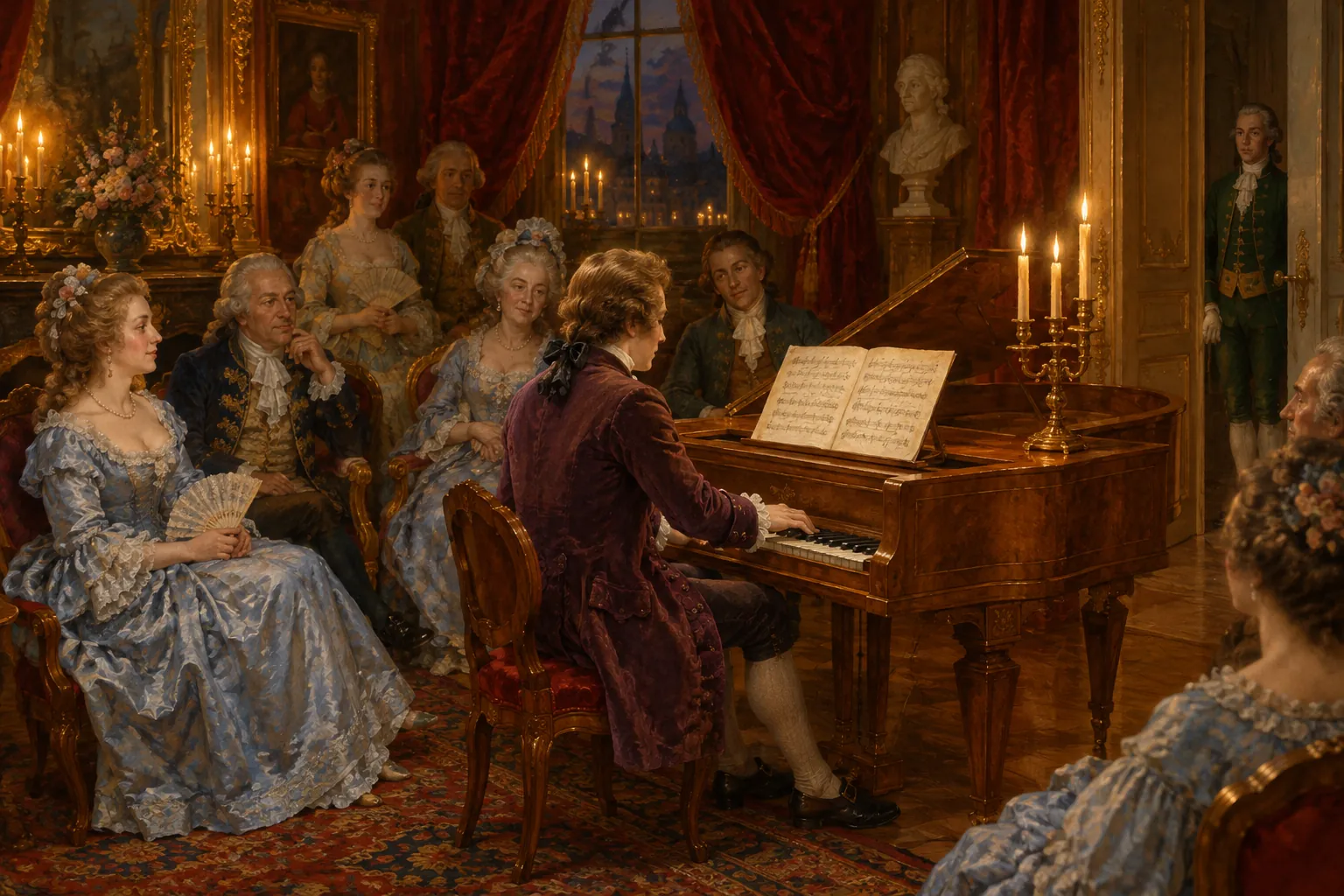
On 4 August 1782 Mozart married Constanze Weber. In the mid-1780s he was at the peak of his Vienna success. He performed his own piano concertos at subscription concerts, writing a remarkable series in 1784–86 for himself as soloist. He sold music, taught pupils and wrote on commission. He earned well in these years, but he also spent heavily and later borrowed money from friends.
He became close to Joseph Haydn, the other great figure of the Classical style, and dedicated six string quartets to him in 1785. Mozart also joined the Freemasons in December 1784. Freemasonry, with its lodges that valued reason, brotherhood and moral improvement, was part of Enlightenment social life in Vienna.
Music and the Enlightenment
It would be too simple to say that music "was" the Enlightenment. But Mozart's world and his art connect in clear ways.
- The audience widened. Concerts, printed music and public theatres created a market beyond the court. Mozart's career is one of the first major examples of a composer using that market.
- The style valued clarity. Classical music favours balanced phrases, clear structure and natural-sounding melody, in the same spirit as the Enlightenment's love of order and reason.
- Ordinary people became subjects. Opera had long been about gods, kings and heroes. Mozart gave rich music to maids, valets, birdcatchers and peasants.
- Ideas were tested on stage. Questions about justice, class and forgiveness run through his later operas.
The great operas
Le nozze di Figaro (The Marriage of Figaro) premiered in Vienna on 1 May 1786, with a libretto by Lorenzo da Ponte. It was based on a play by Pierre Beaumarchais that had been banned in Vienna because it mocked aristocratic privilege. Da Ponte softened the most openly political speeches. Even so, the story is clear: a count tries to take advantage of his servant's bride, and the servants outwit him. The music treats Figaro and Susanna with as much warmth and wit as it gives the count.
Don Giovanni, again with da Ponte, premiered in Prague on 29 October 1787. It mixes comedy and terror in the tale of a seducer who finally meets his punishment. Così fan tutte (1790) is a polished comedy about love and testing.
In 1791 came Die Zauberflöte (The Magic Flute), premiered on 30 September at a suburban theatre in Vienna with a German libretto by Emanuel Schikaneder. It combines fairy-tale comedy with themes of light over darkness, trials and wisdom, often linked to Masonic ideas. Audiences from ordinary Viennese to nobles could enjoy it, which suited the new, wider public.
Last years and the Requiem
In 1787 Mozart's father died, and Mozart was named a court chamber composer by Joseph II, a modest, part-time post. The late 1780s were harder. A war with the Ottoman Empire disrupted Viennese life, and concert income fell. In the summer of 1788 he completed his last three symphonies, Nos. 39, 40 and 41 (the "Jupiter"). Joseph II died in 1790, and the court's mood changed under his successor.
The final year was extremely productive. In 1791 Mozart wrote La clemenza di Tito for the coronation of Leopold II as King of Bohemia in Prague, completed The Magic Flute, composed the Clarinet Concerto and began a Requiem Mass commissioned anonymously by Count Franz von Walsegg. He fell ill and died in Vienna on 5 December 1791, aged 35. The Requiem was unfinished. Constanze had it completed, mainly by his pupil Franz Xaver Süssmayr, so that the commission could be delivered. The exact location of his grave is not known.
Why Mozart still matters
Mozart's catalogue is large. The Köchel catalogue, first published by Ludwig von Köchel in 1862, numbers his works up to K. 626, the Requiem. His music is still among the most performed in the world. Later composers, including Beethoven, built on the Classical language that Haydn and Mozart refined. Historically, he is a symbol of a musician moving from servant of a court to independent artist, a change that continued through the Romantic era.
What exams ask
In world history and AP-style questions, the usual significance points are these.
- Mozart is a leading figure of the Classical period, alongside Haydn and the young Beethoven, centred on Vienna.
- His career shows the shift from court and church patronage towards a public market for music.
- His operas, especially The Marriage of Figaro and The Magic Flute, are linked to Enlightenment themes of reason, equality before the law and criticism of privilege.
- He worked under Joseph II, an enlightened despot whose reforms came from above rather than from a popular revolution.
Read next
Mozart's age ended with the French Revolution and the rise of Romanticism. These pages follow the story of art forward:
- 19th-Century Art and Culture: From Romanticism to the Belle Époque: the overview of what came after Mozart's Classical era.
- What Is Impressionism?: how painters broke with tradition in the same spirit of independence.
- Vincent van Gogh and Post-Impressionism: another artist who worked outside the system and was valued only later.