Beethoven in five minutes
Ludwig van Beethoven (1770–1827) was a German composer who lived through the French Revolution, the Napoleonic Wars and the conservative order that followed, and who wrote music that sounds as if it were about all three. He left nine symphonies, 32 piano sonatas, 16 string quartets and one opera, and he kept composing after he lost almost all of his hearing. His central idea, that music could speak for human freedom and dignity, made him the model of the Romantic artist. He is one of the key figures in the wider story told in 19th-Century Art and Culture: From Romanticism to the Belle Époque.
Background: a court musician's son in Bonn
Beethoven was baptised in Bonn on 17 December 1770. His birthday is usually given as about 16 December, but no record of it survives. Bonn was the seat of the Elector of Cologne, one of the many states of the Holy Roman Empire. Beethoven's grandfather, also named Ludwig, had been the court's music director, and his father Johann sang in the court chapel. Johann hoped for a second Mozart and drilled the boy hard at the keyboard. The teacher who really shaped him was Christian Gottlob Neefe, the court organist, who taught him composition and introduced him to the keyboard music of Bach.
Bonn was a small town, but it was open to new ideas. Elector Maximilian Franz was the brother of the reforming emperor Joseph II and shared some of his Enlightenment outlook. The town's university opened in 1786, and Beethoven signed up to attend lectures in 1789, the year the Bastille fell. Young people around him read Schiller and Kant and followed the news from Paris closely. Schiller's poem "Ode to Joy" (1785), which Beethoven would set decades later, was already on his mind: in 1793 an acquaintance wrote that he planned to set it to music.
Vienna: from court servant to independent composer
In November 1792 Beethoven moved to Vienna for good. Count Waldstein, one of his Bonn patrons, wrote in his farewell note that he hoped Beethoven would receive Mozart's spirit from Haydn's hands. Beethoven studied with Haydn for a short time, then made his name as a pianist famous for improvising. In 1795 he published his first numbered works, the three piano trios of Opus 1.
Aristocrats such as Prince Karl Lichnowsky gave him rooms, money and an audience. Yet Beethoven was not anyone's servant. He sold pieces to publishers, gave public concerts for ticket money and accepted gifts from patrons without belonging to any of them. Haydn, by contrast, had spent decades employed by the Esterházy princes. The change was social as much as musical, and it matches the revolutionary-era argument that a person's worth should depend on talent, not birth.
Deafness and the Heiligenstadt Testament
From about 1798 Beethoven suffered from ringing in his ears and a growing loss of hearing. In October 1802, in the village of Heiligenstadt outside Vienna, he wrote a letter to his brothers Carl and Johann. He admitted his despair and even thoughts of ending his life, but wrote that his art held him back. The letter was never sent and was found after his death; it is now called the Heiligenstadt Testament. His hearing kept declining. From about 1818 he used conversation books, in which visitors wrote their side of a talk, and by the time of the Ninth Symphony he was almost completely deaf.
The Eroica and Napoleon
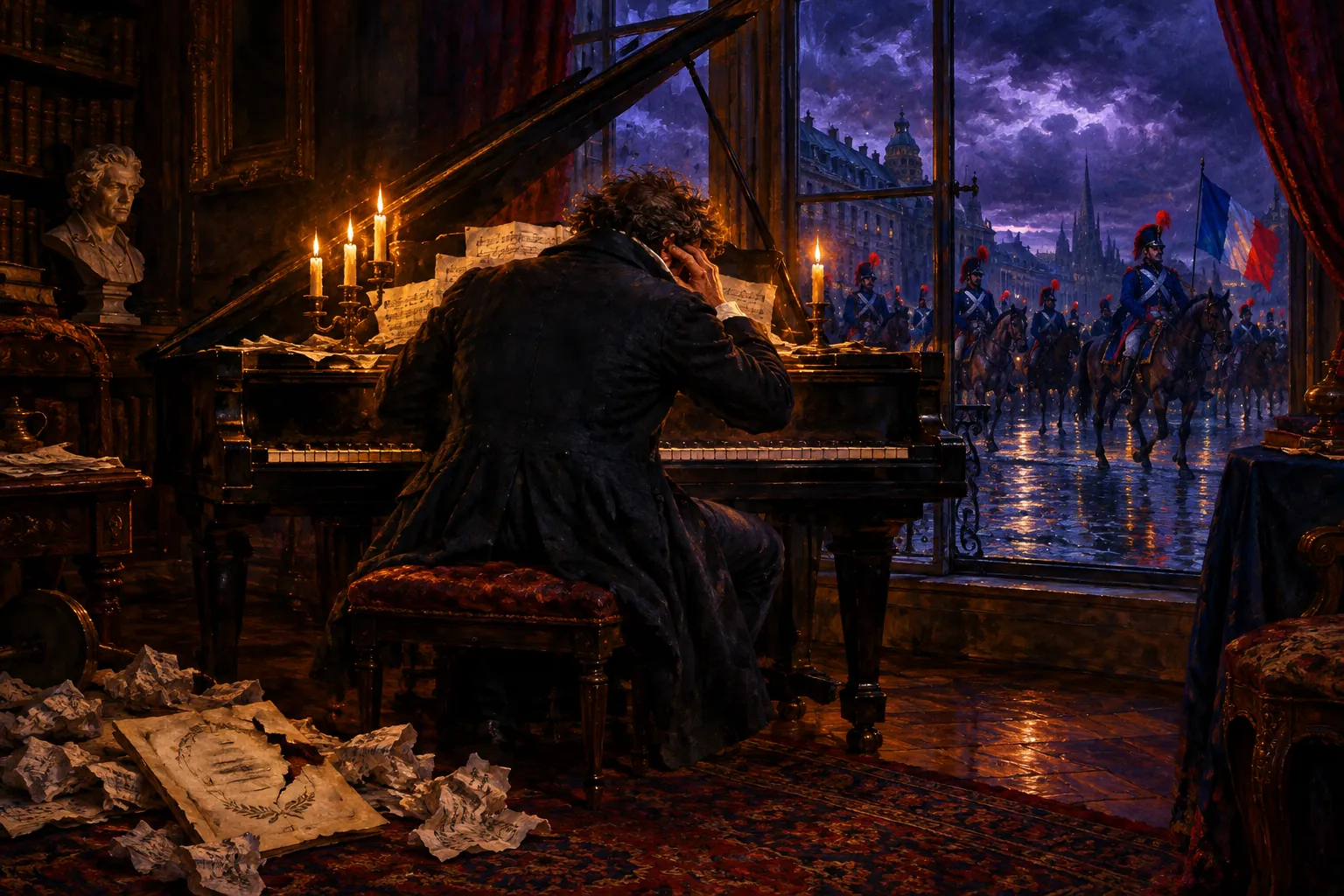
Between 1803 and 1804 Beethoven wrote his Third Symphony. It runs nearly 50 minutes, far longer than most symphonies of its day, and its second movement is a funeral march. At first he admired Napoleon Bonaparte as a leader who seemed to carry the Revolution's ideals forward. According to his pupil Ferdinand Ries, when news arrived in May 1804 that Napoleon had made himself emperor, Beethoven angrily ripped the dedication from the title page. A surviving copy of the score still shows where Napoleon's name was scraped out. When the music was published in 1806 it carried the title "Sinfonia eroica", composed to celebrate the memory of a great man. The first public performance took place on 7 April 1805 at the Theater an der Wien.
Fidelio and a city at war
Beethoven's only opera, Fidelio, is a rescue story. Leonore disguises herself as a young man called Fidelio to free her husband Florestan, a political prisoner. It is based on a French play by Jean-Nicolas Bouilly, and its message of freedom from tyranny fits the age exactly. It opened in November 1805, just days after French troops entered Vienna, to an audience made up largely of French officers. It failed, was reworked in 1806, and only succeeded in its final version of 1814.
The war was never far away. On 22 December 1808 Beethoven presented his Fifth and Sixth Symphonies in a concert lasting over four hours. In 1809 French guns bombarded Vienna, and he is said to have hidden in a cellar with pillows pressed over his ears. That year Napoleon's brother Jérôme, king of Westphalia, offered him a post in Kassel. To keep him in Vienna, three noble patrons, Archduke Rudolf, Prince Lobkowitz and Prince Kinsky, promised him a yearly income.
After Napoleon: the Congress of Vienna and censorship
When Napoleon fell, the rulers of Europe gathered in Vienna for the Congress of 1814–15. Beethoven was then at the peak of his public fame, thanks to the battle piece Wellington's Victory and his Seventh Symphony, both played to packed halls. But the order that followed was conservative. Prince Metternich's police watched for liberal ideas, and the Carlsbad Decrees of 1819 tightened press censorship. Beethoven's conversation books show how carefully people spoke about politics. In this atmosphere he wrote the Missa Solemnis and, in the end, the Ninth Symphony.
The Ninth Symphony and the Ode to Joy
The Ninth Symphony premiered on 7 May 1824 at the Kärntnertor Theatre in Vienna. Beethoven stood on stage beside the conductor, Michael Umlauf, helping to keep the tempos, though he could not hear the music. Accounts of the night say the singer Caroline Unger gently turned him around so that he could see the audience applauding. The finale was the first time a major symphony added solo singers and a chorus. They sing words from Schiller's "Ode to Joy", after Beethoven's own opening lines, which reject the earlier sounds of the symphony in favour of something more joyful. Its core idea is that all people can become brothers.
The melody went on to have a political life of its own. In 1972 the Council of Europe adopted it as its anthem, and the European Community leaders adopted it in 1985; it became the anthem of the European Union. In Japan, German prisoners of war performed the symphony at the Bando camp in Tokushima on 1 June 1918. The work is now played at countless year-end concerts across the country.
Death and legacy
Beethoven died in Vienna on 26 March 1827, aged 56. His funeral three days later drew a very large crowd, and the young Franz Schubert was among the torchbearers. Later composers lived in his shadow: Brahms spent over a decade on his first symphony, partly because the Ninth set such a high standard. Beethoven also changed how people think about music itself. The idea of the composer as a creative genius, and the habit of listening to great works again and again in the concert hall, owe much to him.
What exams ask
- Transition: Beethoven bridges the Classical style of Haydn and Mozart and the emotional, personal style of Romanticism.
- Role of the artist: his career shows the move from court patronage to publishers, public concerts and independent artists.
- Politics and art: the Eroica and the dedication to Napoleon is the standard example of how the Revolution shaped culture; Fidelio carries the theme of freedom from tyranny.
- Symbol: the Ninth Symphony and its Ode to Joy became a symbol of universal brotherhood and later of European unity.
- Typical question: explain how Beethoven's work and career reflect the Enlightenment and the French Revolution.
Read next
- 19th-Century Art and Culture: From Romanticism to the Belle Époque: the full picture of how art changed after the revolutions.
- Mozart: Music of the Enlightenment: the generation before Beethoven, and the musician he was often compared with.
- Vincent van Gogh and Post-Impressionism: another artist who made personal feeling the heart of his work, later in the same century.