In five minutes: Benjamin Franklin
Benjamin Franklin (1706–1790) was a printer from Boston who became the best-known American of his age. He is remembered for three things. He showed through experiments that lightning is electricity and popularised the lightning rod. He built the practical machinery of a city: a lending library, a fire company, a hospital and a school that grew into the University of Pennsylvania. And as a diplomat he won the French alliance without which the American Revolution might well have failed.
He signed the Declaration of Independence, the 1778 treaty with France, the 1783 Treaty of Paris and the Constitution, and he is often described as the only Founder to sign all four. He was never president. His story is part of the wider history of the American Revolution, and the quickest way to understand him is to see a man who kept asking, “How could this work better?” and then built the answer.
Early life: from Boston to Philadelphia
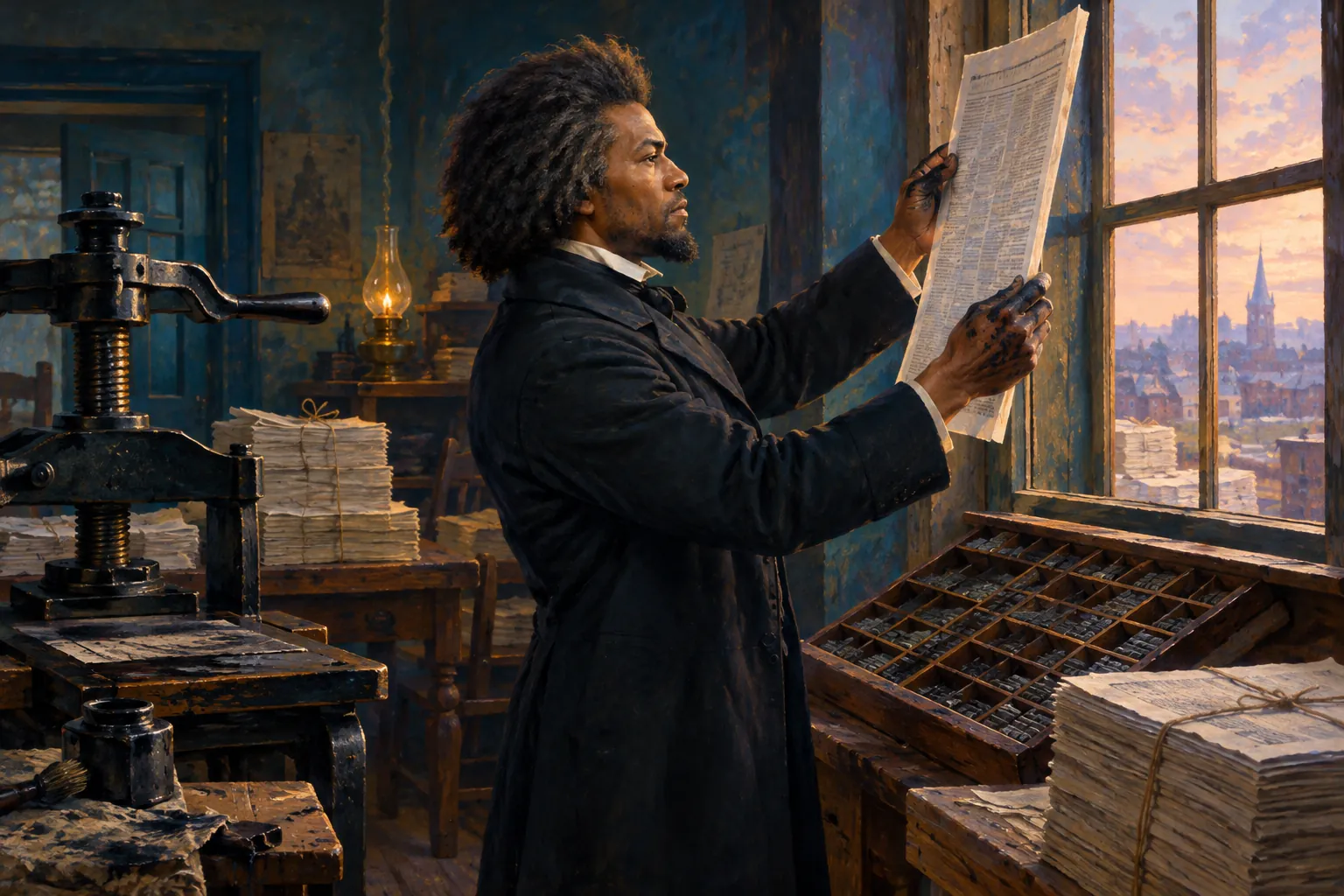
Franklin was born on 17 January 1706 in Boston, one of seventeen children of Josiah Franklin, who made soap and candles. He had about two years of formal schooling before he went to work. At twelve he was apprenticed to his older brother James, a printer. He read everything he could borrow, and he trained himself to write by summarising essays from memory and then comparing his version with the original.
In 1722 he slipped witty letters into James's newspaper, the New-England Courant, under the made-up name Silence Dogood. After quarrels with his brother he left Boston in 1723 and arrived in Philadelphia with little money. He spent 1724–1726 in London working in printing shops, then returned to Philadelphia and, by his early twenties, was running a press of his own.
Printer, organiser and citizen
Around 1727 Franklin formed the Junto, a club of tradesmen who met to discuss ideas and help one another. In 1729 he took over the Pennsylvania Gazette, which became the colony's leading newspaper. In 1732 he began Poor Richard's Almanack, written under the name Richard Saunders. It was full of short sayings about work and thrift, sold widely and ran until 1758.
Many of his civic projects grew out of the Junto: the Library Company of Philadelphia (1731), a volunteer fire company (1736), the American Philosophical Society (1743), the Academy of Philadelphia (founded 1749), which became the University of Pennsylvania, and the Pennsylvania Hospital (1751), set up with Dr Thomas Bond. He served as postmaster of Philadelphia from 1737 and as joint deputy postmaster general for the colonies from 1753. In 1748 he stepped back from daily printing work so that he could spend more time on science and public affairs.
His private life had losses too. He and Deborah Read lived as husband and wife from 1730. Their son Francis died of smallpox at the age of four in 1736.
Scientist and inventor
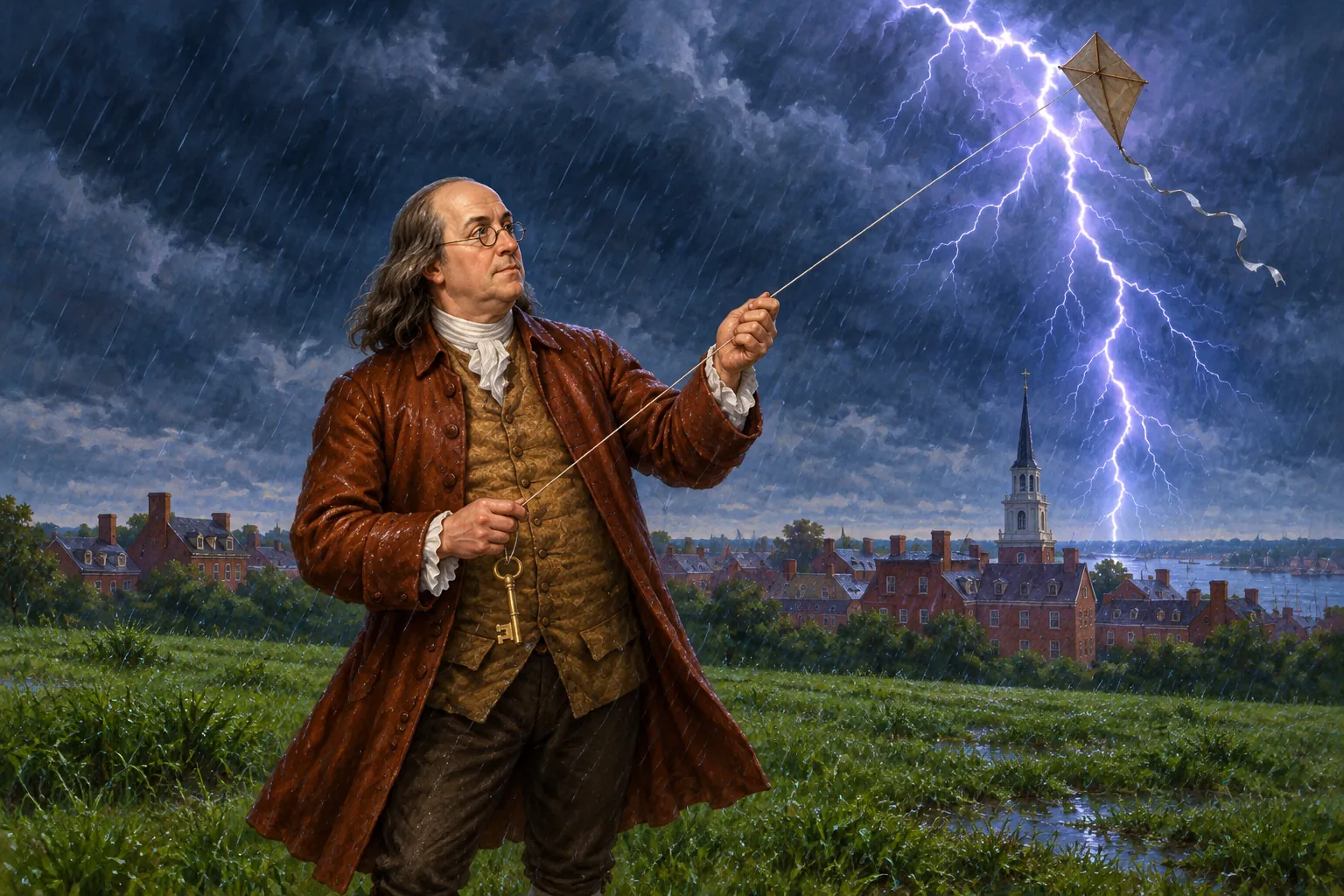
In the 1740s Franklin took up electricity. He experimented with the Leyden jar, used the terms positive and negative for electric charge, and suggested that lightning was the same force as the sparks in his laboratory. In May 1752 French experimenters tested his proposal with a tall iron rod and confirmed it. His own kite experiment in Philadelphia followed in June 1752. He described the lightning rod in Poor Richard's Almanack for 1753, and lightning rods soon appeared on buildings in the colonies and in Europe.
His book Experiments and Observations on Electricity (1751) was translated into several European languages, and the Royal Society awarded him its Copley Medal in 1753. He is credited with the Pennsylvania fireplace, known today as the Franklin stove (about 1741), and the glass armonica, a musical instrument played with wet fingers on spinning glass bowls (1761). Bifocal glasses are traditionally linked to him as well. He chose not to patent his stove, explaining that an invention that helps others should be shared freely.
Diplomat in London: from loyal subject to rebel
In 1754 Franklin proposed the Albany Plan of Union, a scheme to unite the colonies for defence. The colonial assemblies turned it down, but his “Join, or Die” snake cartoon, printed in the Gazette that year, became a lasting symbol of colonial unity. In 1757 he went to London as agent of the Pennsylvania Assembly, mostly to argue against the powers of the Penn family, who owned the colony. He stayed, apart from a visit home in 1762–1764, until 1775.
When Parliament passed the Stamp Act in 1765, taxing printed paper in the colonies, Franklin at first misjudged how angry colonists would be. In February 1766 he was questioned by the House of Commons and argued that Americans would not accept taxes from a Parliament in which they had no representatives. Parliament repealed the act in March 1766.
The relationship broke down in the 1770s. In 1773 Franklin sent private letters of Massachusetts governor Thomas Hutchinson to Boston. When they became public, Alexander Wedderburn attacked him before the Privy Council in January 1774, and Franklin lost his postal office. His wife Deborah died in December 1774. He sailed for home in March 1775 and reached Philadelphia in May, after the fighting at Lexington and Concord had begun.
Independence and the alliance with France
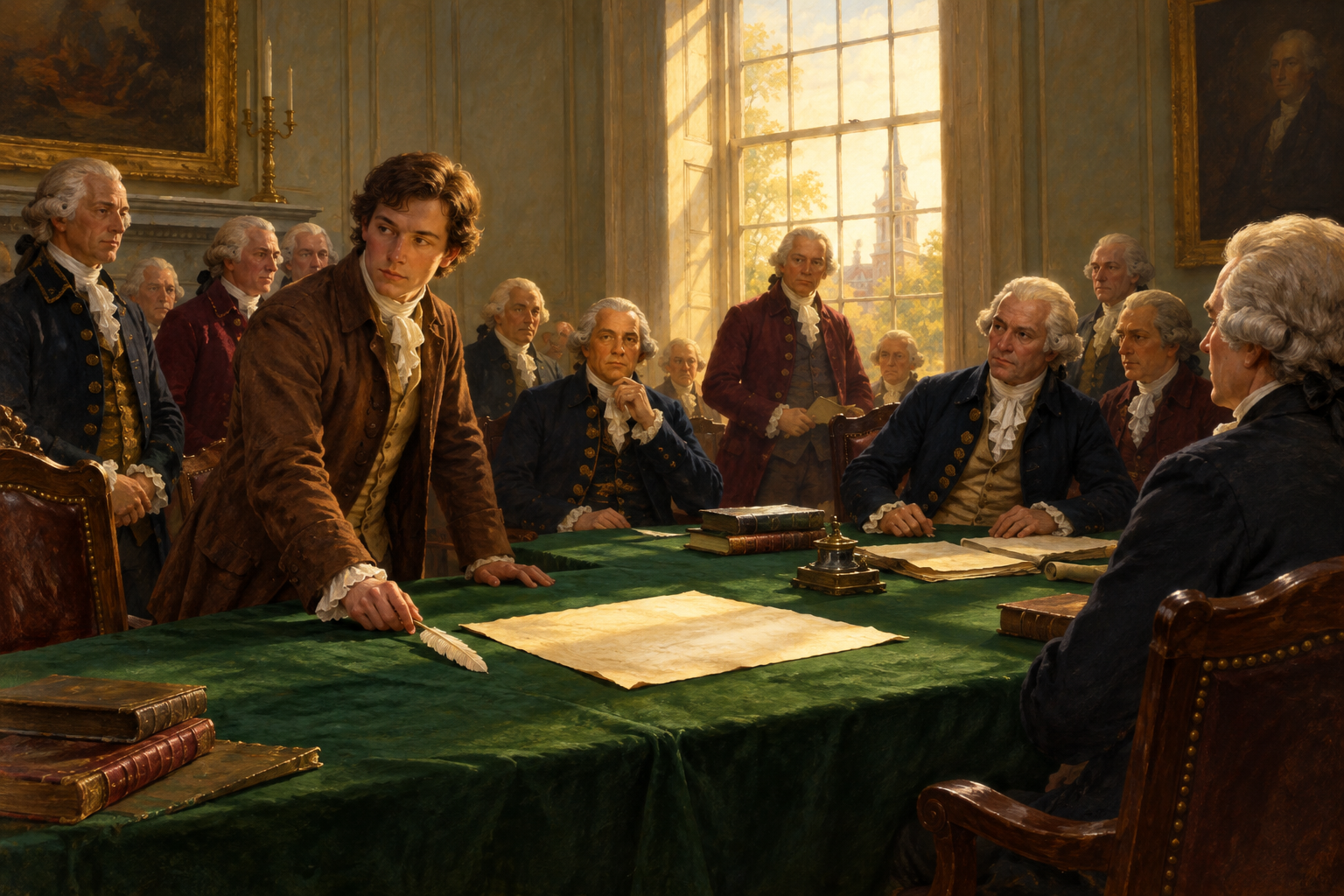
Franklin joined the Second Continental Congress and, in June 1776, became one of the five men chosen to draft the Declaration of Independence, with Thomas Jefferson, John Adams, Roger Sherman and Robert Livingston. Jefferson wrote the main text and Franklin suggested edits. In September 1776 Congress named him one of its commissioners to France, and he reached France in December at the age of seventy.
In Paris he was welcomed as a famous scientist and a plain-spoken representative of a new republic. After the American victory at Saratoga in October 1777, France agreed to a treaty of friendship and commerce and a treaty of alliance, both signed on 6 February 1778. France then supplied money, ships and troops. Franklin later negotiated the peace with John Adams and John Jay, and the Treaty of Paris, signed on 3 September 1783, ended the war and recognised American independence. The military side of the story is told in the American Revolutionary War.
Constitution, slavery and last years
Franklin came home in 1785 and served as president of Pennsylvania's Supreme Executive Council, the state's top executive office, until 1788. At the Constitutional Convention in 1787 he was, at eighty-one, the oldest delegate. He spoke rarely, favoured compromise, and urged delegates to sign even if they disliked parts of the plan.
On slavery, his record changed over time. He had enslaved people in his household and printed advertisements for the sale of enslaved people in his newspaper. In later life he became an opponent of slavery, served as president of the Pennsylvania Abolition Society, and signed a petition asking Congress to act against it in 1790. He worked on his Autobiography from 1771, but never finished it. He died in Philadelphia on 17 April 1790, aged 84.
What exams ask
Questions on Franklin usually test significance rather than a long chain of facts. Be ready to explain: (1) why the Albany Plan and “Join, or Die” matter as early steps toward colonial unity; (2) his argument against the Stamp Act in 1766; (3) his role on the Declaration committee, and how his French diplomacy followed Saratoga and led to the 1778 alliance; (4) his part in the 1783 Treaty of Paris; and (5) how he combined science, publishing and public service. A common trap is the claim that he was president, which is false. Another is the Declaration: Jefferson drafted it, and Franklin was an editor and signer.
Read next
The American Revolution: Causes, War and Independence gives the full overview that places Franklin's work in order.
The Declaration of Independence Explained shows what the committee Franklin joined produced and why it mattered.
The American Revolutionary War (1775–1783) follows the battles that the French alliance helped Americans win.