In five minutes
Edgar Allan Poe (1809–1849) was an American poet, short-story writer and critic. He turned fear, grief and guilt into tales and poems that are still read everywhere: “The Raven”, “The Fall of the House of Usher”, “The Tell-Tale Heart” and “The Murders in the Rue Morgue”.
He matters for two reasons. First, “The Murders in the Rue Morgue” (1841) gave us a detective who solves a mystery by careful reasoning, which is why it is usually called the first modern detective story. Second, he is the best-known American writer of Dark Romanticism, the strand of Romanticism that looked at guilt, madness and the limits of reason instead of the beauty of nature. This page is part of our hub, 19th-Century Art and Culture: From Romanticism to the Belle Époque. It follows one writer, working for magazines and often short of money, who shaped horror, crime fiction and poetry.
Early life: loss before the age of three
Poe was born in Boston on 19 January 1809. His parents, David Poe Jr. and Elizabeth Arnold Poe, were stage actors. His father left the family soon afterwards, and his mother died in Richmond, Virginia, in December 1811, before Edgar was three.
He was taken in by John Allan, a wealthy tobacco merchant, and his wife Frances. His middle name comes from this family. The Allans paid for a good education, including several years at school in England, but they never formally adopted him, and money soon became the sore point between Poe and John Allan.
In 1826 Poe entered the University of Virginia. He left after about a year, owing gambling debts that Allan refused to pay. After a quarrel he left home, published a first book, Tamerlane and Other Poems (1827), without his name on it, and joined the army under another name. He entered the military academy at West Point in 1830, was court-martialled and was dismissed in 1831. By his early twenties he had no family money and no steady job. Writing was the only career left, and it set the pattern for the rest of his life.
Writing for a living in the magazine age
In the 1830s American magazines were multiplying, but they paid little. Publishers could also reprint British authors without paying them, so American writers had to compete with cheap imports. Poe tried to live by his pen anyway.
In 1835 he began work at the Southern Literary Messenger in Richmond, where his sharp reviews and his own stories drew attention. In 1836 he married his cousin Virginia Clemm. The couple later lived in Philadelphia and New York, and Poe worked for magazines such as Burton’s, Graham’s and the Broadway Journal.
Several important books and stories come from these years. The Narrative of Arthur Gordon Pym (1838) is the only novel he completed. “The Fall of the House of Usher” appeared in a magazine in 1839 and was collected that year in Tales of the Grotesque and Arabesque, a book dated 1840. Poe dreamed of running his own magazine, which he planned to call The Stylus, but he never found the money. Virginia died of tuberculosis in January 1847, and Poe was left grieving and short of money.
The works that last
“The Fall of the House of Usher” (1839)
A narrator visits his old friend Roderick Usher in a gloomy mansion. Roderick is ill in mind and nerves, his sister Madeline is also sick, and the cracked house seems to share the family’s fate. The building works as a mirror of a mind, a classic Gothic device.
“The Murders in the Rue Morgue” (1841)
In Paris, a locked-room killing baffles the police. An amateur, C. Auguste Dupin, solves it by observing the scene and reasoning step by step. Poe called such stories “tales of ratiocination”. Later writers, including Arthur Conan Doyle, acknowledged his influence. Dupin returns in “The Purloined Letter” (1844), and the cipher story “The Gold-Bug” (1843) also became very popular.
“The Tell-Tale Heart” (1843) and “The Cask of Amontillado” (1846)
In “The Tell-Tale Heart”, a narrator insists he is sane while he describes killing an old man and is then driven to confess by a sound only he can hear. The horror comes from inside the speaker. In “The Cask of Amontillado”, Montresor lures his rival Fortunato into the vaults beneath his house during carnival and takes revenge. Both stories are told by the person who did the deed, which makes the reader uneasy about how far to trust the voice.
“The Raven” (1845)
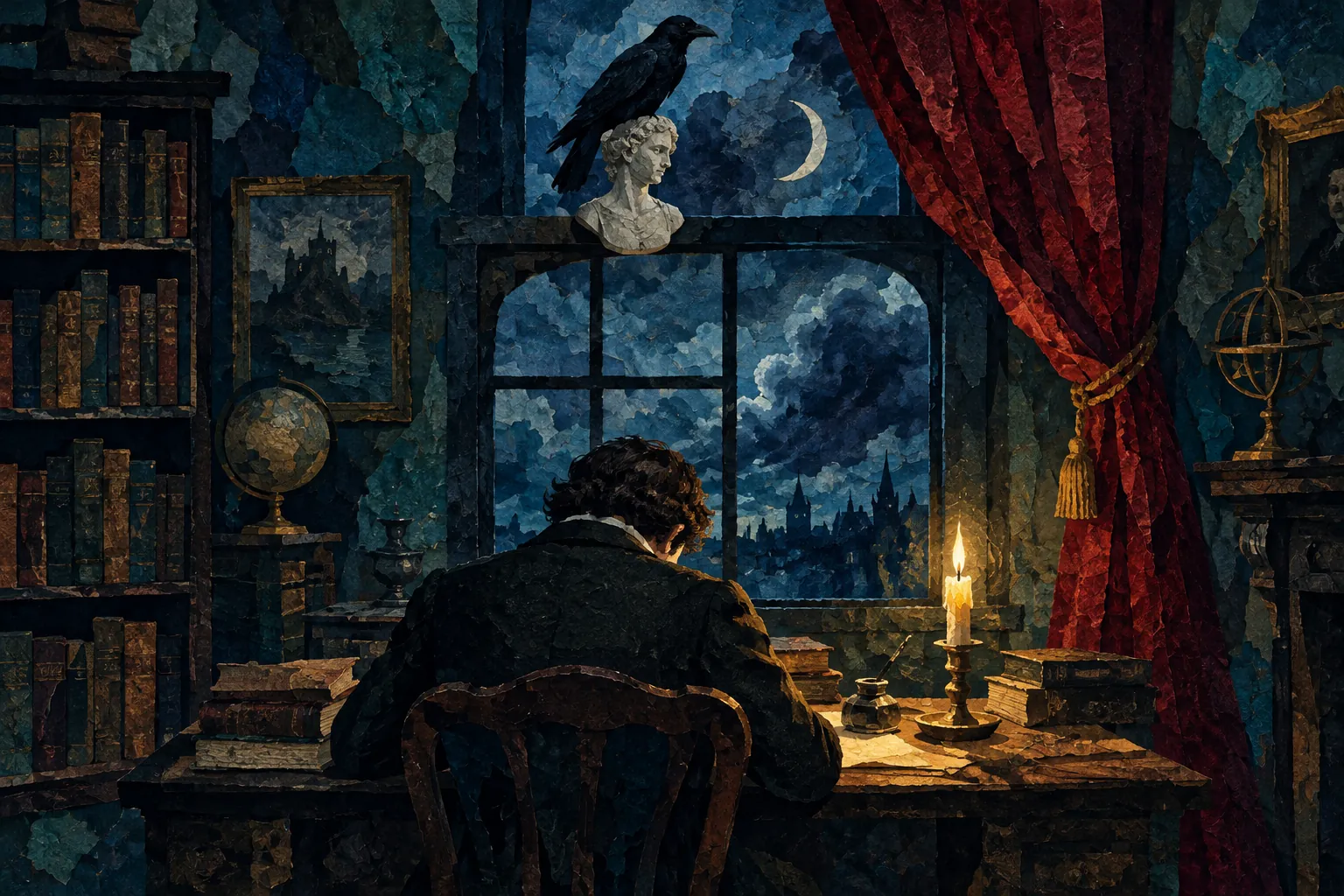
Published in January 1845, this poem has 18 stanzas. A man mourning his lost Lenore is visited at midnight by a raven that answers every question with one word: “Nevermore”. The poem was an immediate success and made Poe famous, though it did not make him rich. In his 1846 essay “The Philosophy of Composition”, Poe explains the poem as if he had built it step by step to produce a chosen effect.
What is Dark Romanticism?
Romanticism, which spread through Europe and America from the late 1700s, valued feeling, imagination and individual experience over strict rules and cold reason. Many Romantics celebrated nature and human potential. Others turned to guilt, sin, madness and the limits of reason. Scholars call this strand Dark Romanticism.
In the United States, Poe is usually grouped with Nathaniel Hawthorne (The Scarlet Letter) and Herman Melville (Moby-Dick). Their mood contrasts with the Transcendentalists, such as Ralph Waldo Emerson and Henry David Thoreau, who trusted the goodness of people and nature. Poe’s fiction shows good and evil living inside the same mind.
Some features recur in his work:
- Unreliable narrators: the more a speaker insists he is sane, the less the reader believes him.
- Closed spaces: houses, vaults and cellars stand for the inside of the mind.
- The death of a beautiful woman: in “The Philosophy of Composition” Poe called it the most poetical subject.
- Unity of effect: in his 1842 review of Hawthorne’s Twice-Told Tales, he argued that a short story should be built to leave one single impression.
Sudden death and growing reputation
On 3 October 1849, Poe was found in Baltimore in a confused state, reportedly wearing clothes that were not his. He was taken to a hospital and died on 7 October, aged 40. The cause of death has never been established.
After his death, the editor Rufus Griswold wrote a hostile obituary and edited Poe’s works, painting him as a drunken madman. That image lasted for decades, though later research shows a hard-working professional writer. His poem “Annabel Lee” was printed in October 1849, just after his death.
His reputation grew faster abroad. In France the poet Charles Baudelaire translated Poe’s tales from the 1850s, and French Symbolist poets admired him. In Japan the mystery writer Edogawa Ranpo took his pen name from the sound of “Edgar Allan Poe”. Since 1946 the Mystery Writers of America have given the Edgar Awards for the best crime writing.
What exams ask
For AP-style questions, the significance of Poe can be summarised in a few points:
- He is a leading American writer of the Romantic period, working mainly in the 1830s and 1840s.
- “The Murders in the Rue Morgue” (1841) is the starting point of modern detective fiction.
- Dark Romanticism, with Hawthorne and Melville, contrasts with the optimism of Transcendentalism.
- The growth of magazines helped the short story become a major form, and Poe wrote about its craft.
- Through Baudelaire, he influenced French Symbolism and world literature.
If you need only the dates, remember four: born 1809, “The Murders in the Rue Morgue” 1841, “The Raven” 1845, died 1849.
Read next
19th-Century Art and Culture: From Romanticism to the Belle Époque places Poe among the painters, musicians and writers of his century.
Vincent van Gogh and Post-Impressionism shows how another 19th-century artist turned inner struggle into lasting work.
Mozart: Music of the Enlightenment gives the 18th-century background that Romanticism pushed against.