In five minutes: the Callisto moon
The Callisto moon is the outermost of the four large moons that Galileo Galilei spotted beside Jupiter in January 1610. It is a ball of ice and rock 4,821 kilometres across, a little narrower than Mercury, and only Ganymede and Saturn's Titan are bigger moons. Callisto circles Jupiter once every 16.7 days at about 1.88 million kilometres, which makes it the most distant of the big moons of Jupiter.
Its great claim to fame is that almost nothing has happened to it. Io is covered in volcanoes, Europa has a young, cracked shell, and Ganymede carries the scars of ancient crustal movement. Callisto has little of that. Its surface is about four billion years old, so craters from the early Solar System are still there, stacked on top of one another. Few places hold such a complete record of impacts, which is why scientists treat Callisto as a kind of history book.
The inside is unusual too. Gravity measurements from the Galileo spacecraft suggest that rock and ice never fully separated into a rocky core and an icy shell. That is a sharp contrast with its bigger neighbour Ganymede. Magnetic readings also hint at a layer of liquid water below the crust, although that has not been confirmed.
Finally, Callisto lies outside the strongest part of Jupiter's radiation. That is why engineers keep choosing it when they imagine a human outpost in the Jupiter system, and why ESA's Juice spacecraft will fly past it many times.
The real science: what we know and what we only suspect
Discovery and name
Galileo saw Callisto through his telescope in January 1610, and the German astronomer Simon Marius claimed to have found the moons independently. The names we use today come from Marius, who published them in 1614. In Greek myth, Callisto was a nymph loved by Zeus. The jealous goddess Hera turned her into a bear, and Zeus later placed her among the stars as the Great Bear.
The discovery mattered far beyond Jupiter. Seeing small points of light that clearly circled another planet showed that not everything in the sky revolved around the Earth. Callisto, as the slowest and outermost of the four, was the easiest to follow night after night, because it drifts so gradually from one side of Jupiter to the other.
Size, orbit and gravity
Callisto is about 99 per cent as wide as Mercury but has only about a third of its mass. The reason is density: roughly 1.83 grams per cubic centimetre, which points to a mix of ice and rock rather than the metal-rich interior of Mercury. Surface gravity is about 1.24 metres per second squared, around one eighth of Earth's. The moon is tidally locked, so one face always looks at Jupiter. Unlike Io, Europa and Ganymede, it is not caught in their orbital resonance, so Jupiter's tides heat it far less.
That lack of heating explains a lot. Tidal flexing keeps Io molten and helps keep Europa's shell active. Callisto is flexed much less, so its interior stayed cooler and its surface was never refreshed by volcanoes or large crustal movements.
A twin that turned out differently
Callisto and Ganymede are close in size and are built from similar amounts of ice and rock, so they look like twins on paper. Their histories split. Ganymede separated into layers and has a metal core, a rocky mantle and a surface reshaped by faulting. Callisto appears to be only partly sorted, with ice and rock still mixed through much of its interior. Working out why two similar moons ended up so different is one of the big open questions about how the Jupiter system formed.
A surface that has barely changed
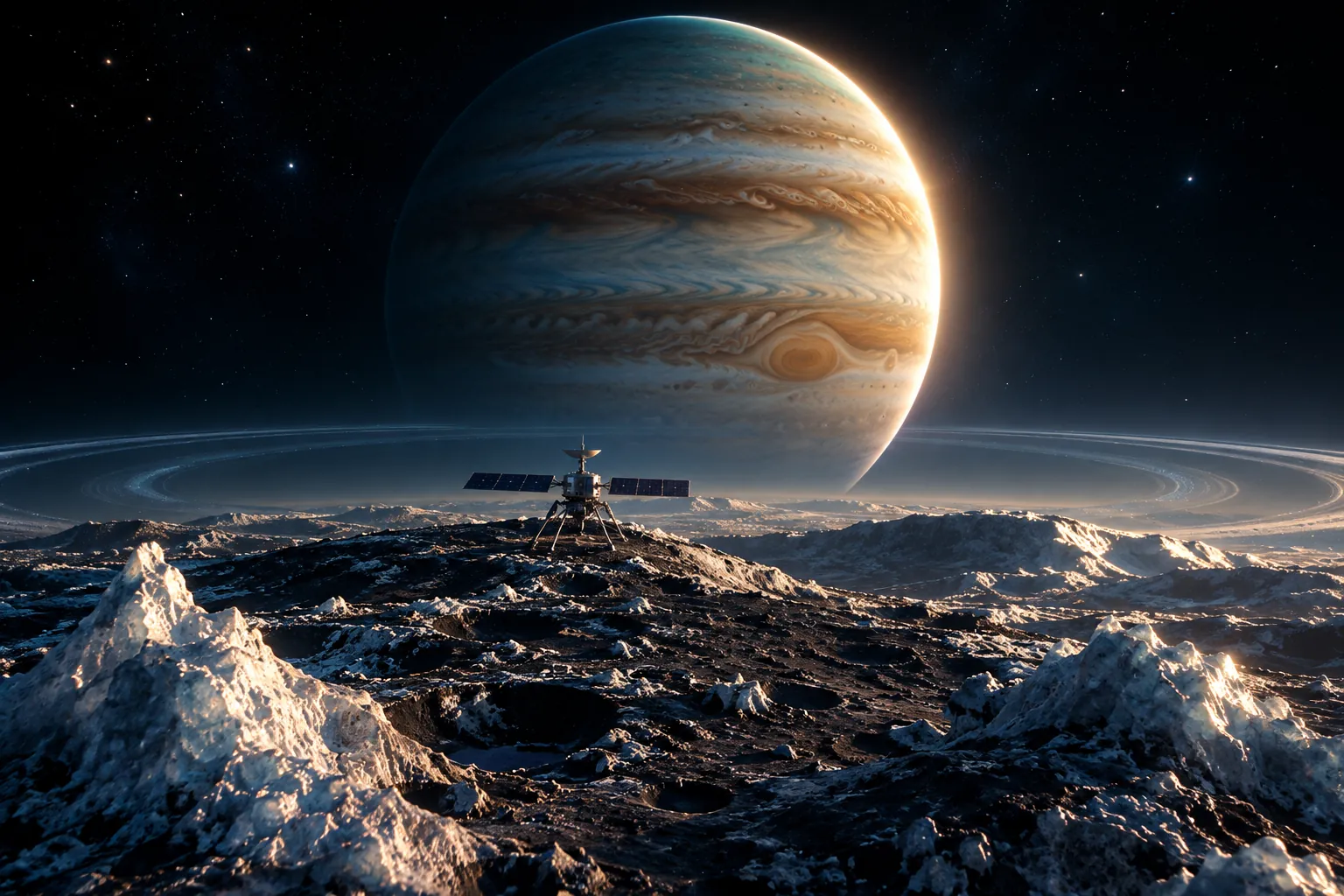
Craters cover nearly all of Callisto, and the ground is a dark mix of ice and rocky dust. The most dramatic feature is Valhalla, a giant impact basin with a bright central patch about 360 kilometres wide. Around it spread rings of ridges reaching almost 2,000 kilometres from the centre. They formed when the crust cracked and rippled after a giant impact long ago.
Planetary scientists date surfaces by counting craters: the more craters per area, the longer the ground has been exposed. By that measure Callisto is among the oldest surfaces known in the Solar System, which is why it works as a reference point for judging how young or old the surfaces of other moons are.
Galileo's close-up images showed something unexpected. Small craters are surprisingly rare, and in their place are smooth dark deposits and pillars of bright ice. The leading explanation is that ice at the surface slowly turns to gas in sunlight, leaving dark dust behind and wearing the landscape down. So the surface is old, but it is not frozen in time.
A possible ocean
In the late 1990s, Galileo's magnetometer found that Callisto disturbs Jupiter's magnetic field as if a conducting layer lay near the surface. The best explanation is a layer of salty liquid water, possibly 100 kilometres or more below the ice. This is indirect evidence, not a sighting, and the details are still debated. Europa is the better-known candidate for life, but Callisto is a useful comparison because it shows how an ocean might survive on a moon with very little tidal heating.
Atmosphere and radiation
Callisto has an extremely thin atmosphere of carbon dioxide, detected by Galileo, plus a patchy electrically charged layer above it. It is far too thin to breathe or to make weather. Radiation at the surface is much lower than at Io or Europa, because the moon orbits outside Jupiter's strongest radiation belts. Lower is not zero, and a long stay would still need shielding. A 2003 NASA study looked at a crewed base on Callisto as a stepping stone to the outer Solar System.
Missions
Pioneer 10 and 11 passed Jupiter in 1973 and 1974, and Voyager 1 and 2 followed in 1979, giving the first real pictures of Callisto's cratered face. The Galileo orbiter then studied the Jupiter system from December 1995 until September 2003, with several close passes of Callisto. ESA's Juice spacecraft launched in April 2023 and is due at Jupiter in 2031. It plans 21 flybys of Callisto before it settles into orbit around Ganymede.
Seeing it yourself
You do not need a large telescope to find Callisto. With binoculars held steady, Jupiter shows up with a short row of faint dots beside it, and Callisto is one of them. Because it takes 16.7 days to go round, it changes position slowly, and over a couple of weeks you can watch it swing from one side of the planet to the other. It is often the dot farthest from Jupiter.
Where it shows up in fiction
Callisto has never been as popular in fiction as Europa or Ganymede, but it has a long pulp history. Isaac Asimov's early story “The Callistan Menace” (1940) is about expeditions to the moon that vanish without a trace. Lin Carter wrote an eight-book Callisto series for Dell between 1972 and 1978, sword-and-planet adventures in homage to Edgar Rice Burroughs. The horror game The Callisto Protocol (2022) sets a prison on the moon.
The fiction mostly imagines jungles, kingdoms or monsters. The real Callisto is a frozen, cratered world, and the gap between the two shows how much the space probes have changed our picture of the Solar System. Early writers could invent almost anything for a moon they had never seen in detail. After Voyager and Galileo, the more interesting stories are the ones that start from the real ice, craters and radiation levels.
Common misconceptions
- “Callisto is bigger than Mercury.” It is slightly narrower and about three times lighter.
- “It is the second-largest moon in the Solar System.” It is second among Jupiter's moons. Counting all moons, Ganymede and Titan are larger, so Callisto is third.
- “A dead world with nothing to study.” Its surface is geologically quiet, but ice is still wearing away, and it may hold an ocean.
- “There is definitely an ocean.” The evidence is indirect. Juice will test it with more flybys.
- “No radiation there.” It is the gentlest of the big moons, but astronauts would still need shielding.
Read next
Jupiter's moons gives the full picture of the four big moons side by side. Ganymede is the larger neighbour with a magnetic field of its own and a very different history.