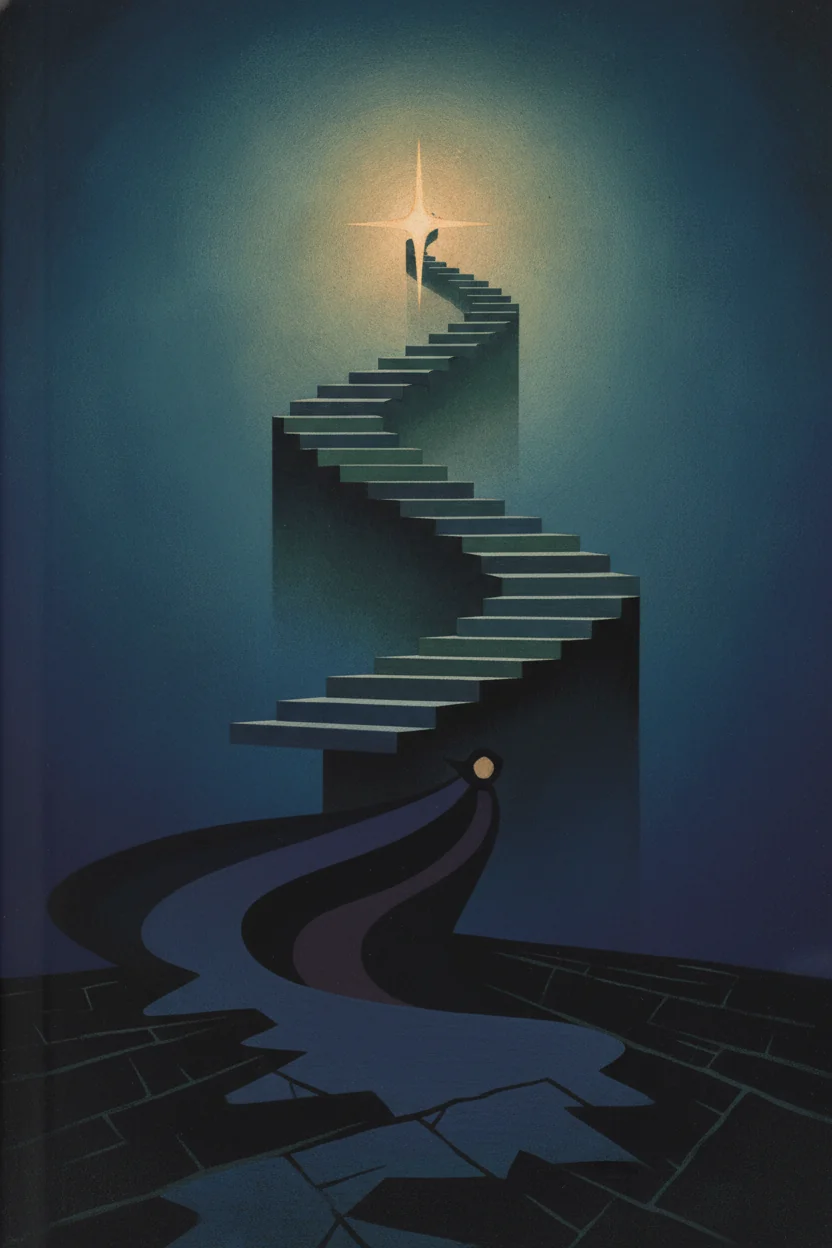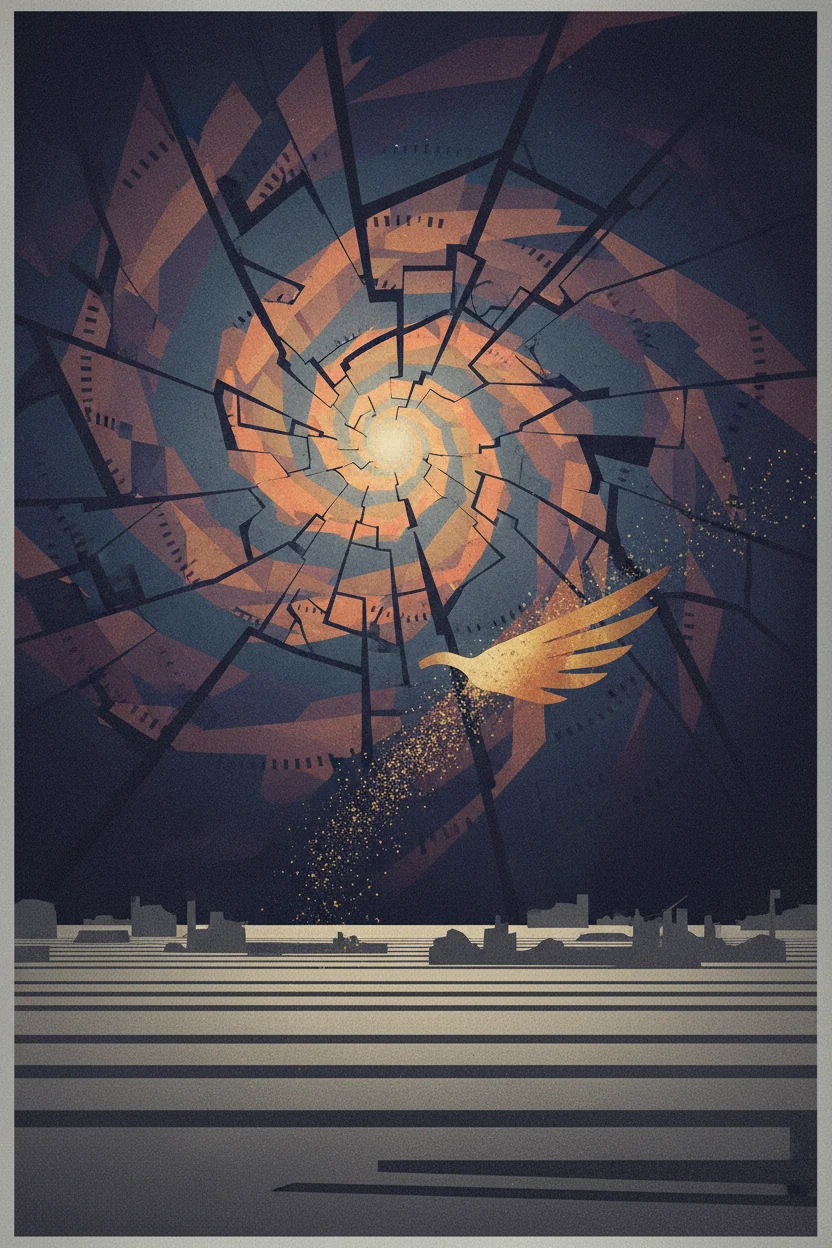
Slaughterhouse-Five by Kurt Vonnegut
by Kurt Vonnegut
Billy Pilgrim experiences his life non-linearly, jumping between his time as a POW in Dresden, his suburban life, and an alien zoo on Tralfamadore. Through this fragmented journey, the book examines the trauma of war and the absurdity of human existence.
The Big Idea
"The novel explores the psychological impact of war and the struggle for agency in a deterministic universe through the lens of a man unstuck in time."
Key Insights
The Illusion of Free Will
Tralfamadorian philosophy suggests that all time exists simultaneously, making human efforts to change the future futile.
Billy accepts the deaths of loved ones because he believes they are still alive in other moments of time.
The Nature of Trauma
The non-linear structure of the book mirrors the experience of PTSD, where traumatic memories intrude upon the present.
Billy suddenly shifts from a 1960s office meeting back to the freezing cold of a German war camp.
The Banality of War
War is depicted not as a heroic struggle, but as a chaotic, senseless event that destroys both the innocent and the guilty.
The description of Dresden as a moonscape after the bombing strips the event of any military glory.
Coping via Detachment
The phrase 'So it goes' represents a psychological defense mechanism to avoid the crushing weight of grief.
The repetition of the phrase after every mention of death creates a rhythmic, numb acceptance of mortality.
Satire of Human Ambition
Vonnegut uses science fiction to mock the human tendency to seek meaning in a universe that is largely indifferent.
Billy's abduction and placement in a zoo treat human life as a curiosity rather than something sacred.
Chapter Breakdown
The Context and Background of a War Novel
Written by Kurt Vonnegut and published in 1969, Slaughterhouse-Five is a semi-autobiographical masterpiece that blends historical trauma with science fiction. The novel is deeply rooted in Vonnegut's own experience as a prisoner of war during World War II, specifically his survival of the Allied bombing of Dresden in February 1945. This event, which killed thousands of civilians and destroyed a city of immense cultural value, serves as the emotional and narrative anchor of the book. Vonnegut spent years struggling to write about Dresden, eventually realizing that a traditional linear narrative was insufficient to capture the absurdity and horror of mass slaughter. To convey the fragmented nature of trauma, he employed a non-linear structure, introducing the concept of being "unstuck in time," which allows the protagonist to jump between his childhood, his war years, and his future on a distant planet.
A Plot Overview of a Life Unstuck
The story follows Billy Pilgrim, a chaplain's assistant in the US Army who is described as an unremarkable, fragile man. Billy becomes "unstuck in time," meaning he experiences his life not as a sequence of events, but as a series of random snapshots. He finds himself alternating between his time as a POW in Dresden, his mundane post-war life as an optometrist in Ilium, New York, and his abduction by extraterrestrials from the planet Tralfamadore. On Tralfamadore, Billy is kept in a zoo and learns the Tralfamadorian philosophy of time: that all moments—past, present, and future—exist simultaneously. This realization becomes Billy's coping mechanism for the horrors he witnessed in the war. The plot weaves through these dimensions, showing Billy's struggle to find meaning in a world governed by chance and cruelty, culminating in the haunting imagery of the ruins of Dresden and the eventual acceptance of the inevitable.
Major Themes: Fate, Free Will, and Trauma
At the heart of the novel is the tension between determinism and free will. The Tralfamadorians believe that since every moment has already happened and will happen again, free will is an illusion. This perspective is encapsulated in the recurring phrase, "So it goes," which appears every time a death is mentioned. While this seems nihilistic, it is also a form of psychological armor for Billy; if death is inevitable and exists eternally in some state, the sting of loss is diminished. Another central theme is the absurdity of war. Vonnegut satirizes the romanticization of combat, depicting soldiers as bewildered children and war as a mindless machine of destruction. The "slaughterhouse" of the title refers not only to the actual meat-packing plants in Dresden but also to the city itself, transformed into a giant abattoir by the Allied forces.
Key Scenes and the Power of Imagery
One of the most poignant sequences is the liberation of the prisoners from the slaughterhouse. After the bombing, Billy and his fellow POWs emerge from the basement to find a landscape that looks like the moon, littered with corpses and rubble. The contrast between the silence of the ruins and the noise of the preceding bombardment highlights the emptiness of victory. Another pivotal element is Billy's relationship with the Tralfamadorians. Their physical appearance—looking like toilet plungers—underscores the surrealism of the narrative. The scene where Billy is placed in a zoo serves as a metaphor for the lack of agency he feels in his own life; he is a specimen being observed, much like he was a specimen of war in Dresden. These scenes emphasize the disconnect between the individual's internal experience of trauma and the external world's demand for normalcy.
The Legacy and Why It Matters Today
Slaughterhouse-Five remains a cornerstone of postmodern literature because of its innovative structure and its refusal to provide easy answers. It challenges the reader to confront the reality of war without the comfort of patriotism or heroism. By blending the mundane with the cosmic, Vonnegut captures the essence of Post-Traumatic Stress Disorder (PTSD) long before it was a formally recognized clinical diagnosis. The novel argues that when the world becomes too horrific to process, the mind creates its own mythology to survive. Its legacy lies in its ability to be both heartbreakingly sad and darkly funny, reminding us that in the face of overwhelming tragedy, the only honest response may be a shrug and a quiet acknowledgment that "so it goes."
Take Action
Practical steps you can implement today:
-
Recognize that trauma is rarely linear; healing requires acknowledging the fragmented nature of memory.
-
Practice a healthy level of detachment when facing inevitable losses to maintain mental stability.
-
Question romanticized narratives of conflict and seek the human cost behind geopolitical victories.
-
Understand that the feeling of powerlessness is often a response to overwhelming external circumstances.
-
Use creativity and storytelling as a tool to process experiences that feel impossible to describe.
Notable Quotes
"So it goes."
— Kurt Vonnegut
"I was a POW. A prisoner of war. A chaplains assistant."
— Kurt Vonnegut
"Everything was beautiful and nothing hurt."
— Kurt Vonnegut
"Poo-tee weet!"
— Kurt Vonnegut
Who Should Read This
This book is ideal for readers interested in postmodern literature, those who enjoy a blend of historical fiction and sci-fi, and anyone seeking a profound meditation on war, fate, and the human psyche. It is particularly resonant for those who appreciate dark humor as a way to process tragedy.
Summary Written By
Software Engineer & Writer
Software engineer with a passion for distilling complex ideas into actionable insights. Writes about finance, investment, entrepreneurship, and technology.
View all summaries →Reviews
No reviews yet. Be the first to share your thoughts!