Jupiter facts in five minutes
Jupiter is the fifth planet from the Sun and the biggest planet in the Solar System. It is a gas giant, so there is no solid surface to land on: the planet is mostly hydrogen and helium that get denser and hotter the deeper you go. More than 1,300 Earths would fit inside it, yet it spins once in about 9 hours 56 minutes, the shortest day of any planet. One trip around the Sun takes almost 12 Earth years.
The rest of the list is just as large. Jupiter has striped clouds, a storm wider than Earth, the strongest magnetic field of any planet, a faint ring and more than 90 known moons, including four big ones that Galileo spotted in 1610. Since July 2016, NASA's Juno spacecraft has been orbiting the planet and measuring what lies under the clouds. For the moons in detail, see our hub on Jupiter's moons.
The real science: what we know
Size, mass and distance
Jupiter's equatorial diameter is about 143,000 km, roughly 11 times Earth's. Its mass is about 318 times Earth's, which is around two and a half times the mass of all the other planets put together. Even so, it is only about one-thousandth of the Sun's mass. Because it is built from light gases, its average density is about 1.3 grams per cubic centimetre, a quarter of Earth's.
The fast spin squashes the planet. It is about 9,000 km wider across the equator than from pole to pole. Jupiter orbits at an average of about 778 million km from the Sun, which is 5.2 times the Earth-Sun distance. Sunlight needs about 43 minutes to get there and arrives roughly 27 times weaker than at Earth.
What it is made of
By number of molecules, Jupiter's atmosphere is about 90 percent hydrogen and 10 percent helium, close to the mix in the Sun, with small amounts of methane, ammonia, water vapour and other gases. The visible clouds are thin layers high in the atmosphere, made of ammonia ice crystals at the top and other compounds lower down. At the cloud tops the temperature is about -145 °C.
Going down, the pressure climbs until hydrogen behaves like a liquid, and deeper still like a metal that carries electricity. Moving metallic hydrogen is thought to be what generates the magnetic field. What sits at the very centre is still being worked out. Older models pictured a small, solid core of rock and ice. Juno's gravity measurements point instead to a "dilute" or fuzzy core, where heavy elements blend gradually into the hydrogen above. Temperatures there are estimated to be above 20,000 °C.
Bands, storms and the Great Red Spot
Jupiter's stripes are alternating light zones, where gas rises, and darker belts, where it sinks. Between them run jet streams that blow at several hundred kilometres per hour. Storms form along these boundaries, and many last for years.
The most famous is the Great Red Spot, a high-pressure storm that spins counterclockwise and is wider than Earth. Astronomers have watched it continuously since the 1830s, and it has been shrinking in recent decades. We explain its history and what powers it in Great Red Spot. Juno also found something no one expected at the poles: a cyclone sitting over the north pole, ringed by eight more, and one over the south pole, ringed by five.
Magnetic field and rings
Jupiter has the strongest magnetic field of any planet, about 20,000 times stronger than Earth's. It traps charged particles in radiation belts so intense that spacecraft need heavy shielding, and it makes auroras at the poles that are far brighter than anything on Earth.
The planet also has rings, but they are faint and made of fine dust, not ice. Voyager 1 found them in 1979. The dust is thought to be knocked off small inner moons when meteoroids hit them.
Moons
More than 90 moons are confirmed, and the count keeps growing as astronomers find small, distant ones. The four large Galilean moons are each a world of their own. Io is the most volcanically active body known. Europa has an ocean of salty water under its ice. Ganymede is the largest moon in the Solar System, bigger than Mercury, and the only moon known to have its own magnetic field. Callisto is an ancient, heavily cratered ball of ice and rock. The full story is in our hub on Jupiter's moons.
NASA's Juno mission
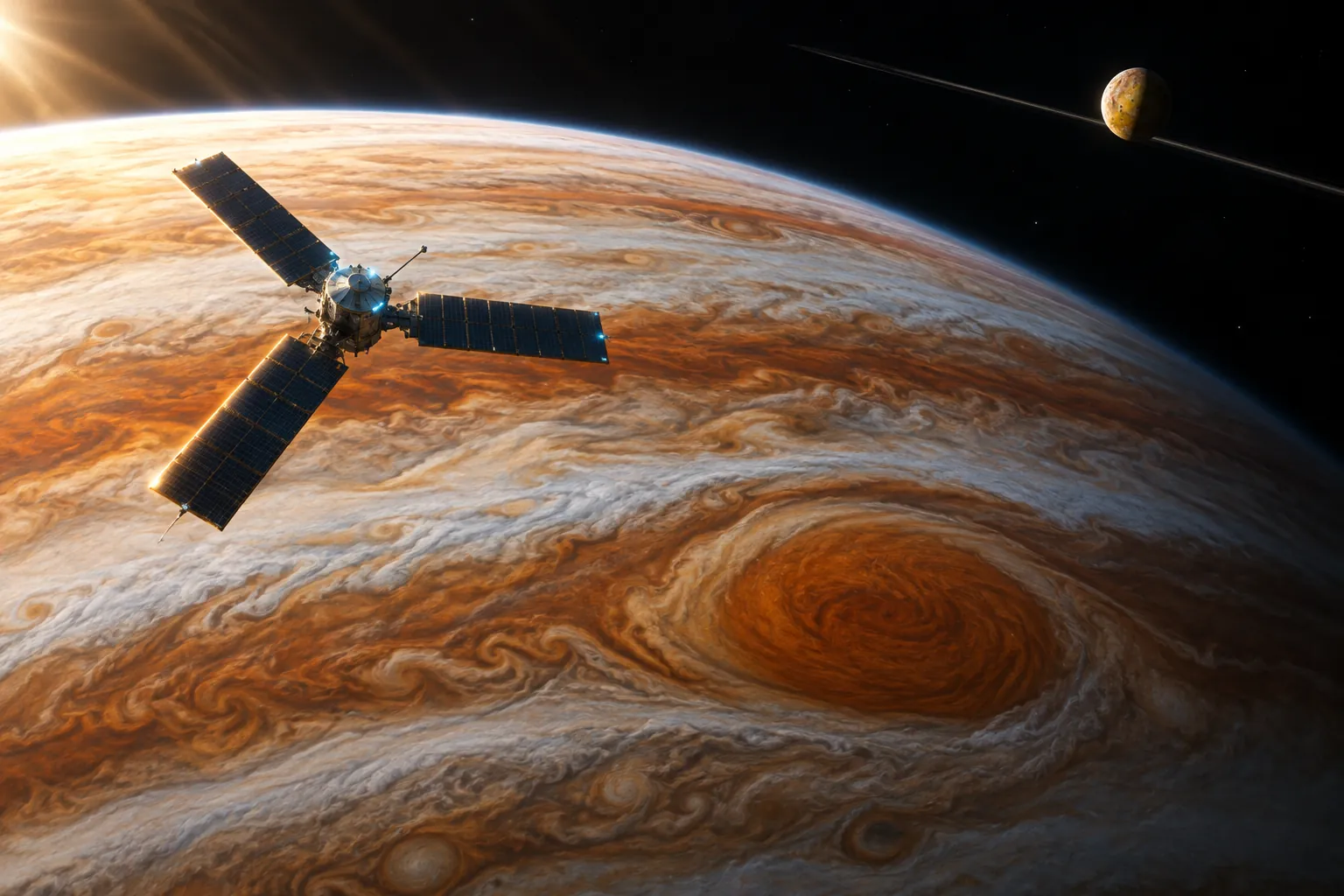
Juno is a NASA probe that launched on 5 August 2011 and entered orbit around Jupiter in July 2016. It is solar powered, with three huge panels, and flies a long, looping path that passes close to the cloud tops every few weeks before swinging far out again. Most of its delicate electronics sit inside a titanium-walled vault to survive the radiation.
Juno's instruments measure gravity, the magnetic field and microwave radiation coming from deep in the atmosphere, which lets scientists "see" below the clouds. Its main results so far:
- The core appears to be diluted and spread out, not a small hard ball.
- Jupiter's jet streams reach about 3,000 km down, much deeper than expected.
- The polar regions hold clusters of giant cyclones.
- The atmosphere holds more water than some earlier estimates suggested, which matters for theories of how the planet formed.
After its first goals were met, the mission was extended to include close flybys of Jupiter's moons: Ganymede in 2021, Europa in 2022, and Io twice, in December 2023 and February 2024. JunoCam, its colour camera, was designed so that the public could help choose and process images, and amateur image processors have made many of its best pictures. Two more missions are following: ESA's JUICE and NASA's Europa Clipper, both launched to study the icy moons.
Where Jupiter shows up in fiction
Jupiter is a favourite spot in classic science fiction. In Arthur C. Clarke's 2010: Odyssey Two (1982), an alien force turns Jupiter into a small second sun, which people nickname Lucifer, so that Europa's ocean can warm (this gives away the novel's ending). Isaac Asimov's young-adult novel Lucky Starr and the Moons of Jupiter (1957) sends its hero to Jupiter's moons. Writers often use the planet the same way: as a giant doorway to the outer Solar System, with its moons as the real destinations. That is also how real planning works today, since the moons are where most scientists hope to look for habitable conditions.
Common misconceptions
- "Jupiter is a failed star." It is made of the same main gases as the Sun, but a body needs roughly 80 times Jupiter's mass to start ordinary hydrogen fusion. Jupiter is far too light to ignite and could never become a sun.
- "You could land on it." There is no solid surface. A spacecraft that sinks deeper meets thicker, hotter gas until it is crushed.
- "The Great Red Spot has always looked the same." Its size and colour have changed over time, and it has become smaller since people began measuring it carefully.
- "Jupiter is only a shield that stops every comet." Its gravity does pull in and fling away comets, and fragments of Comet Shoemaker-Levy 9 struck it in July 1994. But scientists see the shielding effect as more complicated than a simple bodyguard.
- "Only Saturn has rings." Jupiter, Uranus and Neptune have rings too. Jupiter's are just thin and dark.
Read next
Jupiter's moons: the four Galilean worlds and the dozens of smaller ones, and why Europa and Io get the most attention.
Great Red Spot: how long the storm has lasted, why it is shrinking and what Juno measured inside it.