In five minutes
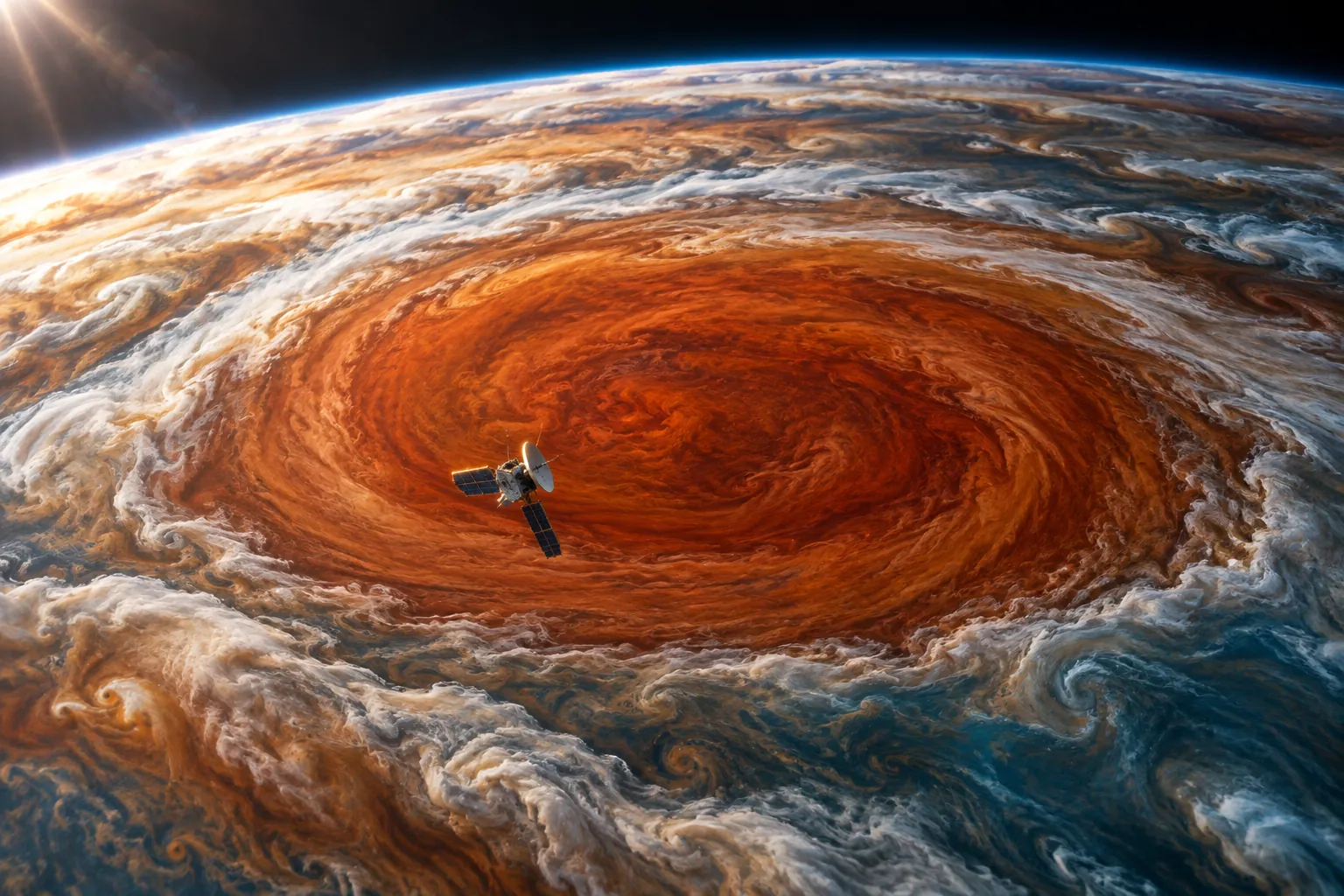
The Great Red Spot is a storm on Jupiter, a spinning oval of cloud in the planet's southern hemisphere that is wider than Earth. Winds around its edge blow at several hundred kilometres an hour, and astronomers have watched it for roughly two centuries. Jupiter has no solid ground to break a storm apart, which is the main reason this one lasts so long. The storm belongs to the bigger picture of the giant planet that we follow in Jupiter's Moons, and the planet's basic numbers are in Jupiter facts.
Here is the short version. The spot sits about 22 degrees south of Jupiter's equator. It turns counterclockwise, which is the direction of a high-pressure system in the southern hemisphere, so it is called an anticyclone. In 2017 it measured about 16,000 kilometres across, roughly 1.3 times the width of Earth. Its centre is fairly calm, while its rim moves at up to about 430 kilometres an hour. It has been shrinking and growing rounder for decades, but it is not about to disappear.
If you remember only three things, make them these:
- It is a giant, long-lived high-pressure vortex, not a hole, a mountain or a lake.
- It is wide enough to hold Earth, yet much smaller than it was in the 1800s.
- Its red colour is real, but scientists have not settled which chemicals cause it.
What kind of storm is it?
Jupiter is made mostly of hydrogen and helium. What we see from outside is a deck of cloud stretched into stripes by the planet's rapid spin: a day on Jupiter lasts under ten hours. The light stripes are called zones and the dark ones belts. Winds in neighbouring stripes blow in opposite directions, and where opposing winds rub against each other, the air can roll up into a vortex.
The Great Red Spot sits on the southern edge of the South Equatorial Belt, between two jet streams that blow in opposite directions. Picture a roller turning between two moving belts. The jets keep it spinning, and the spin stays organised instead of spreading out.
On Earth, a hurricane turns around a centre of low pressure and feeds on warm ocean water. The Spot is a different kind of system. It has high pressure at its centre and turns counterclockwise in the southern hemisphere. Its cloud tops rise a few kilometres above the clouds around it, which is why it stands out so clearly in infrared images.
The real science
Size, speed and depth
The Spot is huge by any human measure. In 2017 it was about 16,000 kilometres wide, while Earth is about 12,700 kilometres across. In the late 1800s observers described it as roughly 40,000 kilometres long, enough for three Earths in a row. By the Voyager flybys of 1979 it was around 23,000 kilometres, and in 2014 the Hubble Space Telescope measured about 16,500 kilometres, the smallest width on record at that time.
The winds follow a clear pattern. Along the rim, air races around at up to about 430 kilometres an hour, close to the speed of the strongest tornadoes on Earth. Toward the centre the air barely moves. One full turn of the oval takes roughly six Earth days.
How deep does it go? For a long time nobody knew. NASA's Juno spacecraft, which has orbited Jupiter since July 2016, flew about 9,000 kilometres above the Spot on 10 July 2017. Its instruments, including gravity measurements and a microwave radiometer that senses heat from below the clouds, indicate that the storm reaches several hundred kilometres down, roughly 300 to 500 kilometres. That sounds like a lot, and it is, but it is still a thin skin compared with Jupiter's radius of about 70,000 kilometres. The Spot is wide and shallow, like a pancake.
Why is it red?
The colour is the most famous thing about the storm, and the least settled. Jupiter's clouds are mostly white ammonia ice, so something must be tinting the Spot. Researchers have two main ideas. In one, sunlight breaks apart chemicals such as ammonia and ammonium hydrosulfide high in the atmosphere, leaving red-brown compounds behind. In the other, the storm lifts material up from deeper layers, where it reacts and changes colour. Laboratory experiments support the first idea in part, but no one has shown for certain which chemicals do the job.
The shade is not fixed. Over the years the Spot has looked brick red, orange, salmon pink and quite pale. That variation is one reason astronomers keep watching it.
Why has it lasted so long?
A hurricane on Earth dies when it hits land or cold water. Jupiter is a gas giant, with no ground and no oceans. Nothing scrapes the storm's base, and the planet's own internal heat keeps the atmosphere moving. The two jets on either side keep spinning it. Computer simulations also suggest that the Spot grows by swallowing smaller vortices that drift into it, which gives it fresh energy.
A storm that lasts centuries still has to lose energy somewhere, and slow friction and turbulence do wear it down. That is why a shrinking Spot is no surprise. The open question is how fast.
Is it shrinking?
Yes. Careful measurements from the late 1800s to the 2010s show the Spot narrowing and becoming rounder, less like a long oval. In 2019, Hubble and amateur astronomers saw pieces of cloud peel away from its edge, which made headlines about a dying storm. Planetary scientists said the flaking was part of normal behaviour, not the end. Whether the Spot will fade within decades or settle at a smaller size is still debated, and the honest answer is that no model has been proven right.
Two centuries of watching
In the 1600s, the Italian-French astronomer Giovanni Domenico Cassini followed a dark spot on Jupiter for years, but astronomers think it was probably a different feature. Clear drawings of the present Spot begin in the 1830s, such as those by the German amateur Heinrich Schwabe. Around 1878 it became strikingly bright red and drew wide attention. Space probes then took over: Pioneer 10 passed Jupiter in 1973, and the two Voyagers in 1979 captured the swirling flow around the Spot in fine detail. Hubble has tracked its size since the 1990s, and Juno now looks beneath it.
Where it shows up in fiction
The Great Red Spot rarely carries a story, but it is the one Jovian landmark that readers already know, so writers use it as shorthand for the sheer size of Jupiter. Arthur C. Clarke's novella "A Meeting with Medusa" (1971) sends an airship into Jupiter's atmosphere, and his novel 2010: Odyssey Two (1982) makes the planet itself the stage for a dramatic change. Stories like these borrow what the real storm teaches: on a world without a surface, weather is the scenery.
For fans of sci-fi, the real Spot is the better story. A storm older than most nations, wider than our planet, and still not fully understood is the kind of thing fiction would be accused of exaggerating.
Common misconceptions
- "It is a hurricane." Not quite. A hurricane is a low-pressure system. The Spot is high pressure and spins the other way in its hemisphere.
- "It is three Earths wide." That was roughly true in the 1800s. Today it is about 1.3 Earths wide.
- "It is a solid thing or a hole." It is cloud. Jupiter has no surface, so a probe would simply sink through ever denser, hotter gas.
- "It is about to vanish." It is shrinking, but the 2019 flaking did not mean it was dying, and no one can give a date for its end.
- "It is the spot Cassini saw." Probably not. Continuous records of today's storm start in the 1800s, not the 1600s.
- "Jupiter has only one storm." It has many. A smaller oval called Oval BA formed in 2000 when white storms merged, and it turned red a few years later.
Read next
- Jupiter's Moons: the four big satellites that circle the same planet, and why Jupiter's gravity shapes them.
- Jupiter facts: size, day length, composition and the numbers behind the planet that hosts the Spot.