In five minutes
A world is tidally locked when it turns exactly once for every trip around the body it orbits. The Moon is the example anyone can see. It takes about 27.3 days to circle Earth and about 27.3 days to spin once, so the same face always points toward us.
This is not a quirk of the Moon. Most large moons in the Solar System are locked to their planets, including the four big moons of Jupiter, which you can meet in our guide to Jupiter's moons. Many planets around small red stars are expected to be locked too.
The short version:
- Gravity stretches a world slightly, raising a tidal bulge.
- If the world spins at a different rate than it orbits, the bulge is dragged out of line, and the pull acts like a brake on the spin.
- The braking ends when spin and orbit match. The bulge then stays lined up, and the world is locked.
- The closer the orbit, the sooner this happens.
What does tidally locked mean? How tidal locking works
Gravity pulls harder on the side of an object that is nearer to its partner than on the far side. That difference is the tidal force, and it stretches the object a little along the line toward the partner. Oceans show this best on Earth, but solid rock stretches too. The Moon is very slightly elongated, with its long axis pointing roughly at Earth.
Now add spin. Imagine a young Moon turning faster than it orbits. Rock does not bend into shape instantly, so the bulge gets carried a little ahead of the line to Earth. Earth's gravity pulls on that offset bulge, and the pull works against the spin, a bit like a hand resting on a turning wheel. Friction inside the Moon turns the lost spin energy into heat.
The braking stops when the spin period equals the orbital period. From then on the bulge sits on the line between the two bodies, nothing drags it sideways, and the rotation stays fixed.
Three things set how long this takes. The first is distance: the time grows roughly with the sixth power of the orbital distance, so doubling the distance makes locking about sixty times slower. The second is the mass of the larger body, since a heavier partner raises bigger tides. The third is the smaller body's own makeup, meaning how stiff it is and how well its interior turns flexing into heat. Close moons lock early. Distant ones may never lock within the age of the Universe.
One point trips people up: locked does not mean not rotating. A locked moon does rotate, once per orbit. That is exactly why one side stays turned toward its partner.
The Moon, our nearest example
For most of human history nobody saw the other side of the Moon. The first photographs came from the Soviet probe Luna 3 in October 1959, and in January 2019 China's Chang'e 4 became the first spacecraft to land there. The far side looks different from the near side, with a thicker crust and far fewer of the dark lava plains called maria.
People often call it the dark side, which is wrong. It gets sunlight like any other part of the Moon. At new moon, when the near side is unlit, the far side is in full daylight.
Over time we can see a little more than half of the surface, about 59 percent, because the Moon's orbit is not a perfect circle and its axis is tilted. The Moon seems to nod and sway slightly, an effect called libration.
The story is not finished. The Moon's tides slow Earth's spin by a tiny amount, adding roughly two milliseconds to the length of the day every century, and the Moon drifts away from Earth by about 3.8 centimetres a year. In principle Earth could one day lock to the Moon as well, but that would take far longer than the Sun will last.
The real science
Here is what has been measured, followed by what researchers are still working out.
Established: most big moons are locked
Locking is the normal outcome for large moons. Jupiter's Io, Europa, Ganymede and Callisto are locked, as are Saturn's largest moons, including Titan. Pluto and its big moon Charon are locked to each other: each keeps one face toward the other, and both turn once every 6.4 days.
Established: tidal heating
Locking is not the end of tidal effects. Io's orbit is slightly oval, because Europa and Ganymede tug on it in a repeating pattern: Io orbits four times for every two orbits of Europa and one of Ganymede. As Io swings closer to Jupiter and farther away, its tidal bulge rises and falls, and the rock flexes. That flexing heats Io's interior, which is why it is the most volcanically active body in the Solar System, with hundreds of volcanoes. Heat of the same kind is thought to help keep Europa's ocean under its ice from freezing. For more, see our page on Io.
Established: Mercury is not locked
Mercury turns three times for every two trips around the Sun, a 3:2 spin-orbit resonance. Its spin takes about 58.6 days and its year about 88 days, so one sunrise to the next takes about 176 days. For decades astronomers thought Mercury always showed one face to the Sun; radar measurements in 1965 showed otherwise. Venus is slow too, taking about 243 days to turn once, backwards, but it is not locked either.
Still being worked out: planets around red dwarfs
Red dwarfs are small, dim stars, and about three in four stars in our galaxy are of this kind. A planet has to orbit very close to one to be warm enough for liquid water, and at that distance locking is likely. Proxima b, a planet around the nearest star beyond the Sun, orbits in about 11 days. TRAPPIST-1 has seven planets with orbits between about 1.5 and 19 days. Such planets are probably locked or caught in a resonance like Mercury's, but the spin of most has not been directly measured.
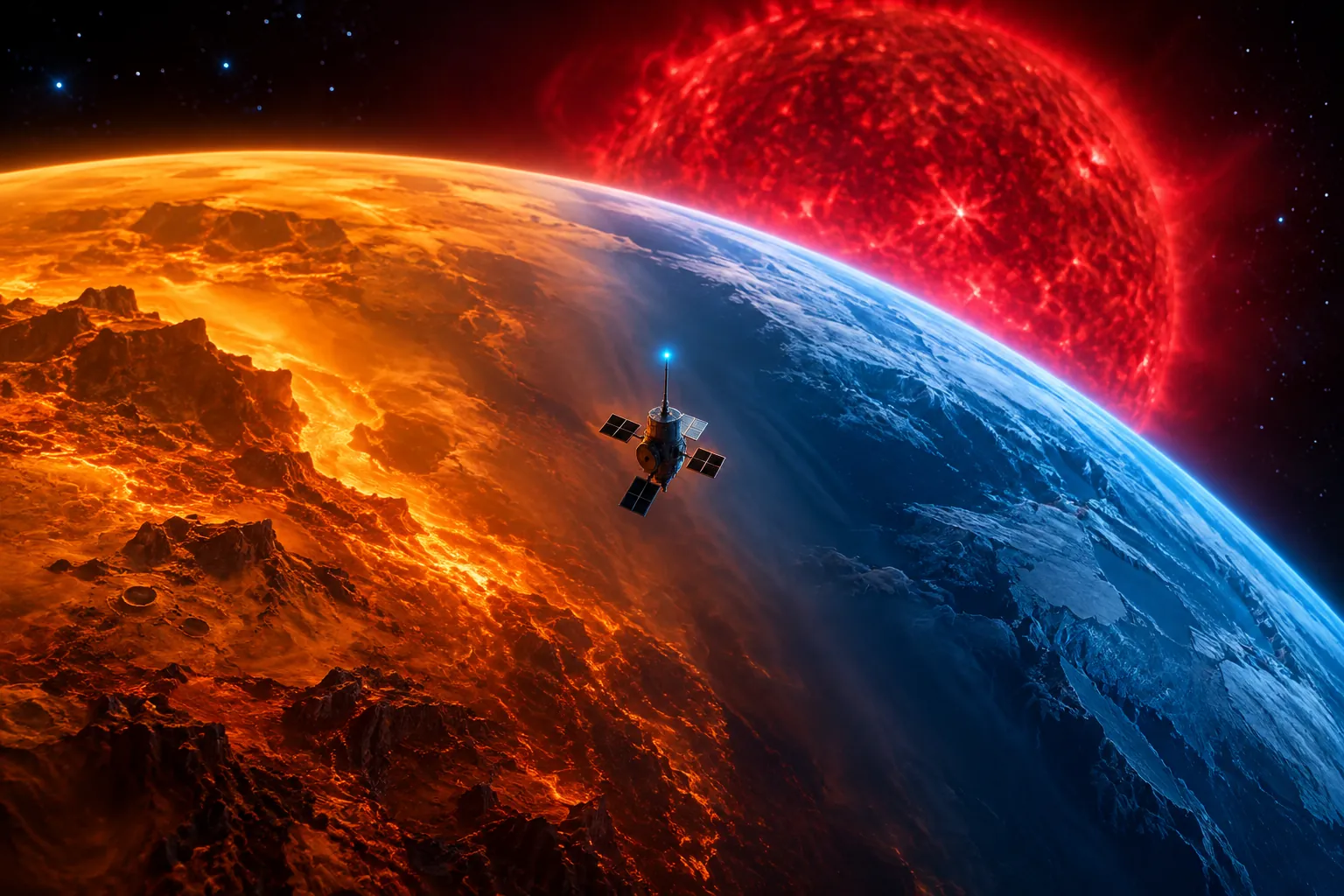
What this does to a planet is still debated. The simplest picture is an eyeball world: a scorched day side, a frozen night side and a ring of mild twilight, the terminator. Climate models suggest that a thick enough atmosphere or ocean could carry heat around and soften the contrast. But red dwarfs also fire strong flares, which might strip a thin atmosphere away. Early James Webb Space Telescope measurements of the two innermost TRAPPIST-1 planets suggest they have little or no thick atmosphere. For the cooler outer planets the answer is still being worked out. Many hot Jupiters, giant planets circling very close to their stars, are also thought to be locked, with scorching day sides.
Where it shows up in fiction
Tidal locking has shaped science fiction for a century, partly because older science got it wrong. Until the 1960s many astronomers believed that Venus and Mercury kept one face to the Sun. Stanley G. Weinbaum used the Venus version in 'The Lotus Eaters' (1935), where life clings to a narrow twilight band between a scorched day side and a frozen night side. Radar later showed that Venus turns slowly backwards, and Mercury turns three times for every two orbits, so the permanent-twilight Venus became a period piece.
Kim Stanley Robinson's 2312 (2012) borrows another half of the idea. Mercury is not locked, but its sunrises are so slow that a city called Terminator rolls on rails around the planet to stay just ahead of the dawn.
Modern writers use real exoplanet science. Eyeball worlds with a habitable ring of twilight turn up in many recent stories, and the setting hands the writer a ready-made map: sunward for heat, the far side for ice, the terminator for everything in between. When a story gives you a world of permanent twilight, ask three questions. Is it locked, or in a resonance? Is there enough atmosphere to move heat? Does the author care? The answers show how seriously the science is being taken.
Common misconceptions
- The Moon has a dark side. It has a far side. Every part of the Moon gets sunlight during its month.
- Locked means not rotating. A locked world rotates once per orbit. Matching the two periods is what keeps one face turned inward.
- Mercury is tidally locked. It is not. It turns three times for every two orbits.
- A locked planet is half fire, half ice. That is the extreme case. Atmosphere, oceans and how fast the planet is heated all change the picture, and models disagree on how mild the night side could be.
- Only moons get locked. Planets, dwarf planets and even stars in close pairs can lock, and Pluto and Charon are locked to each other.
- Earth will soon be locked to the Moon. The change is real but tiny, and full locking would take far longer than the Sun will last.
Read next
Want to see locking at work on the grandest scale? Jupiter's moons shows four locked worlds, each very different. Then read about Io, where tidal flexing drives the most violent volcanoes in the Solar System.