In five minutes
A Dyson sphere is a hypothetical structure built around a star to catch most of its light and turn it into usable power. The physicist Freeman Dyson described the idea in a short 1960 paper in the journal Science. His reasoning was practical. A civilisation that keeps growing will eventually need more energy than its home planet receives, and the largest energy source nearby is its own star.
The numbers show why the idea is appealing. The Sun gives off about 3.8 × 1026 watts. Earth intercepts only about one part in two billion of that. Humanity as a whole uses roughly 18 terawatts, which is tiny next to what the Sun pours into empty space every second. A structure that caught even a fraction of the Sun's output would offer more power than we can easily imagine using.
Everything here is still theory. Nobody has built a Dyson sphere, and nobody has confirmed finding one. It is a thought experiment about what physics allows, and one of the best-loved ideas in science fiction. It belongs to the wider story told in our history of science fiction.
Where the idea came from
Freeman Dyson (1923–2020) was a British-born American physicist. In 1960 he published a two-page paper titled “Search for Artificial Stellar Sources of Infrared Radiation.” Its main question was not “how do we build this?” but “how would we spot someone else who had?”
Dyson was open about his inspiration. He credited the 1937 novel Star Maker by Olaf Stapledon, which describes stars surrounded by networks of light traps that gather their radiance. Dyson never called the idea a sphere himself, and he later said that the name was a mistake of popular retelling. What he described was a loose cloud of separate objects, and what the public pictured was a hollow ball.
The main versions of the idea
Writers and engineers have used the name for several different designs. It helps to keep them apart.
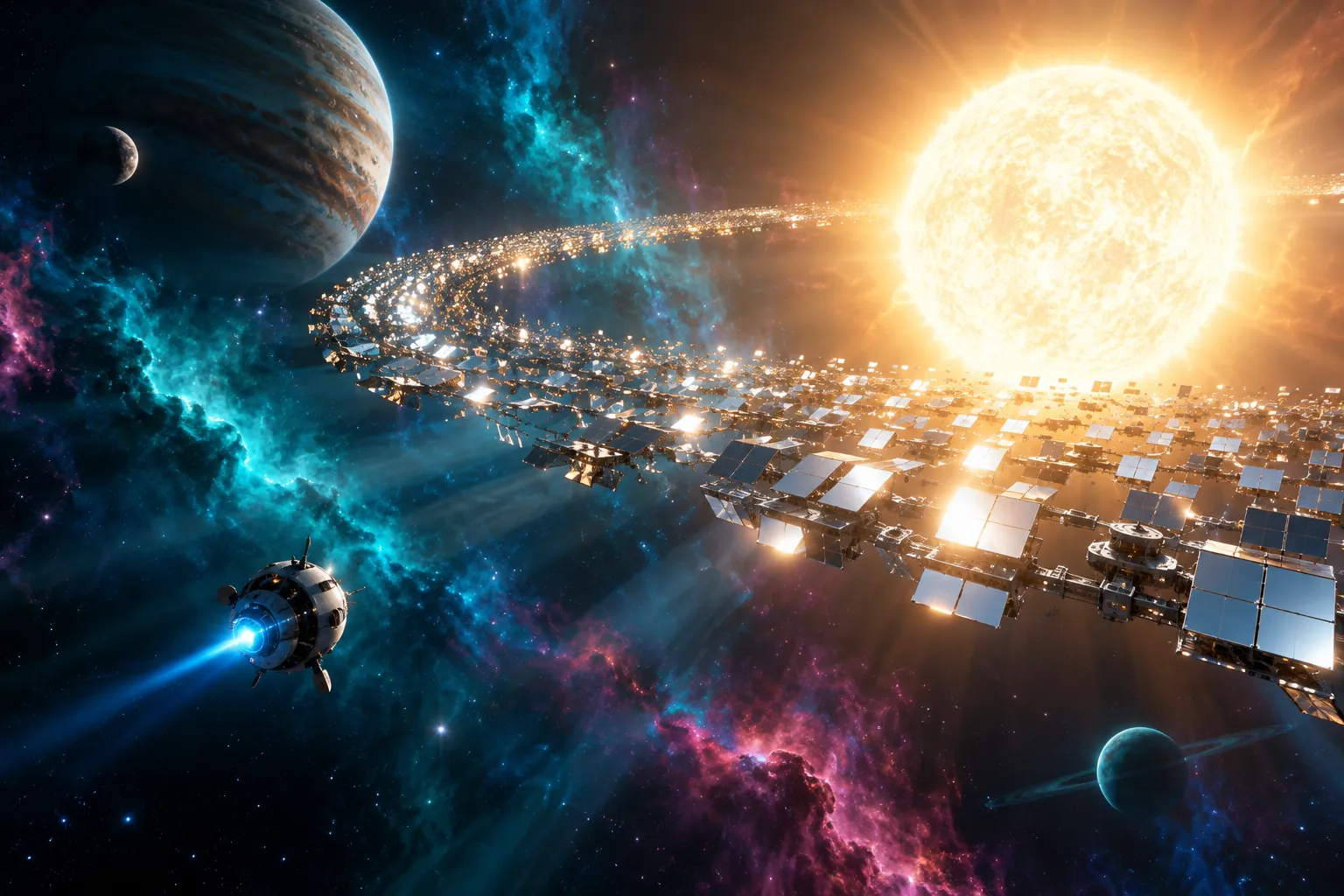
- Dyson swarm. Huge numbers of independent collectors, such as mirrors or solar panels, orbit the star on their own paths. This is closest to what Dyson wrote, and it is the version scientists take most seriously.
- Dyson bubble. Light sails or mirrors that hover in place, held up by the pressure of starlight instead of orbiting. They need no rigid connections, but they must be tuned carefully to stay put.
- Dyson shell. A single solid, hollow sphere with the star inside. This is the version most people picture, and the one that causes the most trouble for physics.
A swarm would also be built in stages. A first few collectors would already return power, and each new one adds to the total. That makes it a project that could grow over centuries, not one that must be finished before it works.
The real science
What is established, and what is speculation, deserves a clear split.
What the physics says
A shell at the distance of Earth's orbit would be a ball about 150 million kilometres in radius. Its inner surface would be around 550 million times the surface area of Earth. That is a huge amount of living space or solar collector, but it also means an astonishing amount of material. No known substance is strong enough to hold a rigid shell of that size together against its own weight and the forces on it.
There are two deeper problems with a solid shell. First, it would be unstable. If the shell drifted even slightly off-centre, the star's gravity would pull harder on the nearer side, and the shell would slide toward the star and eventually collide with it. Without constant active correction, the shell cannot stay in place. Second, gravity inside a uniform hollow shell cancels out, so nothing on the inner surface would be held down by the star. People living inside would need spin or some other force to feel weight.
This is why working scientists tend to think about swarms. Separate pieces in separate orbits do not need to be rigid, and they avoid the stability trap.
How to find one
Dyson's key point concerns heat. Energy cannot vanish. If a structure absorbs starlight and uses it, it must give off the unused energy as waste heat. For a structure at roughly the temperature of a comfortable planet, that heat would show up as infrared light at about 10 micrometres in wavelength. A star dimmed in visible light but glowing in the infrared would look unusual.
The trouble is that nature makes infrared glow too. Young stars wrapped in dust discs, dying giants shedding gas, and plain dusty neighbours can all look similar at first glance. Any candidate has to rule those out before anyone takes it seriously.
The searches so far
The best-known case is KIC 8462852, often called Tabby's Star. In 2015 astronomers reported that this star dimmed in deep, irregular dips seen by the Kepler space telescope. A handful of researchers floated an artificial explanation, among many others. Later observations showed that the dimming differs between colours of light, which fits clouds of dust far better than a solid object. Most astronomers now favour dust.
In 2024 a project called Hephaistos combed data from several sky surveys, covering millions of stars, for stars with an unusual infrared excess. It reported a small number of candidates, all faint red dwarfs, and the authors themselves noted that natural dust is a likely explanation. So far, the count of confirmed Dyson structures is zero. A negative result is still useful, because it tells us how common such structures can be.
Why it connects to the Kardashev scale
In 1964 the Soviet astronomer Nikolai Kardashev proposed ranking civilisations by how much energy they command. A civilisation that uses all the power of its star would sit at his Type II level, and a Dyson swarm is the classic picture of how it might do so. Our article on the Kardashev scale covers that ladder in full.
Where it shows up in fiction
Books come first, because that is where the idea grew.
- Star Maker (1937), Olaf Stapledon. The seed of the idea: stars fitted with light traps by advanced beings.
- Ringworld (1970), Larry Niven. Not a sphere but a single band around a star, about the size of Earth's orbit. Niven's readers soon pointed out that such a ring is unstable, and he answered with the sequel The Ringworld Engineers (1980), where the problem becomes part of the plot.
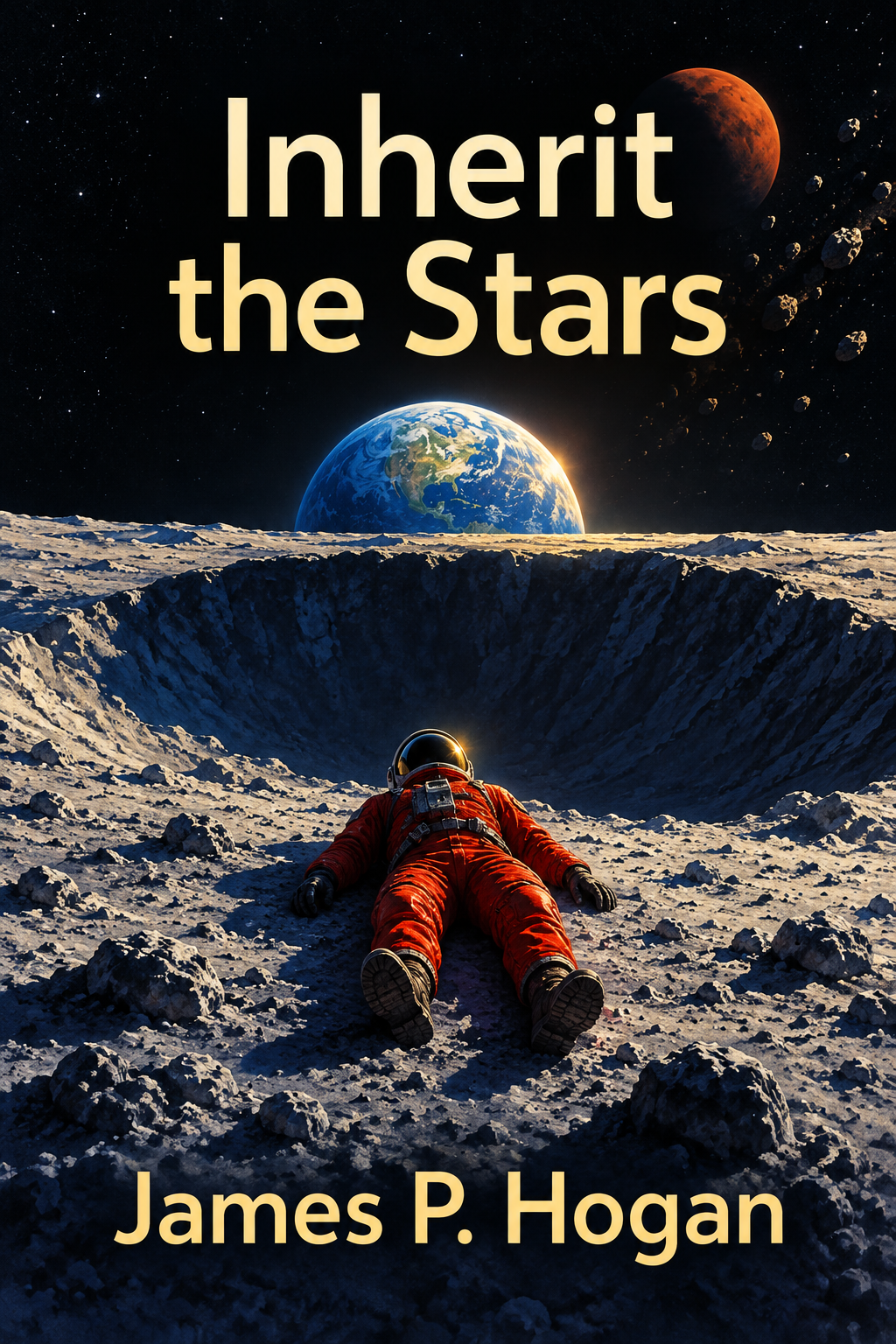
- Hard science fiction in general. Many novels use stellar-scale engineering as a backdrop. For a gripping science puzzle in a related spirit, try James P. Hogan's Inherit the Stars, a detective story about evidence that overturns human history.
Screen fiction has used the idea too. The television series Star Trek: The Next Generation featured a Dyson sphere in the 1992 episode “Relics,” and video games often use similar structures. Those are named here only as examples of how widely the term has spread.
For other giant structures, including rings and orbiting habitats, see our guide to megastructures in sci-fi.
Common misconceptions
- “Dyson invented the solid sphere.” He described a swarm of separate objects. The hollow ball came from later retellings and from fiction.
- “Tabby's Star proved aliens built one.” It did not. Later measurements point to dust, and there is no confirmed Dyson structure anywhere.
- “It would hide the star completely.” A swarm could let some light through, and a partial one could be nearly invisible in visible light while still glowing in the infrared.
- “It is a weapon or a spaceship.” In Dyson's idea it is a power plant, nothing more. Weapons and ships belong to fiction.
- “It would be easy to build once we are advanced enough.” The material and energy needed are huge, and engineers have not shown a complete plan. It remains an open question.
Read next
- Kardashev scale: the ranking of civilisations by energy use, where a Dyson swarm is the textbook example of Type II.
- Megastructures in sci-fi: rings, orbital habitats and other giant builds, compared side by side.
- Inherit the Stars: a science mystery novel that suits readers who enjoy this kind of big-picture reasoning.
- History of science fiction: how ideas like this one moved from novels to laboratories and back.