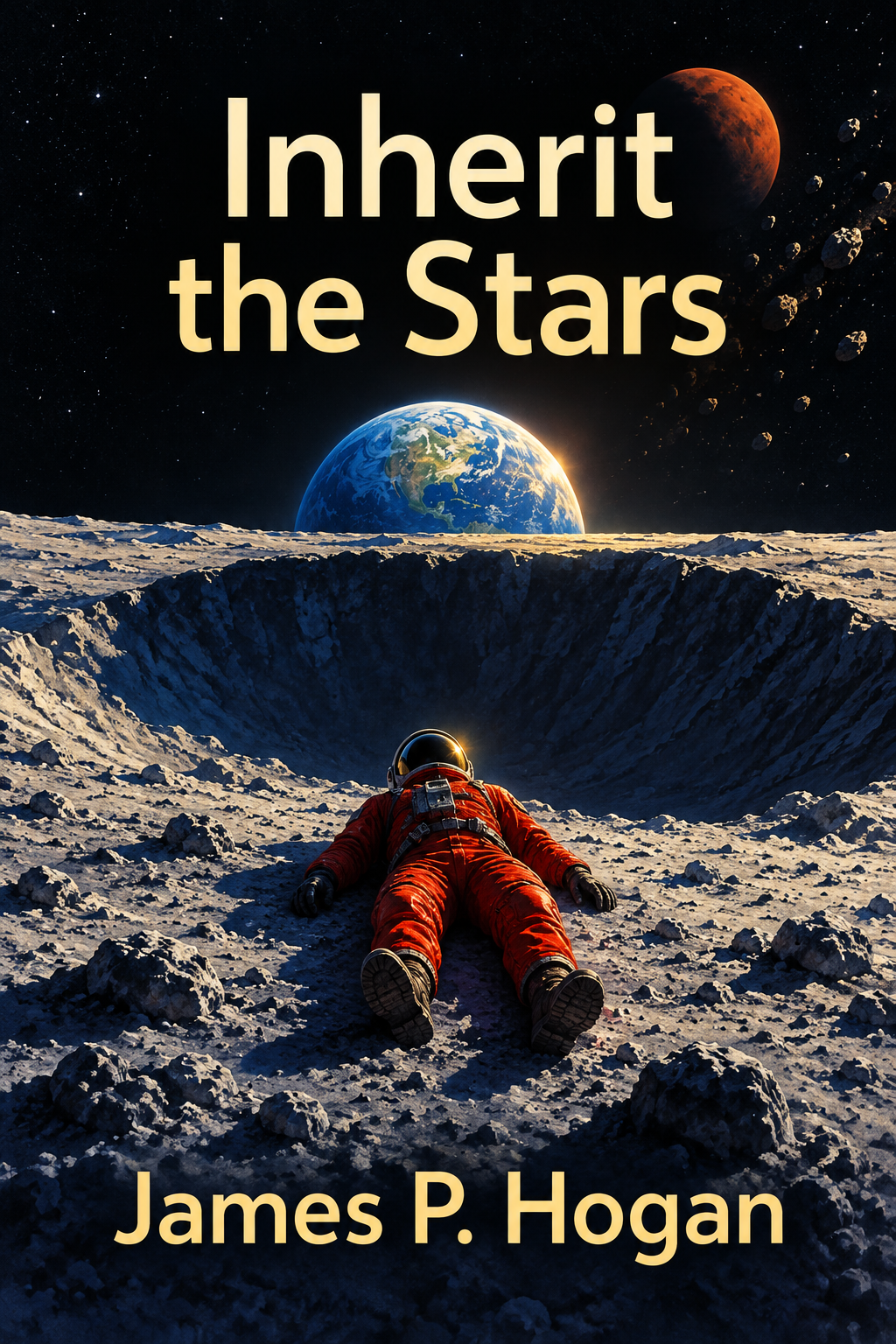
Inherit the Stars
by James P. Hogan
Inherit the Stars is a 1977 science-fiction mystery by James P. Hogan about a dead man found on the Moon. He wears a spacesuit unlike any the UN space agency has built, and he died about 50,000 years ago. Physicist Victor Hunt and biologist Christian Danchekker examine his body and belongings. Every explanation they try fits some clues and breaks on others, so the book becomes a detective story about evidence.
The Big Idea
"A human body found on the Moon forces scientists from different fields to rebuild the history of humanity and the solar system, one checked clue at a time."
Key Insights
Evidence before comfort
The team cannot settle the mystery by choosing the most appealing story. Each claim has to fit the radiocarbon date, the power unit and the biology of Charlie's body. That discipline keeps the plot moving, and it makes the final answer feel earned rather than handed over. A bold theory is often the first to break when the next piece of evidence arrives.
Danchekker confirms Charlie is human, but the fish-like creature in his food supplies cannot have evolved on Earth. Neither fact can be dropped, so no easy explanation survives.
A fresh pair of eyes
The breakthrough on the notebook does not come from the specialists who have been studying it. It comes from a person on Caldwell's staff who looks at the page with no theory in mind. The book suggests that expertise can create blind spots, and that a problem sometimes needs someone who has not already decided what it is.
When the secretary says the symbols are Charlie's calendar, the team tests the idea against Charlie's body chemistry and his natural day, and the language begins to open.
Two fields, one puzzle
Physics and biology each explain part of the problem, and neither is enough alone. The book shows a team gaining strength when experts from different fields argue over the same evidence and check one another's assumptions. Those debates feel close to real research teams, where specialists must translate their findings for each other.
Hunt's Moon and Danchekker's living things both appear in the final explanation: Hunt explains how the Moon came to Earth, and Danchekker explains how the Lunarians became our ancestors.
The past is read from what is left
Nobody can watch events that happened 50,000 years ago, so the team works from what remains: a body, a power unit, a diary, a calendar and a ship. The reader has to separate what is established from what is inferred. This is also the skill a good report needs, because it asks you to say which claim rests on which clue.
The diary says Charlie's people fought a war on a distant world. Only after the Ganymede ship appears does that claim connect to any evidence outside the diary.
Chapter Breakdown
Chapter-by-chapter summary
Spoiler warning: this section covers the whole plot, including the ending.
The novel is told in numbered chapters, and it moves through five broad stages of discovery. This guide follows them in the order the book tells them.
Charlie on the Moon: a dead man in an unfamiliar suit
In the late 2020s, a lunar survey party from the UN Space Arm (UNSA) finds the body of a man in a small cavern on the Moon. His spacesuit is unlike any UNSA design, and no one on record is missing from the Moon. Radiocarbon dating puts his death at about 50,000 years ago. The team nicknames him Charlie. Gregg Caldwell, a senior director in UNSA's Navigation and Communications Division, takes charge of the response and gathers a small group of experts to work out who Charlie was.
Why it matters: the opening sets a puzzle that fits no known history. A person has been lying for tens of thousands of years in a place that supposedly had no past, and the book will answer only what the evidence allows.
Hunt and Danchekker examine the body and his belongings
Caldwell recruits the physicist Victor Hunt, whose company has built the Trimagniscope, an instrument that produces magnified three-dimensional images of the inside of objects. Hunt uses it on Charlie's clothing and kit. Among the finds is a tiny power unit more compact than anything human engineers can make, and the decay of its radioactive material agrees with the age of the body. Meanwhile the biologist Christian Danchekker studies Charlie himself and declares him fully human, a member of Earth's own species. Yet the food supplies in his kit contain a fish-like creature that cannot have evolved from Earth life. Hunt and Danchekker start with different theories and very different temperaments.
Why it matters: the early clues contradict each other. Charlie is one of us, but his equipment and his food are not from our history. The reader learns that a puzzle is hardest when two solid facts will not fit together.
Charlie's notebook: the calendar and the language
Among Charlie's belongings is a notebook-like item filled with columns of symbols that nobody can read. Hunt's group treats it as a table of numbers and gets nowhere. The turning point comes when a woman on Caldwell's staff, his secretary, glances at the page and says that it looks like Charlie's calendar. To test the idea, the team works out Charlie's natural day from his body chemistry, and the calendar starts to make sense. With that foothold, the language opens up. Hunt reasons that the labels on Charlie's equipment must name physical quantities such as voltage and current, and this gives the linguists a way in. The notebook turns out to be Charlie's diary.
The diary tells of a soldier in a long war between two powers from a world of his own, and of a hard march across the Moon with his friend Koriel to reach a base called Gorda. Later discoveries support it: UNSA finds buried bases and equipment on the Moon, and the team begins to call these people the Lunarians. Yet the picture still has gaps. No trace of such a war appears on Earth, and the Lunarians' homeworld is not on any known map of the solar system.
Why it matters: a corpse becomes a witness. The calendar and the language show how an odd idea from an unexpected person can crack a problem that experts have been staring at.
The ship in Ganymede's ice
By now the investigation of Charlie has already made real progress, and then a new discovery arrives from Jupiter's moon Ganymede. An expedition finds the wreck of a spacecraft buried in the ice, millions of years old. Inside are the remains of its crew, humanoid giants about eight feet tall, whom the press quickly names the Ganymeans. The ship also carries samples of Earth animals, including primates. The giants' bodies match the structure of the odd fish-like creature that Danchekker found in Charlie's supplies. Hunt and Danchekker examine the find themselves.
Why it matters: the Moon mystery turns out to be only half of the picture. The Ganymede ship supplies the missing link between life on Earth and life from another world, and the reader has to ask how the two finds can belong to one story.
The answers: Minerva, the Moon and human origins
The pieces fall into place. Between Mars and Jupiter there once orbited a planet that the team calls Minerva, and the asteroid belt is its wreckage. The Ganymeans had carried Earth animals to Minerva millions of years ago, and the primates they brought there eventually evolved into the Lunarians. The Lunarians built a civilisation, split into rival powers and fought a war around 50,000 years ago, the war that Charlie describes. It destroyed Minerva.
Hunt explains the Moon. It was originally the moon of Minerva, which is why Lunarian bases lie on it. When Minerva broke apart, the Moon was thrown loose and Earth captured it. Danchekker explains the people. Survivors of the Lunarians reached Earth, where they displaced the Neanderthals, and modern humans descend from them. Charlie is not a visitor from the past of another planet. He is part of our own family history.
Why it matters: the final answer joins the Moon, the asteroid belt, the fish-like creature and Charlie's diary into one history, and it gives the title its meaning. Humans have inherited something from a lost world.
Characters
Charlie is the man found on the Moon. He was a soldier in the Lunarians' war and died about 50,000 years ago. He never speaks in the present, but his body, his kit and his diary drive the whole investigation.
Victor Hunt is a physicist and one of the two leading scientists. He uses the Trimagniscope to look inside Charlie's belongings and finds the idea that opens up the language. His reasoning is patient and practical rather than flashy.
Christian Danchekker is the biologist. He insists that every claim must make biological sense, which makes him a sharp check on bold ideas. He establishes that Charlie is human and later explains how modern people descend from the Lunarians.
Gregg Caldwell is an executive director in the Navigation and Communications Division of UNSA, the UN Space Arm. He organises the team and keeps it supplied, and he represents the institution that must make sense of the find.
Lyn Garland works on Caldwell's staff. She recognises that the symbols in Charlie's notebook are a calendar, and that one remark changes the course of the investigation.
Koriel is Charlie's friend and companion in the war. The diary shows the two of them struggling across the lunar surface toward Gorda, which gives Charlie a human face.
The Ganymeans are the giant humanoids whose ship is found in Ganymede's ice. They lived millions of years ago and carried Earth animals, including primates, to Minerva, so they start the chain that leads to the Lunarians.
The Lunarians are the people who grew up on Minerva. The name comes from the Moon, where Charlie is found, but they did not originate there. Their survivors reached Earth, and modern humans descend from them.
Writing about this book
A good report on this novel follows the evidence. Choose one clue, such as Charlie's calendar or the ship on Ganymede, and explain what the team could reasonably conclude at that point. Then decide whether the conclusion was fair. You do not need to cover the whole plot. One clue, explained well, is enough for a strong short piece.
Some questions can give your writing a shape. How does the book present scientific doubt: as a weakness that slows the team, or as a strength that protects it? Why does a mystery about the distant past feel urgent to the characters? Does the science feel believable to you, and what would make it more convincing? Each question can become one paragraph of your report.
Another option is to compare Hunt and Danchekker. Which working style would you trust on a hard problem, and why? Answer in your own words, keep any quotation very short, and say which part of the story you are describing so that your reader can follow your argument from start to finish.
Take Action
Practical steps you can implement today:
-
Track the clues in a notebook: write each new fact and the question it raises.
-
Note when a character changes their mind, and which piece of evidence caused the change.
-
Compare Hunt's and Danchekker's methods, then decide which approach you would trust on a hard problem.
-
Ask who looks at a problem differently, as the secretary does with the calendar, before you assume the experts have seen everything.
Notable Quotes
"“Oh, I see you found Charlie's calendar.” (the calendar scene)"
— James P. Hogan
"“Charlie's natural periods of sleep and wakefulness” (the calendar calculation)"
— James P. Hogan
"“They called him Charlie.” (opening line of the book's cover text)"
— James P. Hogan
Who Should Read This
Readers who enjoy hard science fiction and slow, clue-driven mysteries will get the most from this book. It suits older teenagers and adults who can follow scientific reasoning, and it works well on a school science fiction reading list. The story also deals with war and its aftermath, so younger readers may want to read it with a teacher or parent.
Frequently Asked Questions
Is Inherit the Stars part of a series?
Yes. It is the first novel in James P. Hogan's Giants series. The next books are The Gentle Giants of Ganymede and Giants' Star, and later volumes extend the story further. Each later book has its own focus, so you can decide after the first book whether to keep reading. This summary covers only the first novel.
Do I need the sequels to understand the first book?
No. The first book resolves its central mystery, so it works as a complete story on its own. The sequels take the story further for readers who want more. Starting with the first novel is the simplest way to see how the series began.
Is Inherit the Stars hard science fiction?
It is usually described that way, because its plot rests on scientific reasoning about dating, biology and physics rather than on magic. Readers who prefer character drama may find the pace slow, since much of the story follows the investigation step by step. Readers who enjoy puzzles often find that slow pace is exactly what they like.
Who is Charlie in Inherit the Stars?
Charlie is the nickname the team gives to the dead man found on the Moon. He was a soldier of the Lunarians and died about 50,000 years ago. His kit, his calendar and his diary supply most of the evidence in the book.
Does this summary cover a film or TV version?
No. This page covers only the novel. Any adaptation can change names, events and the ending, so check the book itself before you quote or write about the story.
Who is the main character?
There is no single hero in the usual sense. Victor Hunt and Christian Danchekker are the two central figures, and their partnership drives the story. Charlie, the dead man, is its starting point.
Check Your Understanding
Pick an answer for each question to see if you were right.
-
What nickname does the team give the dead man found on the Moon?
Charlie — The team calls him Charlie, and the nickname sticks through the investigation.
-
Which moon of Jupiter is the frozen spacecraft found on?
Ganymede — The ship is found in the ice of Ganymede, the largest moon of Jupiter.
-
Who first recognises that the symbols in Charlie's notebook are a calendar?
Lyn Garland — Lyn Garland, from Caldwell's staff, glances at the page and identifies it as Charlie's calendar.
-
According to the book's final explanation, what was the Moon before Earth captured it?
Minerva's moon — Hunt concludes that the Moon was once the moon of Minerva, a planet that broke apart.
-
According to the book's final explanation, which people are modern humans descended from?
The Lunarian survivors — Lunarian survivors reached Earth, displaced the Neanderthals, and are the ancestors of modern humans.
About James P. Hogan
James P. Hogan (1941–2010) was a British science-fiction writer, born in London. He trained as an electronics engineer and worked in the computer industry, including at Digital Equipment Corporation, before writing full time. Inherit the Stars (1977) was his first novel and began the Giants series, which later grew to several books.
Summary Written By

Software Engineer & Writer
Software engineer with a passion for distilling complex ideas into actionable insights. Writes about finance, investment, entrepreneurship, and technology.
View all summaries →Reviews
No reviews yet. Be the first to share your thoughts!
Write a Review
Keep reading
Explore the topic: FictionSummaries

Out of My Mind
Sharon M. Draper
“Out of My Mind” by Sharon M. Draper is a poignant narrative that explores the life of Melody Brooks, a…

Ender’s Game
Orson Scott Card
“Ender’s Game” by Orson Scott Card is a riveting science fiction novel that transports readers into a future where humanity…

Pachinko
Min Jin Lee
“Pachinko”, a spellbinding multigenerational historical saga by Min Jin Lee, explores the lives of a Korean family trying to make…

The Perks of Being a Wallflower
Stephen Chbosky
The Perks of Being a Wallflower by Stephen Chbosky is a profound coming-of-age novel, told through the intimate letters of…
Articles
The Enlightenment Explained: Ideas, Thinkers and Legacy
The Enlightenment was an 18th-century European movement that trusted reason and evidence over tradition and authority. Its thinkers, from Locke…
World History 1700–1918: Revolutions, Industry, Empire and War
Between 1700 and 1918, revolutions, factories, empires and a world war reshaped societies across Europe, the Americas, Asia and Africa.…

A Christmas Carol themes: generosity, isolation and responsibility
Dickens's novella is usually read as a story about a man who changes his mind. Its themes are sharper than…