In five minutes
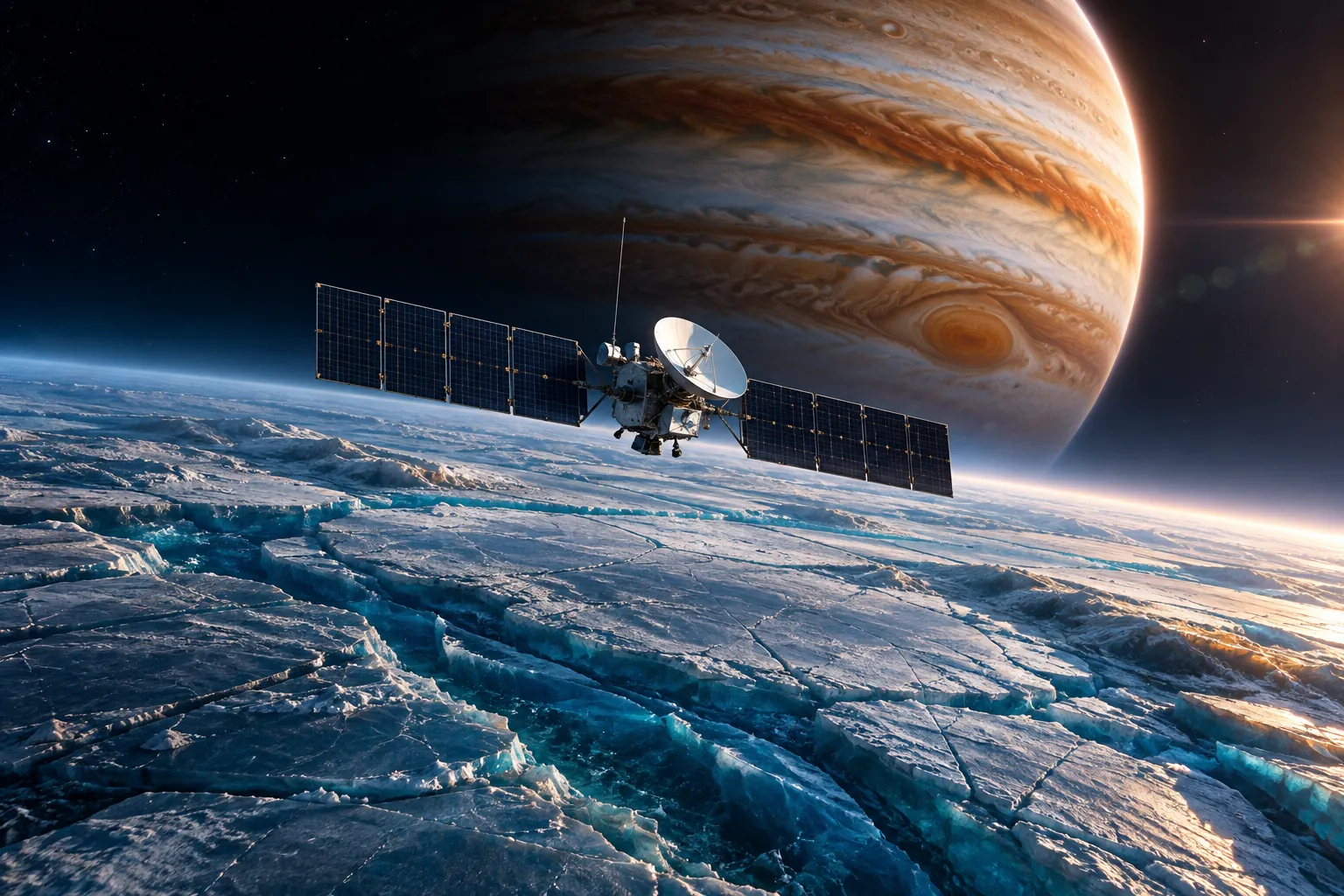
Europa Clipper is a NASA spacecraft built to study Europa, an ice-covered moon of Jupiter. It launched on 14 October 2024 and is due to reach Jupiter in April 2030. From there it will loop around the giant planet and sweep past Europa about 49 times, measuring the ice, the surface and the salty ocean that scientists think lies underneath. It is one stop in our guide to Jupiter's moons.
The key point is what the mission asks. Europa Clipper does not land, and it does not hunt for living things. Its question is narrower: does Europa have what life would need? That means liquid water, chemical building blocks and a source of energy, all able to meet in the same place. Scientists call this habitability, and it is the thread running through every instrument on board.
Why Europa?
Europa is a little smaller than Earth's Moon, about 3,120 km across, and circles Jupiter roughly every three and a half days. Its surface is water ice with very few craters, crossed by long cracks and ridges. Few craters means the surface is young by planetary standards, so something is still reshaping it.
The ocean idea rests on several clues. Voyager's pictures in 1979 showed the cracked ice. In the 1990s and early 2000s, the Galileo spacecraft measured how Jupiter's magnetic field was disturbed near Europa, a pattern easiest to explain with a layer of salty water under the ice. Estimates put that ocean somewhere between about 60 and 150 km deep, holding more water than all of Earth's oceans combined, below an ice shell perhaps 15 to 25 km thick. These are estimates, and measuring them properly is one of Clipper's main jobs. For more on the moon itself, see Europa (moon).
Another clue is tidal flexing. Europa's orbit is slightly oval, so Jupiter's pull on it rises and falls with every lap. The moon stretches and relaxes a little each time, much as a paper clip warms when you bend it back and forth. That flexing can create heat inside Europa, which may keep water liquid even though the surface, far from the Sun, sits at around minus 160 degrees Celsius.
The spacecraft and its instruments
Europa Clipper is the largest spacecraft NASA has built for a planetary mission. Fuelled, it weighs about six tonnes, and its solar arrays, fully unfolded, stretch about as wide as a basketball court. They need to be that big because sunlight at Jupiter is roughly 25 times weaker than at Earth.
Nine science instruments, plus radio measurements of Europa's gravity, work as a team:
- Cameras (EIS) map the surface and look for cracks, ridges and signs of recent change.
- Infrared mapper (MISE) reads the surface chemistry, including salts and organic compounds.
- Thermal imager (E-THEMIS) looks for warm spots that might mark recent activity.
- Ultraviolet spectrograph (Europa-UVS) searches for faint plumes and studies the thin atmosphere.
- Ice-penetrating radar (REASON) probes the shell for layers, pockets of water and the top of the ocean.
- Magnetometer (ECM) and plasma sensor (PIMS) measure the magnetic response that reveals how deep and how salty the ocean is.
- Dust analyser (SUDA) and mass spectrometer (MASPEX) sample the grains and gas around Europa and read their composition.
No single instrument can settle the big questions alone. The radar might spot a pocket of water inside the shell, the thermal imager could show a warm patch at the same spot, and the camera could show how the surface looks there. When several instruments agree about one place, scientists can trust the result far more than any single reading. That is why the flybys are planned so that the same regions are seen more than once, by different tools, in different light.
Jupiter's radiation is brutal, so the electronics sit inside a shielded metal vault. The craft also carries a plate engraved with Ada Limón's poem "In Praise of Mystery: A Poem for Europa", along with names submitted by the public.
The long road to Jupiter
Jupiter is too far for a direct flight with so heavy a spacecraft, so Clipper borrows energy from planets. After launch on a SpaceX Falcon Heavy from Florida, it flew past Mars on 1 March 2025. It returns to Earth for a second gravity assist in December 2026, and that swing sends it on to Jupiter, a journey of about 2.9 billion km in total.
Once there, it does not orbit Europa. Radiation near the moon would wear down an orbiter quickly, so Clipper circles Jupiter in long loops and dives toward Europa again and again. Over roughly four years, about 49 close passes will come as low as 25 km above the ice, each covering a different strip of the surface. Together they build a slow, patient map.
Between flybys the spacecraft waits in the quieter parts of its loop and sends its stored data to Earth. Each pass lasts only a short while, so much of the time is spent returning results rather than collecting them. The slow rhythm of rushing in, looking closely and pulling away again is a deliberate trade: it gives up constant watching in return for a longer working life.
The real science
Here is what is well established. Europa is an ice-covered world. Jupiter's gravity flexes it as it orbits, which can create heat inside. Magnetic data support a salty ocean. And in 2023 the James Webb Space Telescope found carbon dioxide in a region called Tara Regio, which may have come from below.
Here is what is still speculation. Does the ice shell hold pockets of water near the surface? Do plumes of vapour burst from the cracks? Hubble hinted at them more than once, but the evidence is debated. Does the sea floor have hot vents like those on Earth's ocean floor? And, above all, does anything live there? Clipper cannot answer the last question. It can tell us whether conditions are right and which places would suit a future lander, though no lander is currently approved. Europe's JUICE spacecraft, launched in 2023, will study the Jupiter system too, mostly Ganymede, and is due to arrive in 2031.
It also helps to know how scientists will judge the results. A finding of salty water close to the surface would be exciting, but it would not be proof of life; it would only raise the odds that Europa is a good place to look. A finding that the ice is very thick and sealed off from the ocean would lower them. Either result is a real answer, and both would shape what NASA and other space agencies choose to do next.
Where it shows up in fiction
Europa has long been a place for stories. Arthur C. Clarke's novel 2010: Odyssey Two (1982) makes it the one world humans are warned to leave alone, because something is developing there. The 2013 film Europa Report imagines a crewed trip to the ocean. The real Clipper is quieter: a robot, no crew, no aliens in its plan. Yet the question behind the fiction, whether there is life under that ice, is what gives the mission its pull.
Common misconceptions
- "It will land on Europa." It will not. It flies past and never touches the surface.
- "It will look for aliens." It carries no life-detection experiment. It checks whether the conditions for life exist.
- "It orbits Europa." It orbits Jupiter and makes repeated flybys, to limit radiation damage.
- "The ocean and plumes are proven." The ocean is strongly supported but has not been sampled directly. Plumes are still uncertain.
Read next
- Jupiter's moons: the hub for Io, Europa, Ganymede and Callisto.
- Europa (moon): what we know about the world Clipper is visiting.
- Jupiter facts: the giant planet whose gravity and radiation shape the whole mission.