In five minutes
A megastructure is a human-made or alien-made construction so large that people compare it with planets and stars, not buildings. Ringworlds, Dyson spheres, space elevators and giant derelict starships are the classic examples. Science fiction loves them for one reason: they show how powerful a civilization is without a word of explanation. A reader who sees a ring wrapped around a sun understands at once that its builders can do things we cannot.
The idea has two lives. In fiction, a megastructure is a setting, a mystery or a warning. In science, it is a thought experiment. Physicists and engineers ask what materials, energy and orbits it would need, and the answer is often “far beyond us today, but not forbidden by physics.” A few of them, such as the space elevator and the rotating space habitat, are serious engineering proposals. This page walks through the main types, the books that made them famous, and what is real.
How big is big?
Megastructures come in rough size classes. The numbers below are for the real proposals or the fictional designs named.
- Space elevator: a cable that reaches from the ground to well above geostationary orbit, which is 35,786 km up.
- Rotating habitat: a spinning cylinder or ring several kilometres wide, where spin stands in for gravity. Gerard K. O’Neill’s designs from the 1970s are the best known.
- Ringworld: in Larry Niven’s novel, a ring about the size of Earth’s orbit around its star, roughly 1.6 million km wide.
- Dyson sphere or swarm: a cloud of collectors, or in fiction a shell, around a whole star.
This ladder echoes an idea from 1964, when the Soviet astronomer Nikolai Kardashev suggested ranking civilizations by the energy they use. A “Type II” civilization would use the output of its entire star, which for the Sun is about 4 × 10²⁶ watts. Many megastructures in fiction are simply what a Type II civilization might build.
The real science
It helps to split the topic into three boxes: what is established, what is plausible, and what is only story.
Established. The physics of a space elevator is well understood. A cable anchored on the equator and held taut by a counterweight beyond geostationary orbit could carry loads up without rockets. The problem is the material. Carbon nanotubes are extremely strong in tiny samples, but nobody can make them in lengths of tens of thousands of kilometres. In the 1970s, NASA summer studies and O’Neill’s own work also showed on paper that a large spinning habitat could be built from known physics. No one has built one.
Plausible, but far off. A Dyson swarm of solar collectors is allowed by the laws of physics. It would need an enormous amount of material, probably taken from planets and asteroids. Freeman Dyson’s 1960 paper suggested a practical search: a civilization that captures starlight must release the waste heat as infrared light, so astronomers could look for stars that glow oddly in the infrared. Surveys have found no confirmed case.
Story only. A solid ring or a solid shell around a star runs into two problems. First, the spinning ring would need a material stronger than anything known. Niven invented one, called scrith. Second, a solid body around a star is not stable. Any small drift would grow until the ring crashed into the sun, unless something kept pushing it back. Niven acknowledged this in his sequel.
The best real-life test case is Tabby’s Star (KIC 8462852). Citizen scientists spotted its strange, irregular dimming in Kepler data, and a 2016 paper led by Tabetha Boyajian described dips of up to about 20 percent. Some researchers listed an alien megastructure as one wild possibility. Later observations found that the star dims by different amounts in different colours, which points to dust rather than a solid object. Nothing alien has been shown.
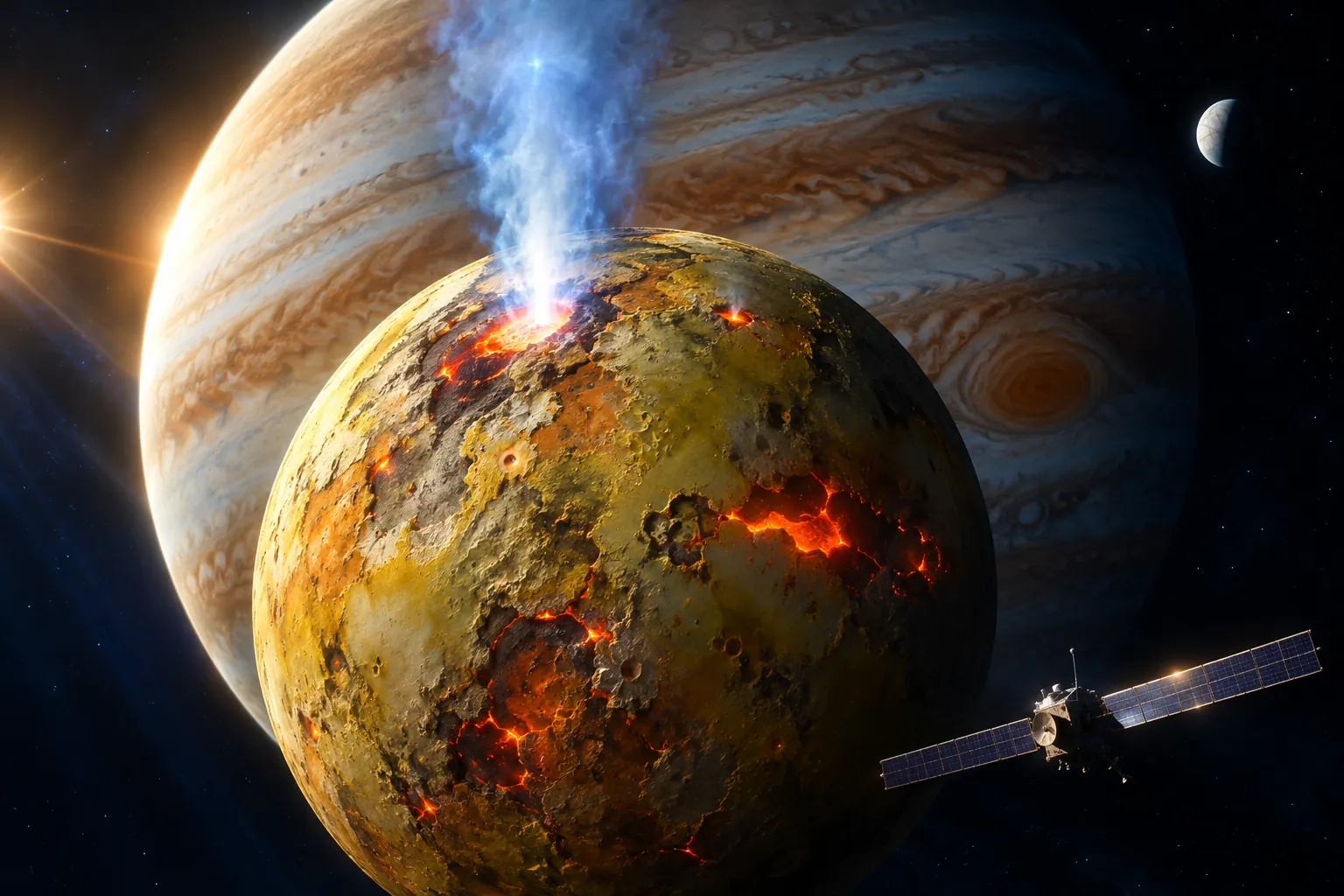
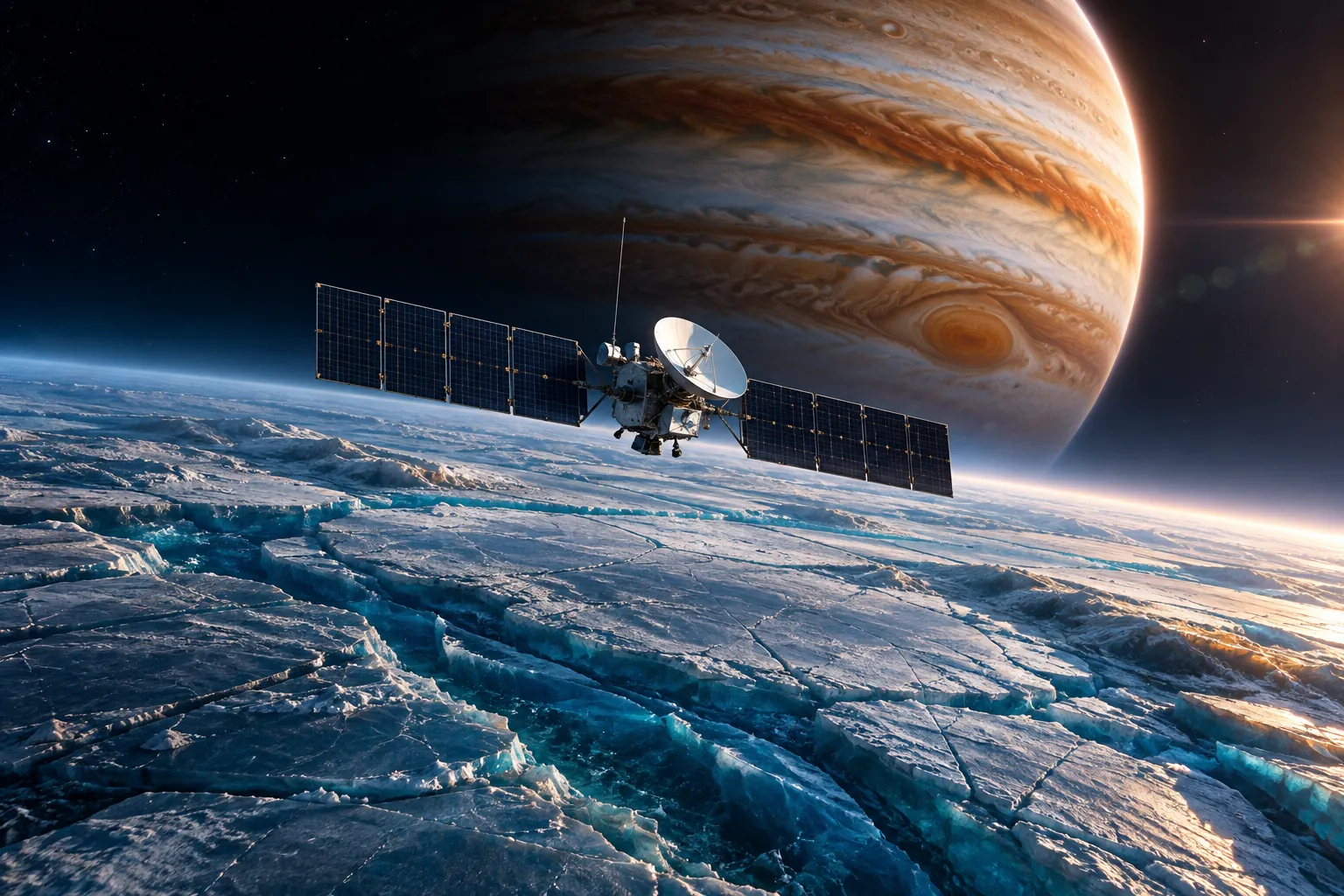
If you want real places that science-fiction writers borrow as settings, our guide to Jupiter’s moons is a good place to start.
Where it shows up in fiction
Ringworlds: Larry Niven’s Ringworld (1970)
A band about the size of Earth’s orbit, spinning at about 1,240 km per second to give roughly one Earth gravity, with an inner surface equal to around three million Earths. A small crew lands on it and finds that the builders are long gone. The book won the Hugo and Nebula awards and made “ringworld” a standard word. The sequel, The Ringworld Engineers (1980), deals with the stability problem.
Dyson spheres: from Star Maker to the swarm
Olaf Stapledon’s Star Maker (1937) imagined civilizations wrapping their stars in rings of habitats, and Dyson later said it inspired his paper. In fiction the idea often turns into a solid shell. Dyson himself meant a loose swarm of independent objects. See our full explainer on the Dyson sphere.
Space elevators: Arthur C. Clarke’s The Fountains of Paradise (1979)
The idea began in 1895 when Konstantin Tsiolkovsky imagined a tower reaching space. In 1960 Yuri Artsutanov proposed hanging a cable down from orbit instead. Clarke made it a novel about an engineer who builds one, and Kim Stanley Robinson’s Red Mars (1992) has an elevator on Mars. Read the details in our space elevator article.
Habitats and orbitals: O’Neill and Iain M. Banks
O’Neill’s 1974 article “The Colonization of Space” argued that spinning habitats could hold whole cities. Iain M. Banks used a variant in his Culture novels, starting with Consider Phlebas (1987): the Orbital, a ring that spins around a star and houses billions of people. Here the megastructure is not a mystery. It is just home.
Alien machines and endless cities
In Arthur C. Clarke’s Rendezvous with Rama (1973), a cylinder about 50 km long and 20 km wide enters the solar system, and a human crew explores it before it leaves. In Frederik Pohl’s Gateway (1977), people use abandoned ships left by an ancient species, the Heechee, to explore space. In Tsutomu Nihei’s manga BLAME! (serialised from 1997), the megastructure is a city so vast that its inhabitants have forgotten it has an outside.
Common misconceptions
- “A Dyson sphere is a solid shell.” Not in Dyson’s paper. He imagined a swarm of separate objects, since a rigid shell would be unstable and impossible to make from known materials.
- “A space elevator is a tall tower.” The classic design is a cable that hangs from far above geostationary orbit, held taut by a counterweight and by the Earth’s spin.
- “Tabby’s Star proves aliens.” It does not. The leading explanation is dust.
- “Megastructures are always alien.” Many, such as O’Neill’s habitats and the elevator, are human designs.
- “Niven’s ring works as written.” The first book’s ring is unstable, which is why the sequel adds fixes.
Read next
- Dyson sphere: how Freeman Dyson’s 1960 idea became a swarm, a shell and a search for waste heat.
- Space elevator: the physics of the cable and why materials are still the problem.