In five minutes: Jack the Ripper
Jack the Ripper is the nickname of the unknown person who murdered women in Whitechapel, a poor district of London's East End, in the autumn of 1888. Most historians link five killings to him, between 31 August and 9 November. The victims were poor women who lived in cheap lodging houses and often had to sleep or work on the streets. The killer was never identified, and the police files never closed with a name.
The case matters beyond crime history. It happened in the Victorian era, a year after the Golden Jubilee of Queen Victoria, in the capital of the world's largest empire. A short walk from the banks of the City lay some of the worst poverty in Europe. The murders pushed that contrast into the newspapers every day for ten weeks.
- Where: Whitechapel and Spitalfields, east of the City of London.
- When: 31 August to 9 November 1888 (the "canonical five").
- Outcome: nobody was charged, and the killer's identity is still debated.
Why Whitechapel? The East End in 1888
By 1888 London had more than five million people, and the East End was where many of the poorest lived. Work around the docks was casual: men queued each morning hoping to be hired for a day. Women took poorly paid jobs in sewing workshops, laundries and factories. In July 1888 the matchgirls of the Bryant & May factory in nearby Bow went on strike over pay and conditions, a sign of how tense life was.
The district was also crowded with newcomers. Irish families had arrived decades earlier, and from 1881 many Jewish refugees fled persecution in the Russian Empire and settled in Whitechapel. Housing was scarce. Many people rented a bed in a common lodging house for about four pence a night, and anyone who could not find the money slept in a doorway or went to the workhouse. The social researcher Charles Booth later found that roughly three in ten Londoners lived in poverty, and the East End was among the worst areas.
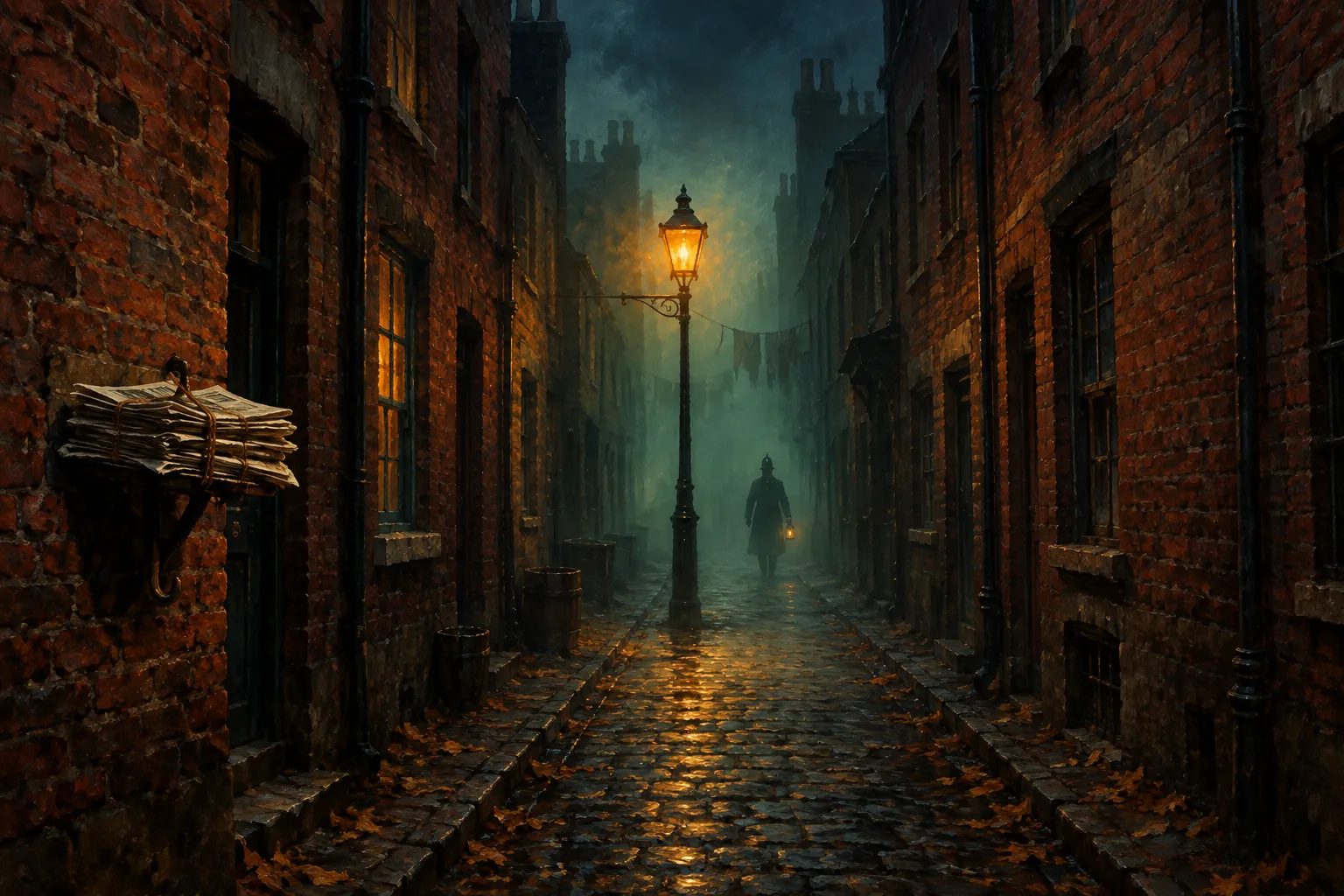
The streets themselves helped a killer. Narrow courts, shared backyards and dark passages sat between the main roads, and the gas lighting was patchy. Tension was already high: in November 1887, on "Bloody Sunday", police broke up a protest by unemployed workers in Trafalgar Square. Many East Enders distrusted the police before the murders began.
The killings
The police grouped the first murders under the label "the Whitechapel murders". Five are usually called the canonical victims. Other deaths, such as that of Martha Tabram on 7 August, are sometimes added, but historians disagree about them.
Mary Ann Nichols, 31 August
Nichols, aged 43, was found in Buck's Row (now Durward Street) in the early hours. She had been turned out of a lodging house because she could not pay for her bed.
Annie Chapman, 8 September
Chapman, aged 47, was found in the back yard of 29 Hanbury Street, Spitalfields. The attack was more severe, and the press began to speak of a single killer.
Elizabeth Stride and Catherine Eddowes, 30 September
On one night, now called the "double event", Stride, aged 44, was killed in Dutfield's Yard off Berner Street. Less than an hour later Eddowes, aged 46, was found in Mitre Square, which lay in the City of London and so under a different police force. A piece of Eddowes's apron was later found in Goulston Street, near a chalk message on a wall. Police chiefs feared that the message might provoke anti-Jewish riots, and it was washed off before daylight.
Mary Jane Kelly, 9 November
Kelly, about 25, was found in her rented room at 13 Miller's Court, off Dorset Street. It was the only killing indoors, and it was the most brutal. No canonical murder followed it.
The letters and the press
The name "Jack the Ripper" came from a letter. On 27 September the Central News Agency received a letter, dated 25 September and signed "Jack the Ripper", that mocked the police. A second message, a postcard, followed after the double event, and both were printed in the papers in early October. Many historians think a journalist wrote the letters, because they appeared to show knowledge the press already had. Yet the nickname stuck, and it turned an unknown man into a character.
On 16 October George Lusk, head of the Whitechapel Vigilance Committee, received a parcel with half a human kidney and a note "from hell". Whether it was real or a hoax has never been settled. Hundreds of other letters followed, almost all of them false.
The press explains why the case became famous. After the 1870 Education Act more working people could read, and cheap papers such as the new Star and the Illustrated Police News competed for readers with lurid reports and drawings. A rumour about a man called "Leather Apron" led to the arrest, and quick release, of a Jewish shoemaker, John Pizer. Fear of foreigners and Jewish migrants grew. At the same time, newspapers and reformers used the murders to describe the slums to a middle-class audience that rarely visited them.
Why the police failed to catch him
The police faced a hard problem. They had no fingerprint system (Scotland Yard adopted fingerprinting only in 1901), no blood typing and no practical way to link a suspect to a scene. Two forces worked in the area, the Metropolitan Police and the City of London Police, and they did not always share information smoothly. The Criminal Investigation Department had been created only in 1878, after a corruption scandal known as the Trial of the Detectives.
Inspector Frederick Abberline led much of the detective work on the ground, and Chief Inspector Donald Swanson oversaw the inquiry from Scotland Yard. Officers went house to house, questioned lodgers and arrested suspects, and a doctor, Thomas Bond, wrote an early offender profile. In October Commissioner Sir Charles Warren even tested bloodhounds in Hyde Park. Warren resigned on 8 November after a long dispute with the Home Office, so the Ripper case was only one of several pressures on him.
The Home Secretary, Henry Matthews, refused to offer a government reward at first. This was widely criticised, and local people formed vigilance committees and patrols of their own.
Suspects and theories
More than a hundred names have been proposed. In 1894 Sir Melville Macnaghten, a senior police official, named three men in a private memorandum: Montague Druitt, a barrister and teacher who was found drowned in the Thames in December 1888; Aaron Kosminski, a Polish Jewish hairdresser who was later placed in an asylum; and Michael Ostrog, a Russian-born convict. The evidence against each is thin.
In 2014 an author claimed that DNA on a shawl proved Kosminski was the killer, but geneticists and historians have challenged the claim. Other popular ideas, such as a royal conspiracy or the artist Walter Sickert, rest on little or no evidence. Most historians say the case cannot be solved with the records that survive. The study of the case is called "Ripperology".
Aftermath and legacy
After Kelly, the killings stopped as suddenly as they began. The Whitechapel investigation slowly ran down. Over the next years, reformers pointed to the murders as proof that slum housing needed to be cleared, and in the 1890s large rookeries in East London were demolished and replaced with planned estates.
The story went on to shape popular culture. Marie Belloc Lowndes published the novel The Lodger in 1913, and Alfred Hitchcock filmed it in 1927. Today the Ripper is one of the best-known figures of Victorian Britain, even though he is also one of its least understood. Historians now urge readers to remember the women, who had names, families and hard lives, and not only the unknown man.
What exams ask
The Ripper himself rarely appears in exam questions, but the setting does. Use the case as evidence for these AP-style points:
- Urbanisation and poverty: industrial cities produced overcrowded slums alongside great wealth.
- Immigration: Jewish and Irish communities in the East End and the hostility they faced.
- Mass media: rising literacy and cheap papers shaped public opinion.
- Policing and reform: professional detective work was still new, and public pressure led to calls for social reform.
Read next
- The Victorian Era (1837–1901): the hub for this topic, covering reform, industry and empire during Victoria's reign.
- Who Was Queen Victoria?: the queen whose long reign gave the age its name.
- The British Empire: the global power whose capital contained the East End.