In five minutes
Lawrence of Arabia was Thomas Edward Lawrence (1888–1935), a British officer and scholar who served as a liaison with the Arab forces fighting the Ottoman Empire in the First World War. The Arab Revolt, led by Sharif Hussein of Mecca and his sons, began in June 1916. Lawrence joined Hussein's son Faisal in the Hejaz, the western strip of Arabia that holds Mecca and Medina, that October. He helped turn a scattered rebellion into a campaign of raids on the Hejaz Railway, and he took part in the capture of Aqaba in July 1917. In October 1918 Arab and British Empire forces reached Damascus, and the Ottomans signed an armistice at the end of the month.
The story did not end happily for the Arab leaders. Britain and France had already planned to divide much of the region between them. Lawrence's own memoir, Seven Pillars of Wisdom, and a famous 1962 film made him a legend, but the revolt was an Arab movement with its own leaders.
Who was T. E. Lawrence?
Lawrence was born on 16 August 1888 in Tremadog, Wales, and grew up in Oxford. He studied history at Jesus College, Oxford, and became fascinated by medieval castles and the Middle East. Before the war he worked as an archaeologist at Carchemish, on what is now the Syrian–Turkish border, and learned the local Arabic.
When Britain went to war in 1914 he was commissioned and sent to Cairo, where he worked on maps and intelligence. In 1916 he joined the Arab Bureau, a small British office that studied the politics of the region. He was a junior officer, not a general. His value was that he knew the land, spoke the language and could explain Arab aims to British commanders, and British limits to Arab leaders.
Why the Arabs revolted
The Ottoman Empire had ruled most Arab lands for about four centuries. It entered the First World War in late 1914 on the side of Germany, which made it an enemy of Britain, France and Russia. Britain wanted to protect the Suez Canal and its route to India, and it wanted Muslim support to answer an Ottoman call for holy war.
Sharif Hussein bin Ali, the Ottoman-appointed guardian of Mecca and Medina, had his own motives. He feared that the government in Istanbul would remove him and tighten its grip on the Hejaz. In 1915 and 1916 he exchanged letters with Sir Henry McMahon, the British High Commissioner in Egypt. Hussein asked for British backing for an independent Arab state. McMahon's replies were warm but vague about borders, and they left out some coastal parts of Syria. Historians still argue about exactly what was promised.
In May 1916 Britain and France also agreed in secret, in the Sykes–Picot Agreement, how they would share influence over the Ottoman Arab provinces after the war. The Arab leaders did not know. The gap between what was said to the Arabs and what the Allies agreed among themselves is the central problem of this story.
The revolt begins, 1916
The revolt began on 10 June 1916, when Hussein's followers attacked Ottoman positions in Mecca. His sons Ali, Abdullah, Faisal and Zeid led forces drawn mostly from Bedouin tribes. They took Mecca and several Red Sea ports, but could not take Medina. It was held by an Ottoman garrison with modern artillery and supplied by the Hejaz Railway, which was built in the 1900s and ran from Damascus to Medina, more than a thousand kilometres through desert. In October 1916 Hussein proclaimed himself king of the Arabs, but Britain recognised him only as king of the Hejaz.
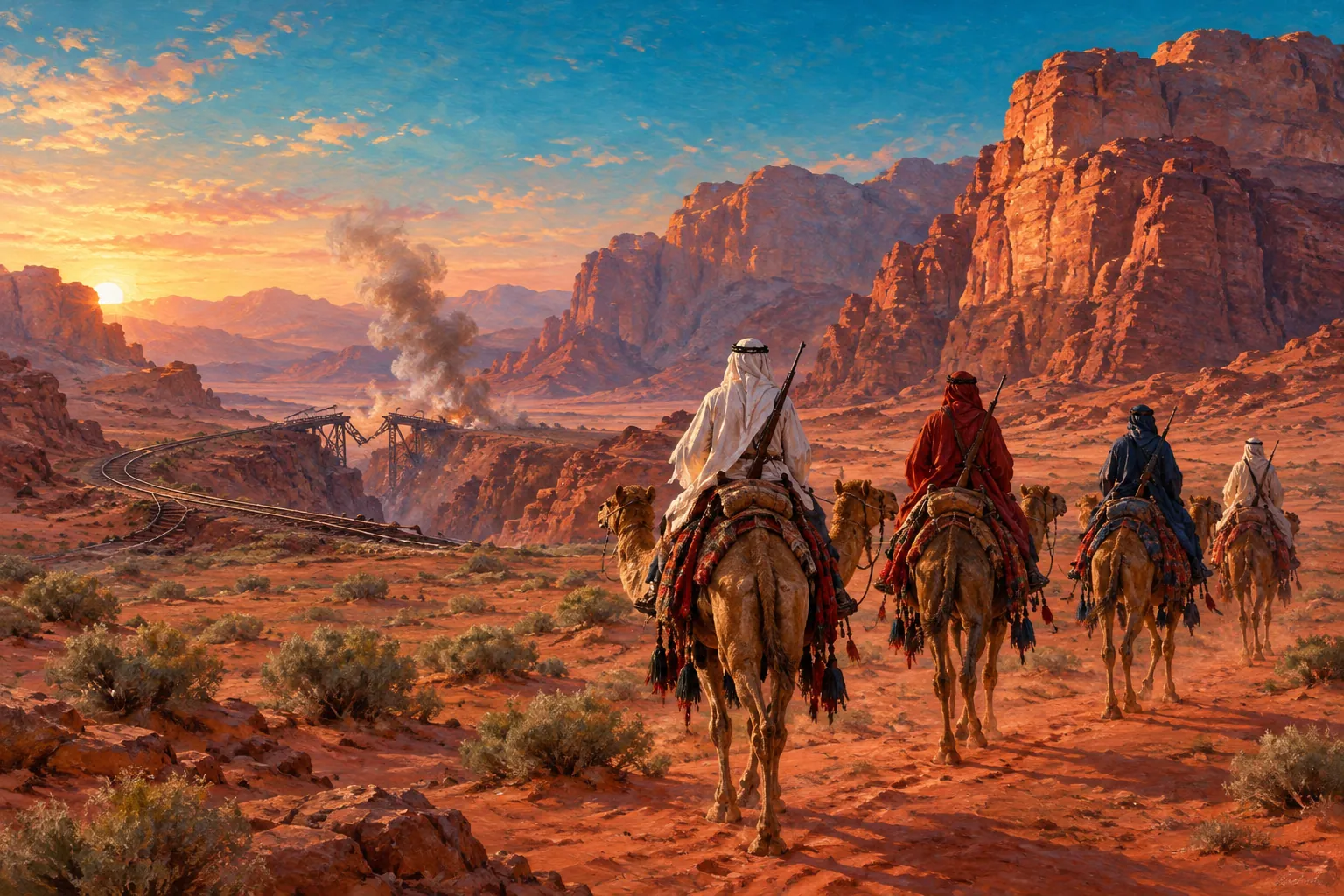
Lawrence travelled to the Hejaz in October 1916 and met Faisal, whom he judged the leader most likely to carry the revolt beyond Arabia. He advised against a frontal attack on Medina. Instead, the Arabs should leave the Ottoman garrison tied down in the city, with a long supply line to defend, and raid the railway again and again. Small mobile groups on camels could blow up track and bridges and vanish into the desert. This guerrilla style tied up Ottoman troops far out of proportion to the number of raiders.
Aqaba, 1917
By early 1917 the Arab forces had taken the Red Sea port of Wejh, which moved their base north. The next target was Aqaba, an Ottoman port at the head of the Gulf of Aqaba. Its guns pointed out to sea, so an attack from the water was hard.
Lawrence and the Howeitat leader Auda abu Tayi, with a small group, rode a long way round through the desert, gathered tribal fighters on the way and approached the town from inland. Aqaba surrendered on 6 July 1917. Lawrence was 28. The port gave the Arab forces a base that could be supplied by sea and was close to the British army in Egypt. Lawrence crossed Sinai to Cairo to report the result.
General Edmund Allenby soon took command of the British Egyptian Expeditionary Force and captured Jerusalem in December 1917. Faisal's army served as his eastern wing, attacking the railway east of the Jordan. In November 1917 Britain had issued the Balfour Declaration, supporting a national home for the Jewish people in Palestine, and the Bolsheviks published the text of Sykes–Picot. Arab leaders were alarmed.
Damascus, 1918
In September 1918 Allenby's main attack broke the Ottoman lines in Palestine at the Battle of Megiddo. As the Ottoman armies fell back north, the Arab forces advanced on Damascus. Arab and British Empire troops entered the city on 1 October 1918. The Ottoman Empire signed the Armistice of Mudros on 30 October. Lawrence, by then a lieutenant colonel, was exhausted and soon left for Britain.
Damascus was meant to be the capital of the Arab state that Faisal hoped to build. That hope was not realised.
After the war
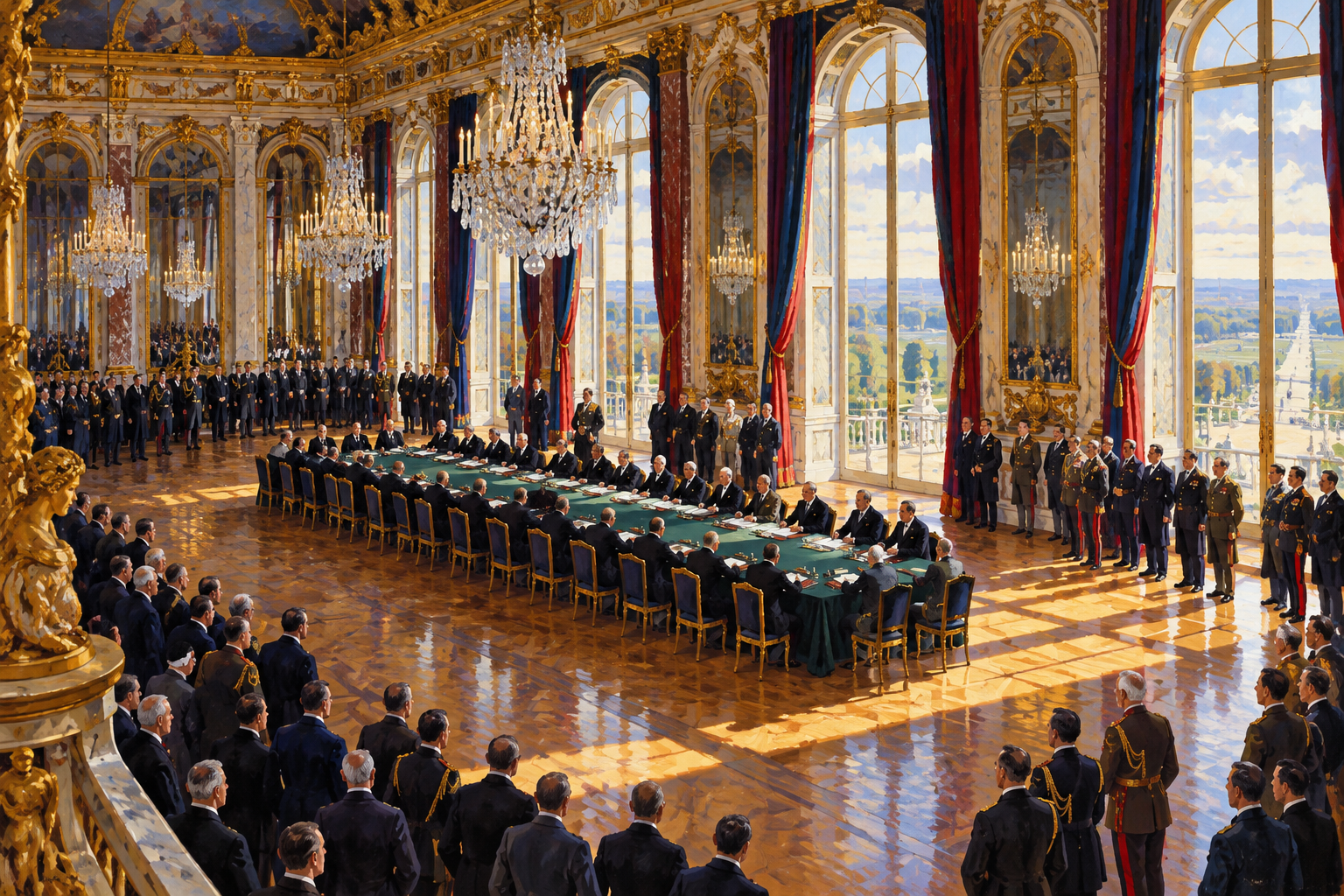
At the Paris Peace Conference in 1919 Lawrence helped Faisal argue for Arab independence. They did not succeed. Syria and Lebanon came under a French mandate, and Palestine, Transjordan and Iraq under a British one. Faisal was proclaimed king of Syria in March 1920, but French troops defeated his army that July and he left.
In 1921, at a conference in Cairo led by Winston Churchill, Britain made Faisal king of Iraq and his brother Abdullah ruler of Transjordan. Lawrence, then an adviser to Churchill at the Colonial Office, saw this as a partial repayment of Britain's debt to the Hussein family. He then withdrew from public life and joined the RAF under the name John Hume Ross, later serving in the army as T. E. Shaw. He died on 19 May 1935, days after a motorcycle accident near his home in Dorset.
The legend and the man
Lawrence became world famous largely through the American journalist Lowell Thomas, whose illustrated lectures from 1919 introduced "Lawrence of Arabia" to audiences in London and New York. Lawrence also wrote Seven Pillars of Wisdom, his account of the revolt, which was first printed privately in 1926 and published openly in 1935. In 1962 David Lean's film Lawrence of Arabia, with Peter O'Toole in the title role, gave the story its best-known image.
Historians read his account with care. He wrote vividly, but he also shaped his own part in events and sometimes made it larger. The revolt was driven by Arab leaders: Faisal and his brothers, and tribal chiefs such as Auda abu Tayi. Regular Arab army units, led by former Ottoman officers such as Jafar al-Askari, carried much of the fighting. The fairest summary is that Lawrence was a gifted liaison and adviser who helped Arab leaders, not the commander of the revolt.
What exams ask
- Name the three wartime commitments, the Hussein–McMahon letters, the Sykes–Picot Agreement and the Balfour Declaration, and explain why they pulled in different directions.
- Explain why raids on the Hejaz Railway mattered even though the raiding parties were small.
- Place the revolt in the wider war: it protected the Suez Canal and drew Ottoman troops away from other fronts.
- Evaluate sources: Seven Pillars of Wisdom is a participant's memoir and should be compared with other accounts.
- Link the mandates after the war to the borders of the modern Middle East.
Read next
- World War I (1914–1918): Causes, Course and Consequences: see where the Middle East fits among all the fronts of the war.
- Where Are the Balkans? Map and Countries: another region where old empires and new nations collided before 1914.
- Triple Alliance vs Triple Entente: the alliance blocs that placed the Ottoman Empire on one side and Britain and France on the other.