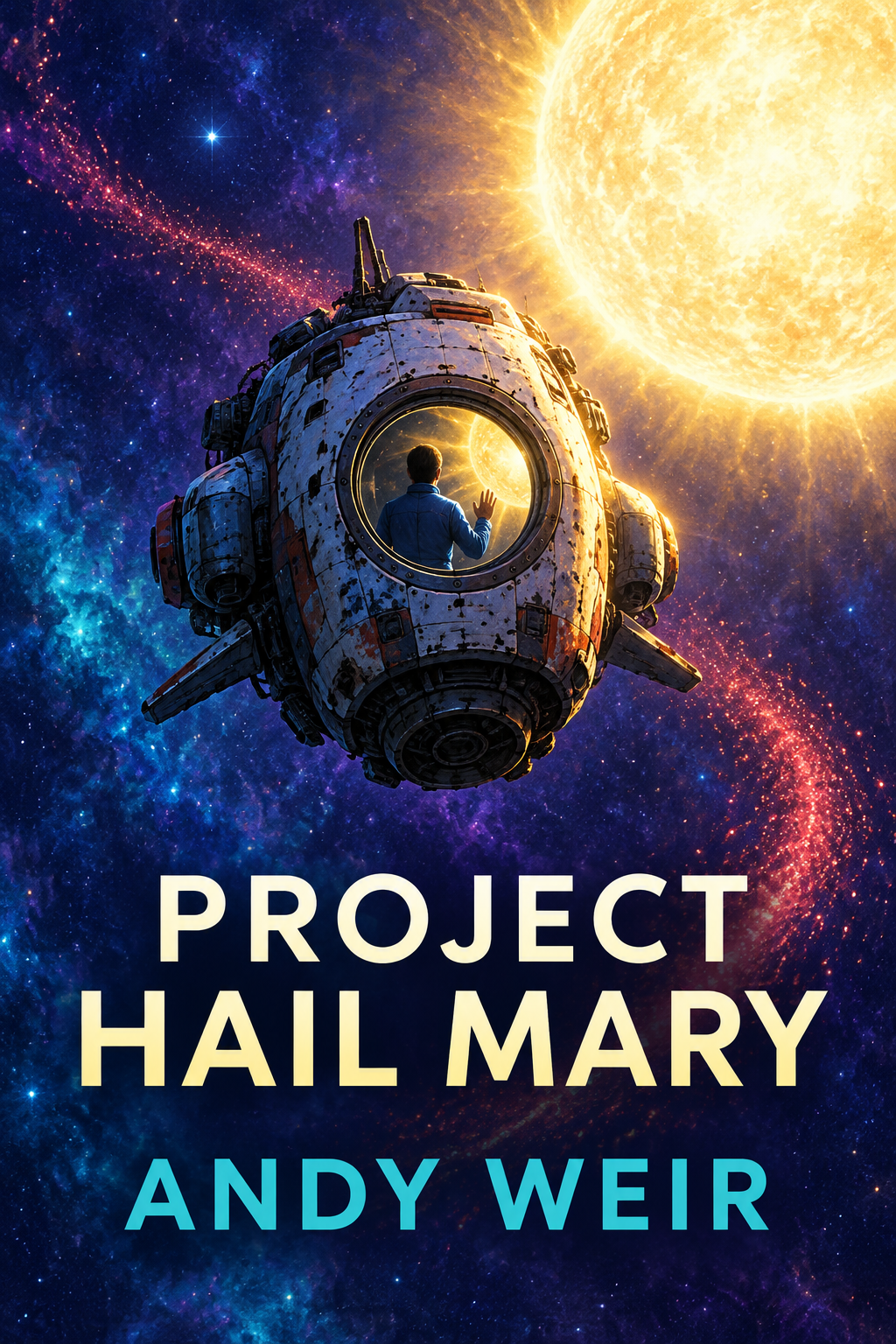
Project Hail Mary
by Andy Weir
Project Hail Mary is a science-fiction novel about a junior high science teacher who wakes up on a spaceship light-years from Earth with no memory of who he is. His two crewmates are dead. Bit by bit he remembers why he is there: a microbe called Astrophage is eating the Sun's energy, and Earth faces an ice age. His mission is to find out why one nearby star, Tau Ceti, is immune, and to send the answer home before it is too late.
The Big Idea
"Project Hail Mary argues that science is a team sport: one out-of-his-depth teacher, alone in deep space, shows how curiosity, careful experiments and a sense of humor can take on a problem the size of a star."
Key Insights
Science as a way of thinking
Grace's real tool is not equipment but method. When he doesn't know something, he makes a guess, designs a small test, checks the result and tries again. He times falling objects, tests samples and keeps careful notes. The book argues that science is less a pile of facts than a habit of breaking a huge problem into small, answerable questions. That is why its hero is a schoolteacher rather than a famous expert. Even his jokes are part of the method: they keep him calm enough to think.
With no memory, Grace drops objects and times their fall to prove he is not on Earth, using reasoning alone before he trusts any screen.
Friendship across every barrier (spoiler)
Spoiler: Grace and Rocky share nothing at first: not body plan, language, air, temperature or even senses, since Rocky has no eyes. They build a conversation from numbers and shared science, then from jokes. The book suggests that understanding does not need sameness; it needs patience, curiosity and promises that are kept. The clear wall between their halves of the tunnel slowly turns from a barrier into a meeting place, and their trust becomes the engine of the plot. Neither could finish the job alone.
Their fist bump through the wall, which Rocky learns from Grace, returns at the moment they say goodbye.
Cowardice and courage (spoiler)
Spoiler: Grace learns he did not volunteer. He refused the mission and was put aboard against his will, and he calls himself a coward. The novel does not define courage as having no fear. It shows a frightened man who once ran away choosing, the next time, to act for someone else. A first failure does not decide who you are; the next choice can. Because Grace is no flawless hero, his final decision lands harder, and his shame makes the ending feel earned.
Grace gives up his only way home to rescue Rocky, choosing danger on purpose for the first time.
The greater good versus one person's choice
Spoiler: Eva Stratt overrides laws, budgets and, in the end, Grace's own consent to give Earth its best chance. Without her, humanity might not survive. Yet Grace was sedated and launched into space against his will. The book refuses to turn either side into a simple villain. It hands readers a hard question instead: when saving billions collides with one person's freedom, which should win, and who gets to decide? The novel leaves that answer to you. Rereading the flashbacks with that in mind changes them.
In the flashbacks Stratt seems cold, yet every hard call she makes has the whole planet's survival riding on it.
Chapter Breakdown
How the story is told
The novel runs on two timelines. In the present, Ryland Grace is aboard the Hail Mary near the star Tau Ceti, solving one problem after another. In the past, told in flashbacks, his memory returns in pieces and shows Earth's race to build the ship. The amnesia is a storytelling tool: Grace learns the truth about himself at the same pace as the reader, so the last flashback changes how you see everything before it. The book has 30 numbered chapters; below they are grouped into eight parts.
Chapter-by-chapter summary
Spoiler warning: this section covers the whole plot, including the ending. It also reveals who Grace meets at Tau Ceti.
Part 1: Waking up alone
A computer keeps quizzing a groggy man with simple questions, starting with “What's two plus two?” He cannot remember his own name. Two crewmates lie long dead in nearby beds. By dropping objects and timing their fall, he works out that the gravity is wrong for Earth, so he must be somewhere else. Scraps of memory return: he was a teacher, and he knows a great deal about something called Astrophage. Looking at an unfamiliar star outside, he realizes he has reached Tau Ceti. Why it matters: before we learn anything else about Grace, the opening shows his real strength, which is careful, step-by-step reasoning.
Part 2: Earth in trouble (flashbacks)
In the flashbacks, scientists spot a faint infrared line running from the Sun to Venus, named the Petrova line after the scientist who noticed it. It turns out to be Astrophage, a single-celled organism that stores huge amounts of energy and is dimming the Sun. Grace holds a PhD in molecular biology but left research after his paper arguing that life might not need water was mocked. Eva Stratt, who has read that paper, recruits him to study samples, and he works out how Astrophage breeds. Other nearby stars are dimming too, except one: Tau Ceti. Why it matters: these chapters set the stakes and the scientific rules the rest of the story depends on.
Part 3: Building a one-way ship (flashbacks)
Stratt's task force is given almost unlimited power by the world's governments. Because Astrophage stores energy so densely, it becomes the ship's fuel. The trip to Tau Ceti takes years, so the crew must sleep through it in an induced coma, and very few people can survive one that long; the crew are chosen partly for a rare genetic resistance. Small probes called Beetles will carry the results home, because the ship has fuel for one direction only. Why it matters: this explains the dead crewmates, the ship's design and the sacrifice the mission demands from everyone aboard.
Part 4: A neighbor at Tau Ceti
Back in the present, Grace detects a second ship near Tau Ceti. Aboard is an alien from the 40 Eridani system, whose star is also being drained by Astrophage. Grace names him Rocky. The two connect their ships with a tunnel split by a clear wall of Rocky's xenonite, because they breathe different air at very different pressures and temperatures. Rocky speaks in musical chords; Grace builds a dictionary on his laptop, and slowly they learn to talk. Why it matters: a lonely survival story turns into a partnership, and the book's warmest thread begins.
Part 5: Two scientists, one problem
They pool what they know. Grace realizes that Rocky's crewmates died of radiation, something the Eridians had never understood. The pair reason that something on a planet they call Adrian keeps Astrophage under control there. A dangerous sampling run into Adrian's atmosphere goes wrong, and Rocky is badly hurt while helping save the ship; Grace, a biologist with no alien medicine to go on, nurses him back. In the samples they find Taumoeba, a microbe that eats Astrophage. Why it matters: the answer the whole mission was built for finally appears, and the cost of finding it shows how much each now depends on the other.
Part 6: Breeding a hero microbe
Taumoeba cannot survive the conditions on the planets where Astrophage breeds back home, so Grace and Rocky breed it generation after generation, keeping only the hardiest, until they have a strain that tolerates nitrogen. Each loads samples for his own world, and they say goodbye with a fist bump through the wall. Around this time Grace's final memory returns: he had refused to go, and Stratt had him sedated and put aboard anyway. He was not a hero who volunteered. He calls himself a coward. Why it matters: this painful truth gives his last decision its weight.
Part 7: Giving up the way home
Alone again, Grace finds that the hardened Taumoeba can slip through xenonite, the clear material Rocky's people build with. Rocky's fuel is stored in xenonite, so the microbes will eat it and leave him stranded in space. Grace sends the Beetles toward Earth carrying Taumoeba, then turns the Hail Mary around to find Rocky, knowing he can no longer get home. Why it matters: the man who once ran from danger now chooses it on purpose, and the title's long-shot gamble becomes personal. It is the most important decision in the book.
Part 8: A new home on Erid
Years later, Grace lives on Rocky's home planet, Erid, in a habitat the Eridians built for him, eating food made to suit a human body. He teaches science to young Eridians. Their measurements show that the Sun has returned to full brightness, so the Beetles reached Earth and the plan worked. He may go home one day, but for now he chooses to stay. Why it matters: the man who doubted his own courage ends the story as a teacher by choice, among friends. The last scene is a classroom, not a launch pad.
Characters
Ryland Grace. The narrator. A junior high science teacher with a PhD in molecular biology, who left research after his paper on life without water was ridiculed. Curious, funny and quick with experiments, he is also sure, deep down, that he is a coward.
Rocky (spoiler). An engineer from the planet Erid, with five legs, a rocklike shell and no eyes; he senses the world through sound. Proud, brave and a brilliant builder, he ends his questions with the word “question”.
Eva Stratt. A former European Space Agency administrator handed near-total authority to run the project. Blunt and focused only on results, she bends laws and people to save Earth, yet the book makes her hard to simply hate.
Yáo Li-Jie. The Chinese astronaut chosen to command the Hail Mary. Disciplined and driven by honor, he appears in training flashbacks. He does not survive the long coma on the way to Tau Ceti.
Olesya Ilyukhina. The Russian engineer and materials expert on the crew. Cheerful and fond of jokes, she is Yáo's opposite in mood. Like him, she dies in the coma during the voyage to Tau Ceti.
Irina Petrova. The scientist who first notices the faint infrared line between the Sun and Venus in the Earth flashbacks. The line is named after her, and her discovery starts the race to understand Astrophage.
Writing about this book
A good essay on this novel picks one idea and follows it through the story, rather than retelling the plot. Quote briefly, and tie each example back to your main point. Some angles to try:
- Courage: Grace calls himself a coward. Is his final choice brave, or something else? What would you have done in his place?
- Communication: how do two beings with no shared language build trust? Compare it with a friendship of your own.
- Scientific thinking: find a scene where Grace solves a problem step by step and explain his method.
- Ethics: was Stratt right to force Grace aboard? Argue both sides before you decide, and think about who had the right to choose.
- Teaching: Grace begins and ends the book as a teacher. How has the meaning of teaching changed for him?
A strong opening could ask the reader to imagine waking alone in space with no memory, then show how Grace reasons his way forward.
Take Action
Practical steps you can implement today:
-
When a problem feels too big, break it into small questions you can test one at a time, and write down what you learn.
-
To understand someone very different from you, start from what you share, such as numbers or facts, and build from there.
-
A past failure does not have to define you; what you choose to do next matters more.
-
Humor is a serious tool: it keeps you calm enough to think clearly when things go wrong.
Notable Quotes
"“What's two plus two?” (Chapter 1)"
— Andy Weir
"“Amaze! Amaze! Amaze!” (Rocky, Part 4)"
— Andy Weir
"“You sleep. I watch.” (Rocky, Part 5)"
— Andy Weir
"“Fist my bump.” (Rocky, Part 6)"
— Andy Weir
Who Should Read This
Readers who loved The Martian, fans of space stories, and anyone who likes clever problem-solving will enjoy it. The science is explained like a good lesson, so strong readers from about age 13 can follow it, and it works well for high school book reports. Adults who saw the 2026 film and want the full story will find much more here.
Frequently Asked Questions
What is Project Hail Mary about?
It follows Ryland Grace, a junior high science teacher who wakes alone on a spaceship near the star Tau Ceti with no memory. A microbe called Astrophage is dimming the Sun, and his mission is to find out why Tau Ceti is unaffected. The story alternates between his problem-solving on the ship and flashbacks to Earth.
Who are the main characters in Project Hail Mary?
The core cast is Ryland Grace, the narrator, and Eva Stratt, the official who runs the project. Grace's dead crewmates, Commander Yáo Li-Jie and engineer Olesya Ilyukhina, appear in flashbacks. Another major character joins the story at Tau Ceti; that reveal is one of the book's best surprises, so see the spoiler-marked Characters section above.
Do you need to know science to enjoy it?
No. Grace is a teacher, so he explains each problem the way he would to a class. There are numbers and experiments, but you only need to follow what he is testing and why. Skimming a calculation will not spoil the story, and the human side carries you through.
What does the title Project Hail Mary mean?
In American football, a Hail Mary pass is a long, desperate throw at the end of a game, when nothing else is likely to work. The name fits a one-way, last-chance mission to save Earth that may well fail, and it sets the tone for the whole book.
Is Project Hail Mary connected to The Martian?
No, it is a standalone novel with a new story and characters. It shares The Martian's style, though: a lone, funny narrator solving one scientific problem after another to survive. Readers who liked one usually enjoy the other.
Check Your Understanding
Pick an answer for each question to see if you were right.
-
What was Ryland Grace's job on Earth when he was recruited?
Junior high science teacher — Grace had trained as a molecular biologist but was teaching junior high science when Stratt brought him in.
-
What is Astrophage?
A single-celled organism that absorbs a star's energy — Astrophage stores huge amounts of energy taken from stars, which is why the Sun is dimming.
-
Why is the Hail Mary sent to Tau Ceti?
It is the only nearby star that is not dimming — Tau Ceti resists Astrophage, so the mission hopes to learn why and copy the answer.
-
How are the mission's results meant to reach Earth?
Aboard small probes called Beetles — The ship only has fuel for one way, so the Beetles probes are built to carry findings home.
-
Why were the crew chosen partly for their genes?
Resistance to a long induced coma — The crew sleep through the years-long trip in a coma that very few people can survive.
About Andy Weir
Andy Weir is an American novelist and former software engineer, born in 1972. He first published The Martian chapter by chapter on his website; it became a bestseller and a 2015 film. Project Hail Mary (2021), his third novel, brings back his trademark mix of hard science, problem-solving and humor, and was adapted as a film in 2026.
Summary Written By

Software Engineer & Writer
Software engineer with a passion for distilling complex ideas into actionable insights. Writes about finance, investment, entrepreneurship, and technology.
View all summaries →Reviews
No reviews yet. Be the first to share your thoughts!
Write a Review
Keep reading
Explore the topic: FictionSummaries

Out of My Mind
Sharon M. Draper
“Out of My Mind” by Sharon M. Draper is a poignant narrative that explores the life of Melody Brooks, a…

Ender’s Game
Orson Scott Card
“Ender’s Game” by Orson Scott Card is a riveting science fiction novel that transports readers into a future where humanity…

Pachinko
Min Jin Lee
“Pachinko”, a spellbinding multigenerational historical saga by Min Jin Lee, explores the lives of a Korean family trying to make…

The Perks of Being a Wallflower
Stephen Chbosky
The Perks of Being a Wallflower by Stephen Chbosky is a profound coming-of-age novel, told through the intimate letters of…
Articles

The Enlightenment Explained: Ideas, Thinkers and Legacy
The Enlightenment was an 18th-century European movement that trusted reason and evidence over tradition and authority. Its thinkers, from Locke…
World History 1700–1918: Revolutions, Industry, Empire and War
Between 1700 and 1918, revolutions, factories, empires and a world war reshaped societies across Europe, the Americas, Asia and Africa.…

A Christmas Carol themes: generosity, isolation and responsibility
Dickens's novella is usually read as a story about a man who changes his mind. Its themes are sharper than…