In five minutes
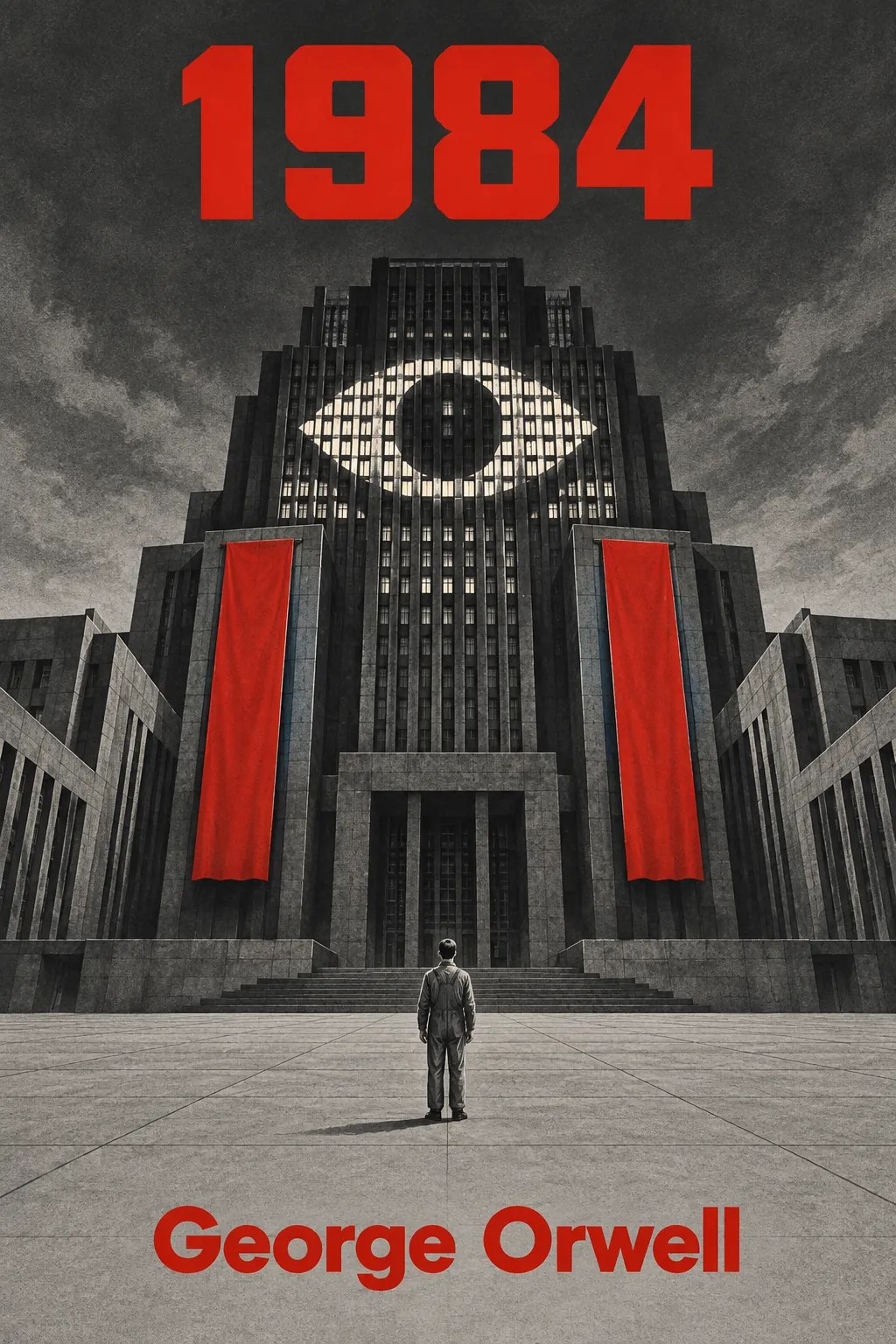
Big Brother is the face of the ruling Party in George Orwell's novel Nineteen Eighty-Four. He looks down from posters, stares out of screens, and stands for a state that watches everyone and demands love as well as obedience. If you have ever wondered about the Orwellian meaning of the name, that is the short answer. It is one of the best-known ideas in the history of science fiction.
The story is set in Oceania, one of three superstates, where Britain has become a province called Airstrip One. The Party rules through four ministries, a Thought Police and a screen in almost every home. Its public face is Big Brother, a man with a heavy black moustache whose picture hangs everywhere. The caption under the poster is the most famous line in the book: “Big Brother is watching you.”
Three things make Big Brother work as an idea. First, he is everywhere, so nobody can ever be sure they are unobserved. Second, he is presented as a protector, so fear is mixed with gratitude. Third, he may not be a real person at all, so nobody can argue with him, bribe him or replace him.
The Orwellian meaning of Big Brother
Where he appears in the book
Big Brother shows up on the first page. Winston Smith, a low-ranking Party worker in London, walks home past a huge poster whose eyes seem to follow you wherever you move. Inside his flat is a telescreen, a device that broadcasts Party messages and also watches and listens to the person in front of it. Winston can turn it down but never off. The Thought Police might be tuned in at any moment, or might not; nobody can tell, so everybody behaves as if they are always watched.
The Party feeds the cult of its leader through daily rituals. The best known is the Two Minutes Hate, when workers watch a film of the supposed traitor Emmanuel Goldstein and scream at the screen. The film ends with Big Brother's face, calm and strong, and the crowd chants his name. Hatred, fear and relief are all aimed at one figure. Meanwhile Winston writes “DOWN WITH BIG BROTHER” in his secret diary again and again, an act that counts as his first great crime of thought.
What holds the system up
- Telescreens: two-way screens that make privacy impossible, even at home.
- The Thought Police: an agency that punishes wrong thinking, not only wrong acts.
- Newspeak and doublethink: a shrinking vocabulary and a trained habit of believing two opposite things. See the article on doublethink.
- Changing the past: the Ministry of Truth rewrites records so that the Party always seems to have been right.
Is Big Brother real?
A mild spoiler follows: one scene from near the end of the book.
The novel answers this in a famous interrogation scene. Winston asks his questioner O'Brien whether Big Brother exists. O'Brien says that of course he does, because Big Brother is the embodiment of the Party. When Winston asks whether Big Brother exists in the same way he himself does, O'Brien tells him: “You do not exist.” The point is that the Party matters more than any single person, and a person who opposes it can be wiped out of the record.
Spoiler warning: the next paragraph gives away how the novel ends.
After the torture of Room 101, Winston is broken. The story ends with him in a café, watching Big Brother on the screen and realising he loves him. The last sentence of the story, “He loved Big Brother,” shows what the Party was really after: not just obedience but sincere affection. That is why Big Brother is more than a symbol of cameras. He stands for a state that wants to reach inside the mind.
The real science and the real world
Orwell finished the novel in late 1948, and it was published in June 1949. Europe had just come out of the Second World War, and the memory of Stalin's Soviet Union and of the cult of the leader in Nazi Germany was fresh. Orwell had worked for the BBC during the war and had seen how information and language can be bent for political aims. In his 1946 essay “Politics and the English Language” he argued that vague, dishonest wording helps people hide ugly acts. This is the second half of what “Orwellian” means: not only watching, but bending words and facts.
Telescreens did not exist in 1949, and television was only beginning to enter homes. So Orwell was not predicting a gadget. He was describing what happens inside people who think they might be watched. Even the possibility is enough to make them change their words and their faces.
Today governments and companies collect large amounts of data through cameras, phones and online accounts. In 2013 Edward Snowden, then a contractor for the US National Security Agency, revealed programmes of mass data collection, and many commentators reached for the name Big Brother. What is established is that such data collection exists. Whether it is the same thing as Orwell's nightmare is a matter of opinion, because much modern tracking is run by companies and accepted by users, while the telescreen was forced on everyone.
The television show Big Brother borrowed the name. The format was created by John de Mol and first aired in the Netherlands in 1999. Housemates live under cameras, and viewers vote people out. The difference from the novel is large: contestants choose to take part and can leave, and the power sits with the audience, not with a state.
Where it shows up in fiction
The place to start is the novel itself; our study guide to 1984 covers it part by part. Big Brother also had ancestors. Yevgeny Zamyatin's novel We, written in the early 1920s, has a ruler called the Benefactor, and Orwell reviewed it in 1946.
Other books approach the same fear from different angles. Ray Bradbury's Fahrenheit 451 (1953) fills living rooms with giant wall screens that eat up people's attention. Aldous Huxley's Brave New World (1932) is often set beside 1984 because its rulers control people with pleasure instead of fear. On screen, Terry Gilliam's Brazil (1985) and Apple's “1984” advertisement, shown at the Super Bowl in January 1984, both lean on Orwell's imagery. For the wider family of such stories, see the article on dystopia.
Common misconceptions
- “Big Brother watches everyone every second.” The novel stresses that nobody can know whether they are being watched at a given moment. The uncertainty itself keeps people in line.
- “Big Brother is a dictator who gives speeches in person.” In the book he appears as a poster, a screen image and a voice. Whether the man exists is left deliberately unclear.
- “The TV show is what Orwell meant.” The show took the name, but its contestants volunteer and a vote decides their fate. The novel is about a state that cannot be left or voted out.
- “Orwellian just means any government control.” It points more precisely to surveillance together with the twisting of truth and language. Orwell also attacked propaganda in democracies.
- “Orwell was only writing against communism.” He called himself a democratic socialist and fought on the Republican side in the Spanish Civil War. His target was totalitarian rule of any colour.
Read next
- 1984 by George Orwell: the full study guide, with chapter summaries and characters, for anyone who wants the whole story behind Big Brother.
- Doublethink: how the Party trains people to hold two opposite beliefs, which is the thinking side of Big Brother's power.
- Dystopia: the wider genre of nightmare societies, to see where Oceania fits.