In five minutes: the simulation hypothesis
The simulation hypothesis is the idea that the universe we live in, including our own minds, might be a computer simulation run by beings far more advanced than we are. The modern version comes from the philosopher Nick Bostrom, whose 2003 paper "Are You Living in a Computer Simulation?" argued that this is not as silly as it sounds. He did not say we are simulated. He said that if you accept a couple of reasonable assumptions, you are forced to pick one of three uncomfortable options. The idea also sits at the heart of a lot of fiction, which is why it fits into the wider story told in History of Science Fiction.
Here is the whole argument in plain words. First, assume that a mind does not have to be made of flesh. If a computer could copy the workings of a brain closely enough, the copy would have experiences too. Philosophers call this substrate independence. Second, assume that a civilization that survives long enough could build computers of enormous power. Put those together and such a civilization could run detailed recreations of its own past, with simulated people inside who believe they are real. Bostrom called these ancestor simulations.
Now count heads. If even a small share of advanced civilizations ran many such simulations, simulated minds would far outnumber the original, flesh-and-blood ones. A randomly chosen mind with experiences like yours would then be much more likely to be a simulated one. That is the engine of the argument: it is about numbers and probability, not about spotting glitches in the world.
The three options
Bostrom's conclusion is a trilemma. At least one of these statements must be true:
- Almost every civilization at our level dies out before it becomes "posthuman", meaning able to run simulations like these.
- Almost every posthuman civilization has no interest in running such simulations, or is not allowed to.
- We are almost certainly living in a simulation.
Notice what this does and does not say. It does not prove the third option. A person can accept the argument and still believe the first or second is the true one. Maybe civilizations rarely last. Maybe future people find ancestor simulations pointless, or ethically troubling, and never build them. Bostrom's point was that you cannot comfortably wave away all three at once. If you think humanity will probably survive, and will probably run such simulations, then you have already talked yourself into the third option.
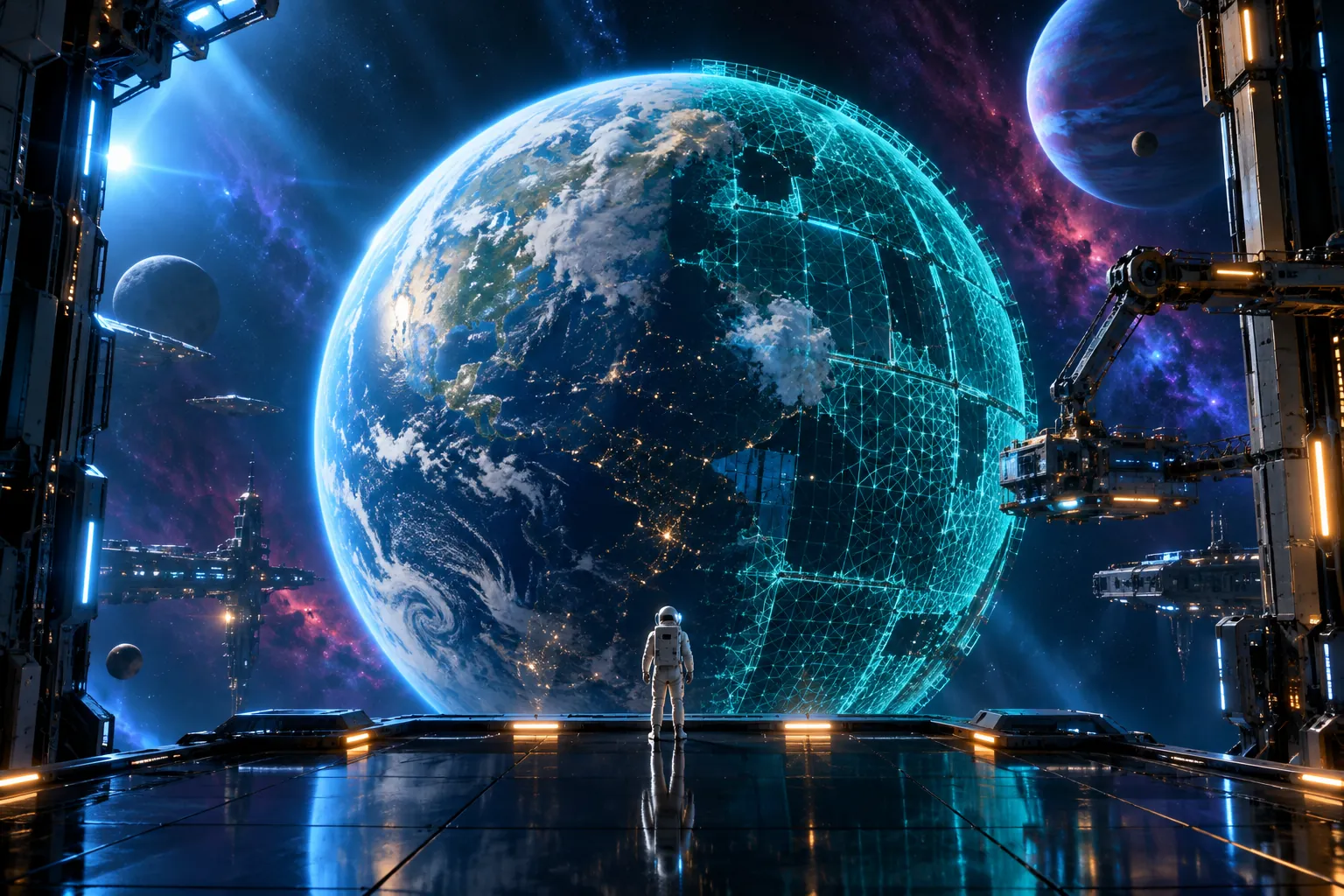
The argument also does not require the entire universe to be simulated. A simulator would only need to render enough detail where observers are actually looking, the way a video game draws what is on screen. That makes the computing cost far smaller than simulating every atom in every galaxy, though nobody can say how much smaller.
An old question in new clothes
The worry that the world might not be what it seems is ancient. The Chinese thinker Zhuangzi, writing around the third or fourth century BC, described dreaming that he was a butterfly and then wondering whether he was now a butterfly dreaming that he was a man. In 1641 René Descartes imagined a powerful deceiving demon who could make everything he sensed false. In 1981 the philosopher Hilary Putnam used the image of a brain in a vat, wired to a computer that feeds it a fake world, to ask what our words can really refer to. That one has its own page: Brain in a vat.
What Bostrom added was the probability argument and a modern, computer-based setting. Earlier thinkers asked, "How can I be sure I am not deceived?" Bostrom asked, "If simulations are cheap and numerous, how likely is it that I am in one?" That change from certainty to odds is what made the idea feel like something you could reason about, and it is why the paper is still cited more than twenty years on.
The real science
Be clear about what is established and what is speculation. Established: computers can simulate physical systems, and simulations are used every day to model weather, galaxies and molecules. In 1981 Richard Feynman pointed out that an ordinary computer struggles to simulate quantum physics exactly, which helped inspire the idea of quantum computers. Speculation: everything else. Nobody knows whether consciousness can run on a computer at all. Philosophers and scientists disagree, and some argue that something about biology, or about physics we do not yet understand, may be essential. If the first assumption fails, Bostrom's argument falls apart.
Can the hypothesis be tested? A few physicists have tried. In 2012 a team led by Silas Beane, with Zohreh Davoudi and Martin Savage, asked what would show up if our universe were simulated on a regular grid, as today's physics simulations are. They suggested that the highest-energy cosmic rays might travel unevenly along the grid's axes. The observations did not reveal such an effect, but that only argues against one narrow kind of simulation. A careful simulator could use a method that leaves no trace, or could simply edit anything we noticed.
This is the main complaint from critics. A hypothesis that explains every possible observation, and can be rescued from every possible failed test, risks being unfalsifiable. Many scientists therefore treat the simulation hypothesis as philosophy rather than physics. Others reply that it is still useful as a way to reason about the future of computing and about what we mean by "real". Public figures have added their own odds: Elon Musk said in 2016 that the chance we are in base reality is perhaps one in billions, while Neil deGrasse Tyson said around the same time that he put it at about fifty-fifty. Those are personal bets, not measurements.
Where it shows up in fiction
Fiction got there first. Daniel F. Galouye's 1964 novel Simulacron-3 follows an engineer who learns that his city is a simulation built for market research, and it became the German television film World on a Wire by Rainer Werner Fassbinder in 1973. Greg Egan's 1994 novel Permutation City imagines copies of people living inside software and asks hard questions about what happens when the computing stops or runs unevenly. Philip K. Dick wrote again and again about worlds that turn out to be false, even if he did not use computers to explain them.
The most famous example is the 1999 film The Matrix, where humans' bodies lie in pods while their minds live inside a shared computer world. It is a good picture of the idea, but a different one from Bostrom's, as the next section explains. Video games have also made the thought familiar: anyone who has played a game with a detailed open world has already seen how an artificial place can be built to be convincing from the player's point of view.
Common misconceptions
"Bostrom proved we live in a simulation." He did not. He proved only that one of three statements must hold, if his assumptions are right. Which one is true is still open.
"It is the same as The Matrix." Not quite. In the film, real human bodies are plugged into a machine. In Bostrom's version, there may be no body outside at all: the mind itself is part of the simulation. There is no red pill to take, because there is no body to wake up in.
"If we are simulated, nothing matters." Many philosophers disagree. David Chalmers, in his 2022 book Reality+, argues that a simulated world can be fully real, and that the people and things in it are not illusions. Pain would still hurt, and friendships would still count.
"We should look for glitches." The argument itself does not predict glitches. A well-made simulation would show none, and anything odd we noticed would have many ordinary explanations.
"Famous people believing it makes it science." Opinions from entrepreneurs and scientists are interesting, but the idea stands or falls on its assumptions about consciousness and computing, and those are still unsettled.
Read next
The simulation hypothesis belongs to a family of "what if reality is not what it seems" puzzles. For the old philosophical version with a vat and a computer, read Brain in a vat. For a very different idea, in which a mind appears by random fluctuation in a universe that is otherwise empty, read Boltzmann brain. To see where simulated worlds sit among other sci-fi ideas, go back to History of Science Fiction.