In five minutes
A warp drive is a proposed way to travel faster than light without the ship itself ever outrunning light. The best-known design is the Alcubierre drive, described by the Mexican physicist Miguel Alcubierre in 1994. It is a valid solution of Einstein's equations of general relativity. It is not a machine, and nobody knows how to build one.
Warp drive is one of the oldest tools in the history of science fiction, and one of the few that physicists have taken seriously enough to write down in equations.
The problem it tries to solve is distance. The nearest star system, Alpha Centauri, is about 4.2 light-years away, so even light needs more than four years to get there. Voyager 1, moving at about 17 kilometers per second, would take roughly 75,000 years. Special relativity says that an object with mass cannot be pushed up to the speed of light through space, so a bigger rocket never solves this. The speed limit is built into how space and time work.
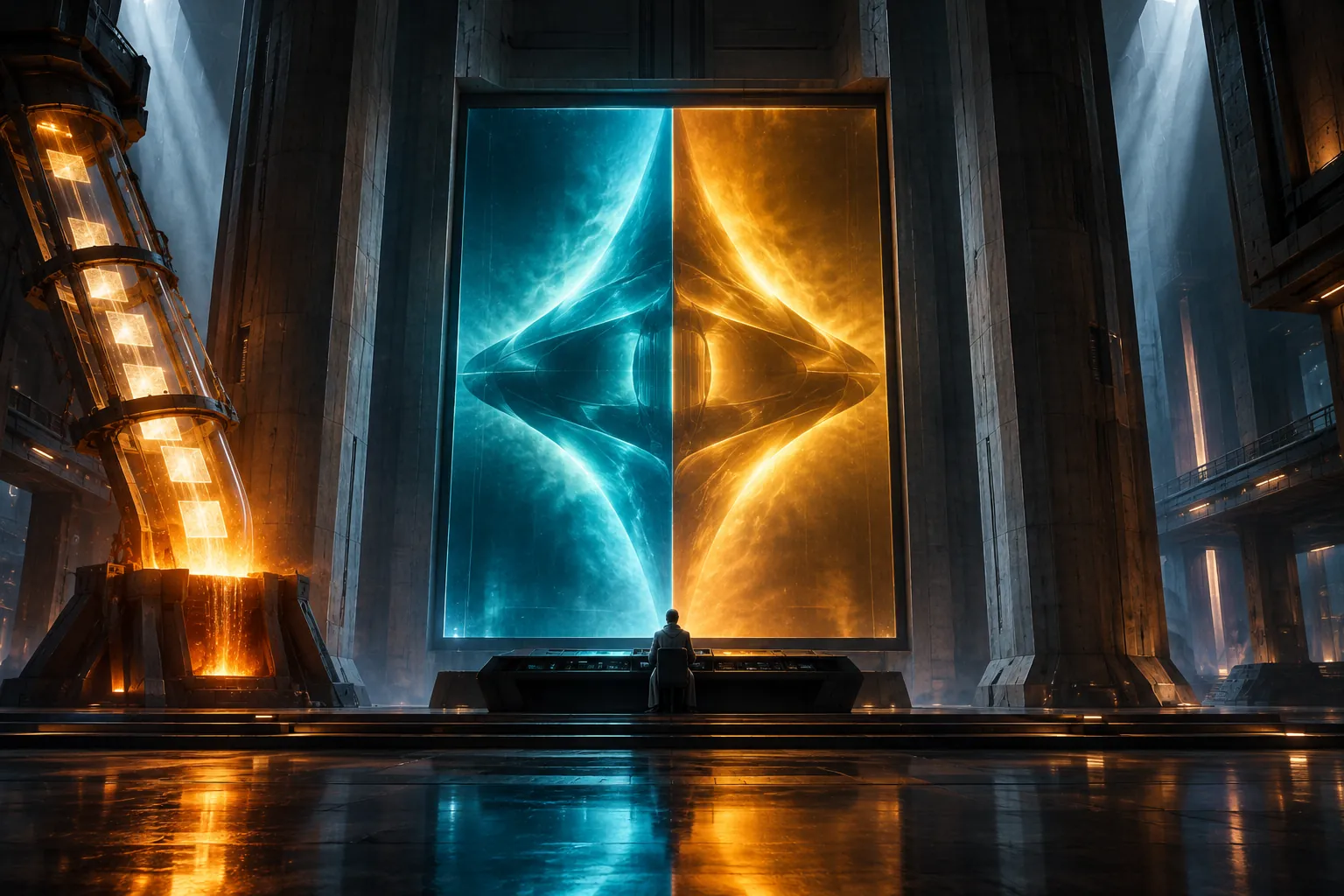
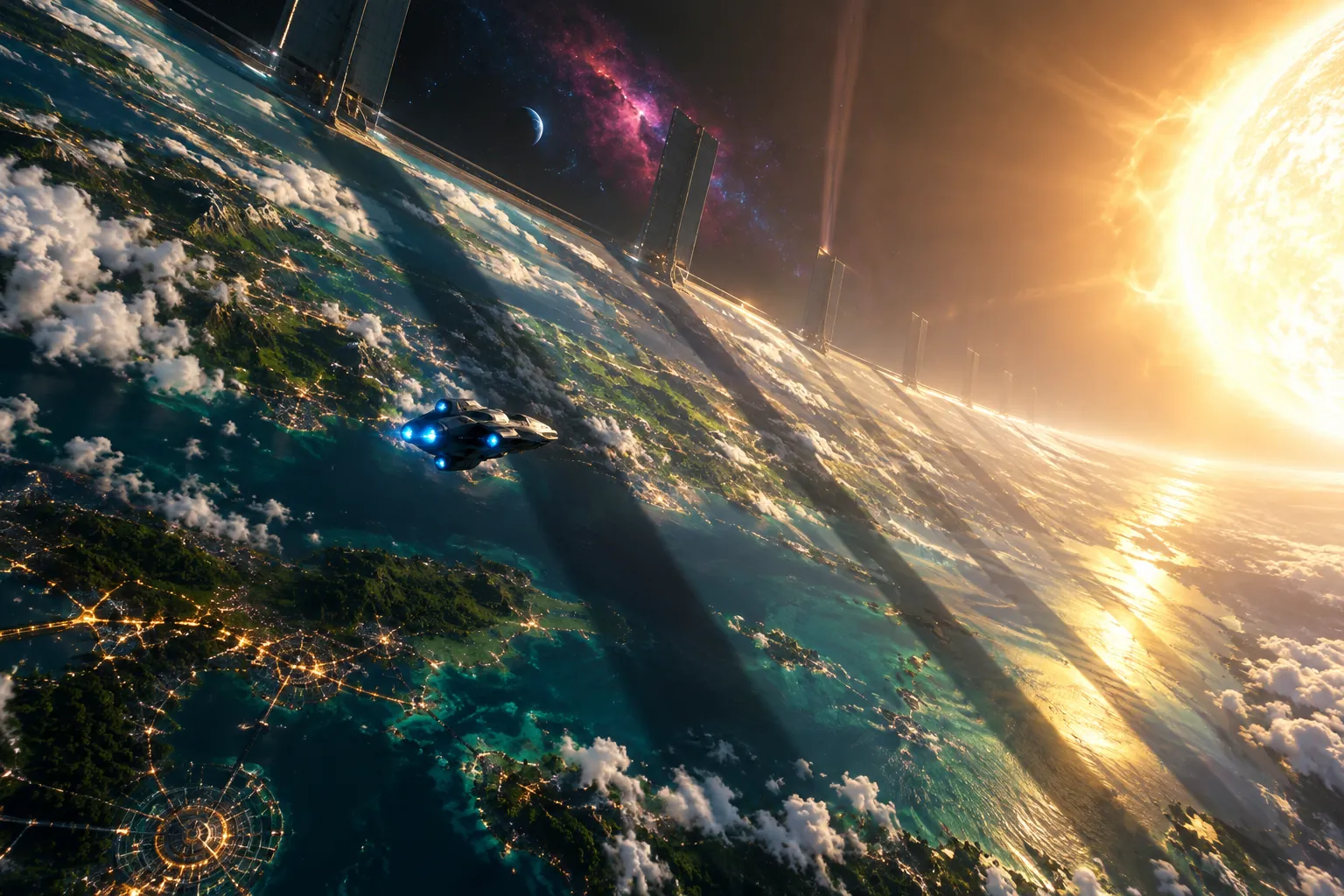
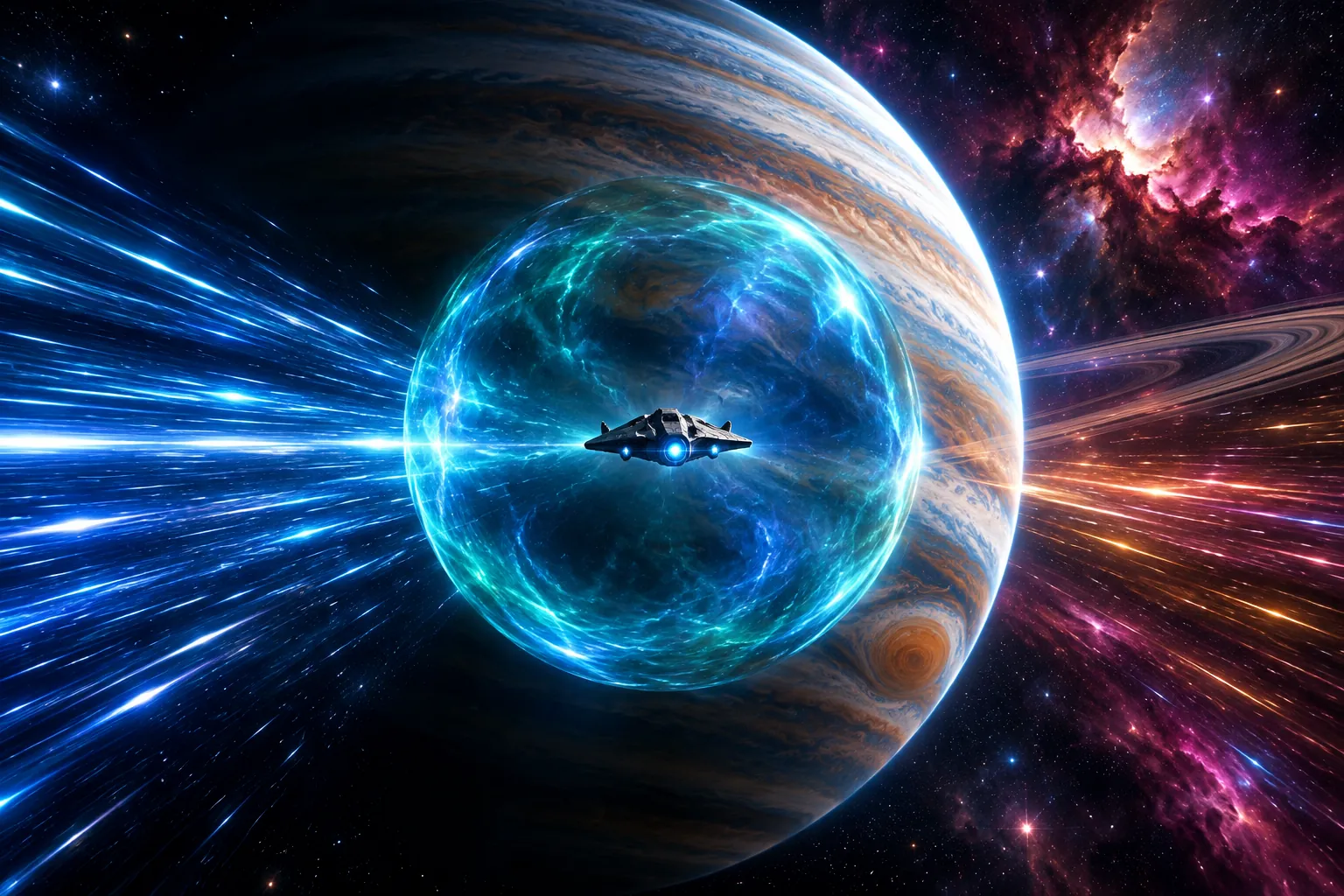
Alcubierre's idea is to stop moving the ship and move space instead. Imagine a bubble around the ship. In front of the bubble, space contracts, which brings the destination closer. Behind it, space expands, which pushes the starting point away. The ship sits inside the bubble in ordinary, flat space, while the whole bubble rides the wave of changing space. A surfer does not outrun the ocean; the wave carries the surfer. A moving walkway in an airport works in a similar way: you stand still on it and still arrive early.
This does not break relativity's speed limit, because the limit applies to motion through space. It says nothing about how fast space itself may stretch. Space already does this on a cosmic scale: the expansion of the universe carries very distant galaxies away from us faster than light. Inside the bubble, the crew would be at rest in their own patch of space, and in Alcubierre's design they would feel no acceleration at all.
The idea in four steps
- Wrap the ship in a bubble of flat space.
- Shrink the space ahead of the bubble.
- Stretch the space behind it.
- Let the bubble travel while the ship stays still inside it.
The real science
Start with what is established. Alcubierre's equations are correct mathematics, published in 1994 in the journal Classical and Quantum Gravity. General relativity does allow space to be bent, and it does allow a bubble shaped like this. What remains speculation is whether anything in nature can supply what the bubble needs.
The price is a kind of energy that has never been seen in bulk: negative energy density, often called exotic matter. Tiny amounts of negative energy show up in laboratory effects such as the Casimir effect, where two metal plates placed very close together feel a small pull. Nobody has made enough of it to matter, and nobody knows how.
How much is enough? In 1997 the physicists Michael Pfenning and Larry Ford estimated that a bubble 100 meters across would need negative energy about ten orders of magnitude greater than the mass of the visible universe. In 1999 Chris Van Den Broeck proposed a reshaped bubble that cut the requirement a great deal, to a few times the mass of the Sun. That is a huge improvement on paper and still far beyond anything we could produce.
There are other problems. The front wall of the bubble is cut off from the ship, so the crew could not switch the bubble on, steer it or stop it from inside; something would have to shape the space ahead of the ship. A 2009 study by Stefano Finazzi, Stefano Liberati and Carlos Barceló found that a faster-than-light bubble would probably be unstable once quantum effects are included. Another analysis, in 2012, suggested that particles swept up along the way could be released in a violent burst when the bubble stops.
In 2021 the picture shifted a little. Alexey Bobrick and Gianni Martire published a general framework for physically realistic warp drives, including slower-than-light bubbles that in principle need only ordinary positive energy. Erik Lentz proposed a faster-than-light version without negative energy, but it depends on energy sources far beyond anything known, and other physicists have questioned it. None of this is a blueprint.
Experiments so far are small. Around 2011 and 2012 Harold White and colleagues at NASA's Johnson Space Center studied ways to reshape the bubble and ran a tabletop test looking for tiny distortions of space. It did not show a warp effect. Warp drive today is a question for theorists, not engineers.
Where it shows up in fiction
Books got there in different ways. In Isaac Asimov's Foundation stories (the first book appeared in 1951), ships make jumps through hyperspace, a shortcut that the stories never explain in detail. Frank Herbert's Dune (1965) has Guild navigators who fold space so that ships cross huge distances at once. In Cixin Liu's Death's End, the third book of the Three-Body trilogy, a curvature drive lets ships travel by lowering the speed of light in the trail they leave behind. Each author solves the same problem differently, and each has to deal with the speed limit.
The word warp itself became famous through the television series Star Trek, which started in 1966 and made warp speed part of everyday language. Alcubierre has said the show inspired his work. Star Wars has its hyperdrive, and the Japanese anime Space Battleship Yamato is known for its warp jumps. These are mentioned here by name only: each one is a story device, and none of them follows Alcubierre's math.
If warp drive never works, fiction has an older answer for the stars: go slowly and take generations. Read about that in Generation ship.
Common misconceptions
- "Warp drive breaks Einstein's speed limit." Not in Alcubierre's design. The ship never moves faster than light through its own patch of space. Space itself does the moving, and relativity does not limit that.
- "Someone has built one." No. There is no working warp drive and no prototype. Lab work so far has only looked for tiny effects, and none was found.
- "Warp drive and hyperspace are the same thing." In fiction, hyperspace usually means going into another realm and coming back out. Alcubierre's bubble stays in our space and changes its shape around the ship.
- "A warp drive is a wormhole." A wormhole is a shortcut, a tunnel between two places. A warp bubble is a moving region of bent space. The two ideas are cousins, but different. See Wormhole.
- "The crew would be crushed." In the model, the ship rides along in free fall, so the crew would feel no acceleration. The extreme forces sit in the bubble wall, not in the ship.
Read next
- Wormhole: another proposed shortcut across space, and how it differs from a moving bubble.
- Generation ship: the slow answer to the same distance problem.
- History of Science Fiction: where warp drive and its relatives fit in the larger story of the genre.