In five minutes: what transhumanism is
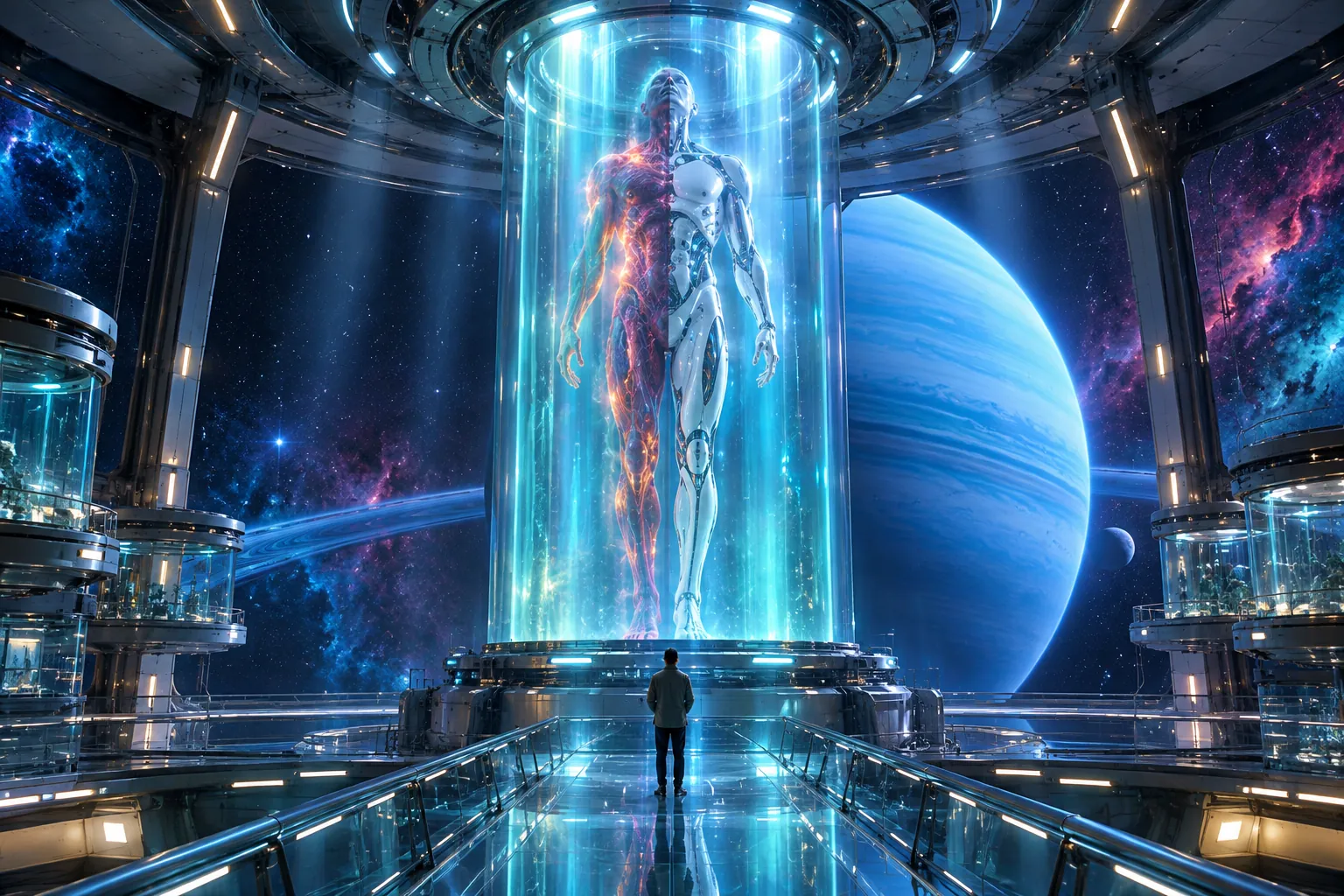
Transhumanism is the view that humans should use science and technology to improve their own bodies and minds, and that ageing, disease and even death are problems to be solved rather than facts to accept. It is both a philosophy and a loose social movement, and it has fed science fiction for a century. This page is part of the wider story told in History of Science Fiction.
The word is built from "trans-" (beyond) and "human". Supporters do not usually want to leave humanity behind. They want to stretch what a human life can be: longer health, sharper memory, new senses, freedom from pain. Most also say that people should choose for themselves, and that safety and fairness matter as much as the technology.
Three ideas sit at the centre. First, the human body is not a finished design. Evolution produced it without any plan for our happiness. Second, tools that already repair us, such as glasses, vaccines and cochlear implants, point towards tools that could improve us. Third, the risks are real, so the future needs careful debate rather than blind hope or blind fear.
Where the word comes from
The ideas are older than the name. In 1923 the biologist J. B. S. Haldane imagined, in his essay Daedalus, how biology might reshape human life. In 1929 the scientist J. D. Bernal, in The World, the Flesh and the Devil, pictured people merging with machines and moving into space. Then the biologist Julian Huxley, brother of the novelist Aldous Huxley, used the word "transhumanism" in a 1957 essay to describe humanity going beyond itself through its own efforts.
The modern movement took shape later. The futurist FM-2030 (born Fereidoun M. Esfandiary) wrote about "transhumans" from the 1970s. In 1990 the philosopher Max More published an essay that set out transhumanism as a philosophy of life. In 1998 Nick Bostrom and David Pearce founded the World Transhumanist Association, which issued a Transhumanist Declaration. The group was renamed Humanity+ in 2008.
The real science: what exists and what is speculation
Some of what transhumanists talk about is ordinary medicine. Cochlear implants return a sense of hearing to many deaf people. Modern prosthetic limbs can be controlled by the muscles or nerves of the wearer. Gene therapy has started to treat inherited disease: in late 2023 the UK and then the US approved Casgevy, a CRISPR-based treatment for sickle cell disease. These are treatments, not enhancements, and that difference matters in the debate.
Brain-computer interfaces are further out but real. Research teams have let paralysed volunteers move a computer cursor or a robotic arm by thought alone, using electrodes placed in the brain. In January 2024 the company Neuralink reported its first human implant. These devices aim to restore lost function, and their use to make healthy people smarter or faster remains a prospect, not a product.
Other ideas are speculation. No therapy has been shown to stop or reverse ageing in humans. Mind uploading, the idea of copying a brain's pattern into a computer, has never been done, and nobody knows whether a copy would be the same person or a new one. Cryonics, the freezing of bodies after death in the hope of future revival, has no proof that it works. In 2018 the researcher He Jiankui announced that he had created gene-edited babies. Scientists around the world condemned the work as unsafe and unethical, and a Chinese court later sentenced him to prison.
Where it shows up in fiction
Fiction got there first, and it often asks the hard questions. Aldous Huxley's Brave New World (1932) imagines people made in factories and sorted into castes by design. It is usually read as a warning, and it shows that the questions behind transhumanism are older than the word. Read it for a picture of what happens when enhancement is controlled by the state instead of chosen by the person.
Later authors took the idea in many directions. Bruce Sterling's Schismatrix (1985) follows factions of humans reshaped by biotechnology and machines across the solar system. Greg Egan's Permutation City (1994) explores copies of minds living inside software. Charles Stross's Accelerando (2005) follows a family across generations as technology changes what a person is. The Japanese manga Ghost in the Shell by Masamune Shirow asks what is left of a self when almost every part of the body is artificial, and the video game Deus Ex turns augmentation into a political story.
Two neighbouring ideas often appear alongside transhumanism. A cyborg is a being that combines living and mechanical parts. The technological singularity is the idea that machine intelligence could one day change the world faster than we can follow.
Why people disagree about it
Supporters point to suffering that could be reduced. If a safe treatment could prevent dementia or restore a lost limb, they ask, why should anyone refuse it? They also argue that adults should be free to make choices about their own bodies.
Critics raise several worries. The political scientist Francis Fukuyama, in his 2002 book Our Posthuman Future and a 2004 essay, called transhumanism one of the most dangerous ideas in the world, because he feared it would erode the equal dignity that human rights depend on. The philosopher Michael Sandel, in The Case Against Perfection (2007), argued that the urge to design our children and ourselves weakens our sense of life as a gift. Others worry about fairness: if only wealthy people can afford enhancements, the gap between rich and poor could become a gap in biology. Some disability advocates add that the movement can treat difference as a defect to be fixed.
Common misconceptions
- "Transhumanism means becoming immortal." Longer healthy life is one goal among many. Others include better senses, less pain and improved thinking.
- "It is the same as the singularity." They overlap, but the singularity is a prediction about machine intelligence. Transhumanism is a set of values about human improvement.
- "It is one organisation with one plan." It is a loose collection of thinkers, groups and online communities that disagree on goals, politics and risks.
- "Uploading a mind is just around the corner." It remains a thought experiment. Questions such as the brain in a vat show how little we know about what a mind needs in order to exist.
- "Anyone who wears glasses is already a transhumanist." Using medical technology does not make someone a follower of a philosophy. The real debate is about where treatment ends and enhancement begins, and that line is blurry.
Read next
- Technological singularity: the prediction that machine intelligence will outrun human understanding, and why people argue about it.
- Cyborg: how the idea of a living-and-mechanical being grew from a 1960s space-medicine paper into a staple of fiction.
- Brain in a vat: the thought experiment behind many questions about uploading and what a mind really is.
- Brave New World: the 1932 novel that shows a world where human nature is engineered from birth.