In five minutes: what doublethink means
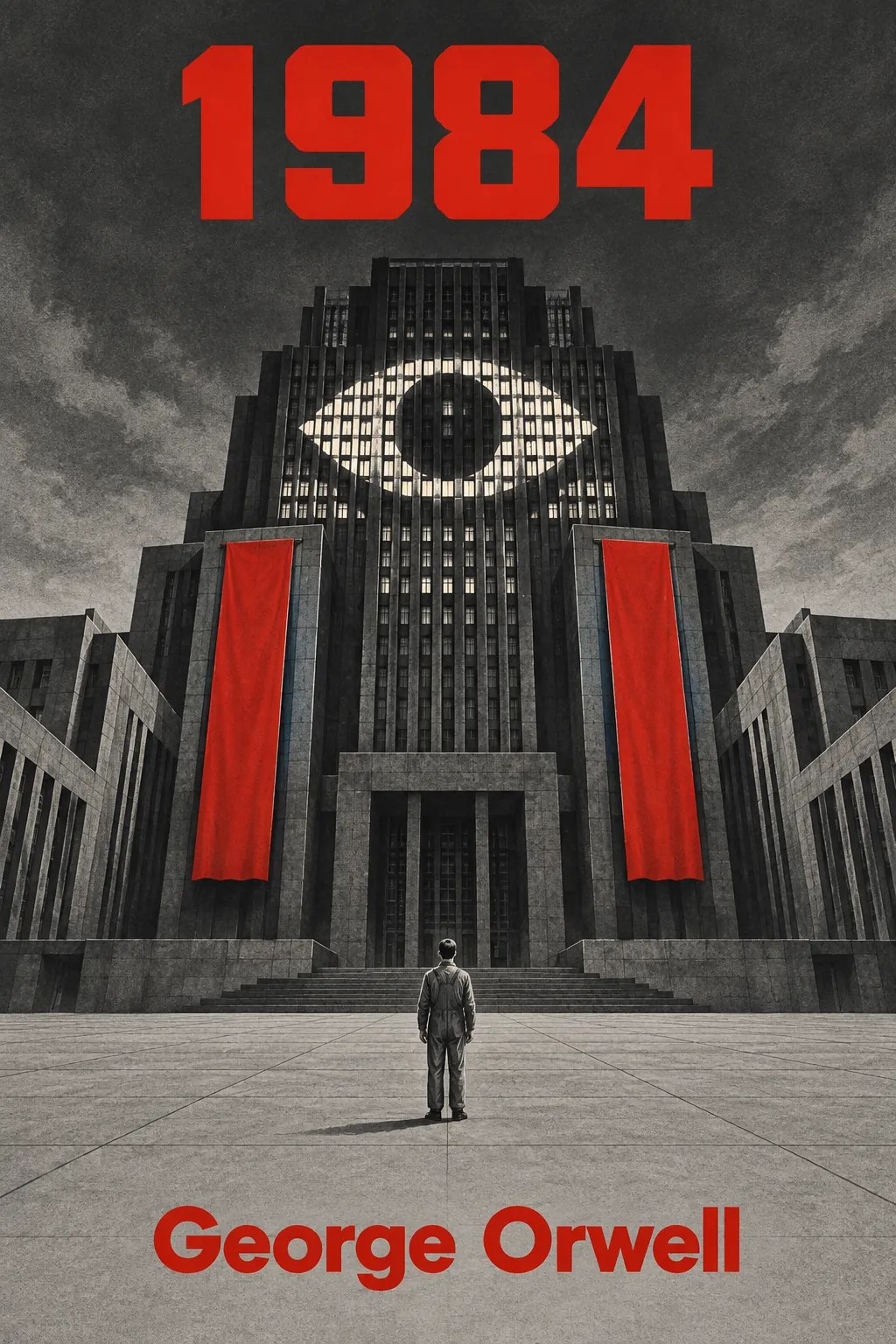
Doublethink is the ability to believe two opposite things at the same time and to accept both as true. The word comes from George Orwell's novel Nineteen Eighty-Four (1949), a landmark of the dystopian tradition covered in our history of science fiction. In the book, the ruling Party needs its citizens to accept slogans and statistics that contradict one another, and doublethink is the mental habit that makes this possible.
The key detail is that doublethink is not ordinary lying. A liar knows the truth and hides it. A person practising doublethink has trained themselves to sincerely believe the Party's version, and then to forget that they trained themselves to do it. The Party's slogans show the pattern: “War is peace. Freedom is slavery. Ignorance is strength.” (Part 1, Chapter 1)
Orwell gives the plainest definition in the forbidden book that Winston Smith reads in secret: “the power of holding two contradictory beliefs in one's mind simultaneously, and accepting both of them.” (Part 2, Chapter 9) Together with Newspeak and the Thought Police, it sits at the centre of the Party's control over what people think.
How doublethink works in Nineteen Eighty-Four
The novel is set in Oceania, a super-state where the Party controls every record. Winston Smith works in the Records Department of the Ministry of Truth, where he rewrites old newspaper articles so that they match the Party's current line. When a prediction fails or an ally becomes an enemy, the old article is replaced and the original is dropped down a memory hole to be burned. (Part 1, Chapter 4)
Rewriting paper is the easy half. The harder half is the minds of the people who read it. In Part 1, Chapter 3, Winston reflects on what the Party asks of its members: to know and not know at once, to tell carefully built lies while believing them, to drop an awkward fact and call it back when it becomes useful. The Party also teaches that whoever controls the past controls the future. Orwell adds a final twist. The word “doublethink” is itself an act of doublethink, because you must know you are deceiving your own mind in order to do it well.
Hate Week shows how this plays out in public. A speaker is halfway through a sentence about Oceania's war with Eurasia when a note is passed to him, and he carries on as if the enemy had always been Eastasia. The crowd adjusts within minutes, and posters naming the old enemy are torn down. Nobody admits that anything has changed. (Part 2, Chapter 9)
Spoiler note: the next paragraph mentions a scene from Part 3, but not the ending.
In Part 3, the interrogator O'Brien tells Winston that the real test is not whether he will say that two plus two make five, but whether he will truly believe it. Back in Part 1, Winston had written in his diary that freedom is the freedom to say two plus two make four. The clash between those two moments is the whole book in miniature.
Examples of doublethink in the novel
Doublethink turns up all over Oceania. These are the clearest cases.
- The three slogans. “War is peace”, “Freedom is slavery” and “Ignorance is strength” are displayed on the Ministry of Truth, each one the opposite of what the words normally mean.
- The names of the ministries. The Ministry of Peace runs the war, the Ministry of Love handles torture, and the Ministry of Plenty manages shortages. (Part 1, Chapter 1)
- The rewritten past. When yesterday's record disagrees with today's, party members are expected to accept that the current record is the true one.
- The shifting enemy. Oceania changes the nation it is fighting overnight, and everyone agrees it was always so.
The real science: is doublethink a real thing?
Doublethink is a fictional idea, not a diagnosis or a term from psychology textbooks. No research has shown that people can switch off contradictions on command the way the Party demands. What is well established is that people are often uneasy when their beliefs clash, and that they find ways to ease the discomfort.
The closest real concept is cognitive dissonance, developed by the American psychologist Leon Festinger in the 1950s. His 1957 book described the tension people feel when two beliefs, or a belief and an action, do not fit together. People then tend to change a belief, add an excuse, or avoid information that makes the tension worse. A smoker who knows smoking is harmful may decide the risk is exaggerated. That is rationalising, and it is common and ordinary.
Doublethink goes much further. Cognitive dissonance describes a tension that people usually try to escape without noticing. Doublethink is a trained, deliberate skill that removes the tension completely and then erases the memory of having done so. Psychologists do describe related habits, such as compartmentalisation (keeping conflicting ideas in separate mental boxes) and motivated reasoning (believing what one wants to be true), but these are partial and imperfect. Orwell's version is an extreme one, chosen to make a point about power.
Holding a contradiction is not always a flaw either. In his 1936 essay “The Crack-Up”, F. Scott Fitzgerald said that keeping two opposed ideas in mind and still being able to function is a sign of a first-rate mind. The difference is honesty. Fitzgerald's thinker knows the ideas conflict. Doublethink demands that you do not notice.
Orwell's interest in this came from the propaganda and political language of the 1930s and 1940s. In his 1946 essay “Politics and the English Language”, he argued that vague, slippery words make it easier to avoid clear thought.
Where it shows up in fiction
Nineteen Eighty-Four is the origin, and our 1984 study guide covers the full plot and characters. Doublethink works hand in hand with Newspeak, the shrinking language that makes some thoughts impossible to express, explained in Newspeak and doublethink, and with the watching figure described in Big Brother.
Other science fiction touches the same nerve without using the word. In Ray Bradbury's Fahrenheit 451, Captain Beatty throws lines from different books against each other to argue that books are worthless, switching sides with perfect calm. In Aldous Huxley's Brave New World, citizens are conditioned from birth to like the roles they are given, so conflict is prevented rather than hidden. Both books share a view of how control works: a society can steer what people think by steering what they notice. They belong to the wider tradition explained in Dystopia.
Common misconceptions
- “It is just lying.” A liar knows the truth. A person practising doublethink has pushed the truth out of their own awareness, so they are not hiding anything, even from themselves.
- “Any hypocrisy or inconsistency counts.” Everyone is inconsistent sometimes. Orwell described a system that trains people to accept contradiction and punishes those who point it out.
- “It is the same as cognitive dissonance.” They are related, but dissonance is a real and common tension, while doublethink is a fictional, total form of mental control.
- “Orwell predicted it.” Orwell described the book as a warning about where totalitarian ideas could lead, not a forecast of exact techniques.
Why the word is still used
The word survives because it names something people recognise: the moment when a group, a company or a government holds a position that cannot be squared with its own earlier statements, and nobody seems bothered. Writers and commentators use it as shorthand. It helps to remember Orwell's standard before using it that way. The mark of doublethink is not inconsistency alone but a system that rewards people for not noticing and punishes those who say so. Used loosely for any slip, the word loses the sharpness Orwell gave it.
Read next
- Newspeak and doublethink (1984): see how the Party shrinks the language so that dangerous thoughts have no words.
- Big Brother (Orwellian): learn who Big Brother is and why his name became shorthand for surveillance.
- Dystopia: explore the wider tradition of bad-place fiction that Orwell belongs to.
- 1984 by George Orwell: read the full study guide with plot, characters and themes.