Solarpunk in five minutes
Solarpunk is a branch of science fiction that imagines a future in which people have dealt with climate change and live well: clean energy, green cities, shared work and strong local communities. Its mood is hopeful but not naive. In the history of science fiction it sits beside cyberpunk and dystopia as their cheerful opposite. Those genres ask "how bad could it get?" Solarpunk asks "what would a good outcome take?"
Three ideas hold most solarpunk together:
- Renewable energy and ecological design are part of everyday life, not a side story.
- Cooperation and community matter more than lone heroes or giant corporations.
- The future is something people build, so the stories show the work: repairs, gardens, meetings and arguments.
The "punk" half of the name is borrowed from cyberpunk and steampunk. It does not mean the music. It stands for an attitude of refusing the way things are and doing it yourself, often with a handmade, repair-it-don't-bin-it spirit.
Where the word came from
The term appeared around 2008, in a blog post called "From Steampunk to Solarpunk" on the blog Republic of the Bees. It wondered what a sunlit, sustainable partner to steampunk might look like. Not much happened at first, but Brazilian writers picked the word up, and the editor Gerson Lodi-Ribeiro gathered a Portuguese-language anthology of solarpunk stories about ecological, sustainable worlds, published by Editora Draco. An English translation by Fábio Fernandes followed in 2018.
In 2014 Adam Flynn wrote "Solarpunk: Notes toward a manifesto" on the Project Hieroglyph site. It set out the movement's goals in plain language and helped the word spread, especially among artists and online communities. English-language anthologies followed, including Sunvault: Stories of Solarpunk and Eco-Speculation (2017) and Glass and Gardens: Solarpunk Summers (2018).
So solarpunk is young. It was named in the 2000s and organised in the 2010s, and the label was then applied backwards to older stories that already shared its spirit.
What a solarpunk world looks like
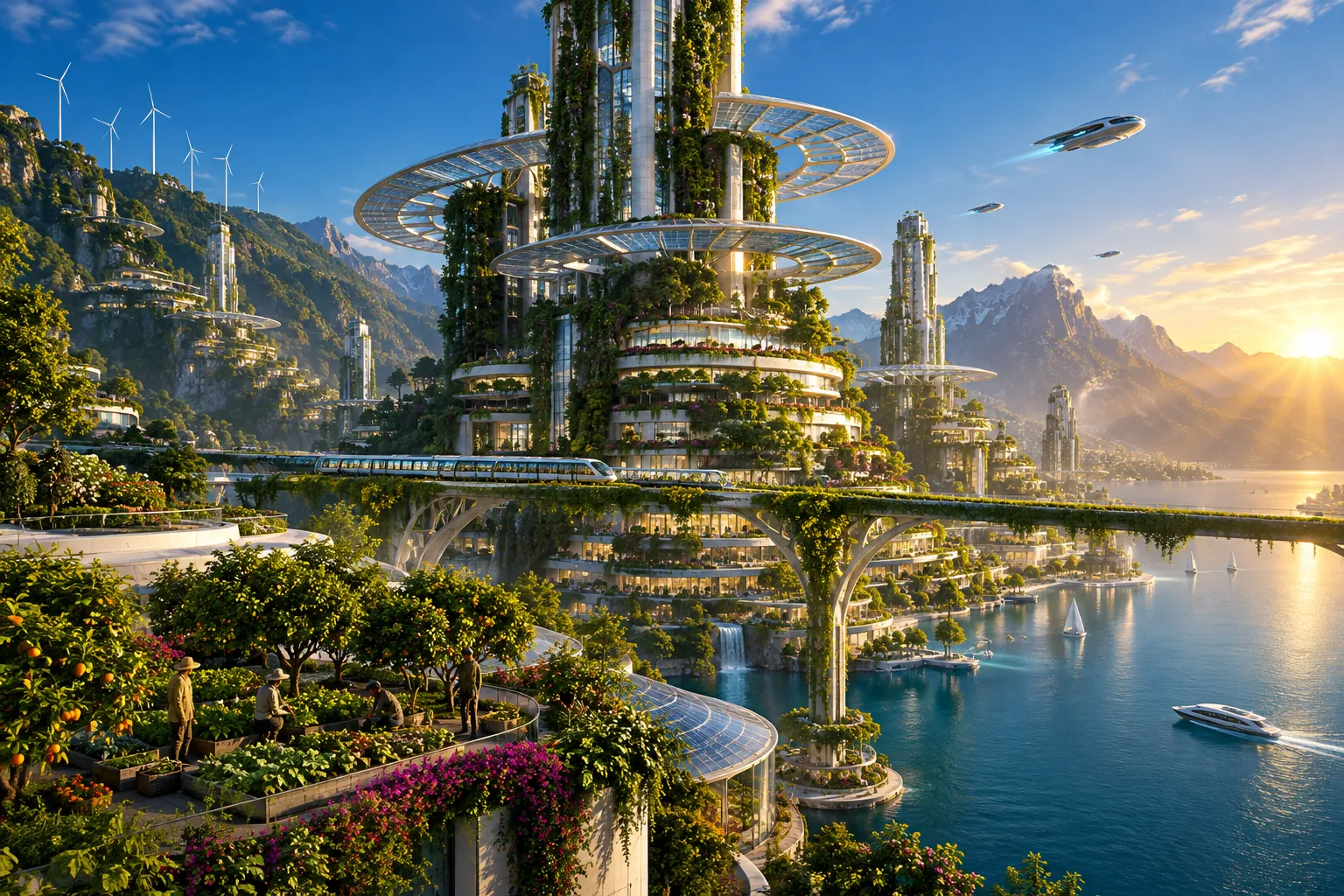
The pictures are easy to recognise. Buildings are covered in plants. Rooftops hold farms and gardens. Solar panels, wind turbines and trams are built into the city instead of hidden away. Food is grown close to where people eat it, and tools are shared and mended. Technology is present, but it is often small-scale, understandable and repairable.
The visual style leans on bright colour and flowing lines, often compared with Art Nouveau. That is partly on purpose. Solarpunk artists want to show that a sustainable world could be beautiful, not a grey life of doing without.
Politics sits quietly behind the scenery. Many solarpunk stories imagine economies that value care, repair and sharing, and societies that are fairer and more varied than ours. Stories differ widely on how far that goes, from a village that runs on solar power to a whole planet that has rebuilt its economy.
The real science
Solarpunk is a vision, not a forecast, so it helps to separate what is established from what is hope.
Established: solar panels and wind turbines have become much cheaper since about 2010, and in many countries they are now among the cheapest ways to add new electricity. Green roofs, urban farming and community energy projects exist today and are well studied. Plants and trees in cities can lower summer heat and make streets more pleasant.
Speculation: the hard part is everything around the panels. Storing energy, supplying materials, rebuilding old infrastructure and agreeing who pays are political and economic problems as much as technical ones. Solarpunk stories often assume these problems can be solved through cooperation. That is an optimistic bet, and the best stories admit it is not an easy one.
Where it shows up in fiction
Solarpunk is still a young label, so many famous works are called solarpunk only in hindsight.
- A Psalm for the Wild-Built (2021) by Becky Chambers. A tea monk named Sibling Dex meets a robot named Mosscap in a world where robots left the factories long ago and society rebuilt itself around balance with nature. It is often named as the best-known recent example, gentle and conversational.
- Ecotopia (1975) by Ernest Callenbach. A novel about part of the Pacific Northwest breaking away from the United States to form an ecological society. It was written decades before the word existed and is often cited as an ancestor.
- Anthologies. Sunvault and Glass and Gardens collect short stories made specifically for the genre.
- Film and animation. Fans often name Studio Ghibli's Castle in the Sky (1986) and Nausicaä of the Valley of the Wind as solarpunk-leaning favourites, because of their interest in people and nature.
Notice how different these are in tone. Solarpunk covers calm everyday stories as well as adventure, and conflict does not disappear. It just rarely depends on one ruined planet to be interesting.
Solarpunk beyond books
Solarpunk is not only a shelf in the library. People use the word for illustration, fashion, architecture sketches, games and online communities. Illustrators share bright pictures of leafy towns, and some gardeners, makers and neighbourhood groups call their projects solarpunk because they share the same hopes.
Real-world things that fit the mood include community gardens, repair cafés where volunteers help fix broken items, shared tool libraries and neighbourhood solar schemes. None of these is a full solarpunk society, but each shows the spirit in small form: people choosing to make something better with the means they have.
This everyday side explains part of the genre's appeal. A story about saving a galaxy is far away. A story about fixing a water pump, planting a roof or running a town meeting is close enough to try.
How solarpunk compares with its neighbours
- Cyberpunk: high technology, powerful corporations and crowded, dark cities. It warns. Solarpunk borrows the "punk" attitude but points it toward repair and cooperation.
- Dystopia: a society that has gone badly wrong, often under heavy control. Solarpunk usually starts from the other side and asks how a fair society might be built.
- Climate fiction: a wide label for stories shaped by climate change. Some are grim, some hopeful, and solarpunk is the hopeful corner.
- Utopia: a perfect society. Solarpunk is usually more modest, showing a place that is better but still has trouble.
- Steampunk: a retro-futuristic look built on Victorian machines. It gave solarpunk the idea of a "-punk" with its own style and its own technology.
Common misconceptions
- "It describes a perfect utopia." Good solarpunk still has problems, disagreements and loss. The difference is that the characters have ways to respond and a world worth protecting.
- "It is only about solar panels." The sun is a symbol. Food, housing, neighbourhoods, work and care matter just as much as energy.
- "It is against technology." It rejects technology that wastes resources or harms people and nature. Many stories include advanced machines, networks and science. The question is what the technology is for.
- "It is the same as climate fiction." Much climate fiction warns about what happens if we fail. Solarpunk focuses on what happens if we succeed, although the two often overlap.
- "It is just an aesthetic." The look is the doorway, not the whole house. Many writers and activists treat solarpunk as practice for imagining real change, and sometimes as a way to act on it. Critics who call it pretty pictures without a plan have a point, and the best stories answer by showing the work: who does it, who benefits and where the materials come from.
Read next
- Cyberpunk: the high-tech, low-life genre that gave solarpunk half of its name and much of its energy.
- Dystopia: the dark futures that solarpunk answers, from warning stories to controlled societies.
- History of Science Fiction: how all these genres grew out of each other.