In five minutes
The bootstrap paradox is a time-travel puzzle about something with no beginning. An object, a piece of information or even a person is sent back in time, and that trip turns out to be the only reason the thing exists. Nobody ever made it. It simply goes round and round in a loop, which is why it is also called a causal loop or an ontological paradox.
Here is the classic example. A traveller from the future gives a young composer the sheet music of a famous symphony. The composer copies it out, publishes it as their own work and becomes famous. Centuries later, the traveller finds that same score in a library, carries it back in time and hands it to the young composer. So who wrote the symphony? Not the composer, who only copied it. Not the traveller, who only found it. The music has no author and no moment of creation. It exists because it was sent back, and it was sent back because it exists.
The name comes from the old saying about pulling yourself up by your own bootstraps. That describes an impossible job, because you cannot lift yourself by tugging on your own boots. In a bootstrap loop, the thing seems to lift itself into existence. The label is informal. When physicists want to be exact, they talk about closed timelike curves and self-consistent histories.
Two points are worth holding on to. First, nothing in the loop contradicts itself, which makes it different from the grandfather paradox, where a traveller undoes their own past. Second, the strange part is the missing origin. The score, the idea or the person is clearly in the world, but there is no point at which anyone made it.
Where the name comes from
The label comes from Robert A. Heinlein’s novella “By His Bootstraps”, published in Astounding Science Fiction in October 1941 under the pen name Anson MacDonald. Its hero, a student named Bob Wilson, is pulled through a time gate and meets other versions of himself. Step by step he finds that the situation he is caught in was arranged by his own later actions. The whole plot is one closed circle, and readers and critics later borrowed the title as a name for any loop of this kind.
That is why “bootstrap paradox” is a fan and critic term rather than a technical one. You will also see “ontological paradox”, which stresses that the problem is about where a thing comes from, and “causal loop”, which stresses that cause and effect run in a circle.
The real science
Start with what is established. Einstein’s general relativity ties space and time together, and in some mathematical solutions of its equations a path can curve back to an earlier moment. These paths are called closed timelike curves. In 1949 the logician Kurt Gödel found a solution describing a rotating universe that contains them. Our universe does not appear to rotate in that way, so his model is a mathematical curiosity and not a description of reality.
In 1988 Michael Morris, Kip Thorne and Ulvi Yurtsever showed on paper that a traversable wormhole could, in principle, be turned into a time machine. The catch is that it would need “exotic matter” with negative energy density, and nobody knows whether enough of it can exist. In 1992 Stephen Hawking proposed the chronology protection conjecture: the idea that the laws of physics always stop time machines from forming. It is a conjecture, not a proven result.
Now the speculative part. If closed timelike curves did exist, many physicists expect that only self-consistent histories could happen. This is often called the Novikov self-consistency principle, after the Russian physicist Igor Novikov. Under it, a bootstrap loop is allowed, because it contradicts nothing, while the grandfather paradox is not. The remaining unease is about information. A symphony that nobody composed seems to come from nowhere, and some people take that as a hint that time loops cannot exist. Others point out that the total amount of matter and energy in the loop stays the same, so no conservation law is broken. Other proposals, such as David Deutsch’s quantum model from 1991, treat loops quite differently, and the debate continues.
No experiment has ever seen a signal or an object travel into the past. The bootstrap paradox is a thought experiment, and it is useful because it shows how strange “cause” becomes if time is allowed to loop.
Where it shows up in fiction
Books first. “By His Bootstraps” is the original. Heinlein returned to loops in “—All You Zombies—” (1959), a very short story that pushes the idea about as far as it can go. Spoiler warning: it builds one person’s whole family tree out of that person alone, so skip it if you want to read the story fresh.
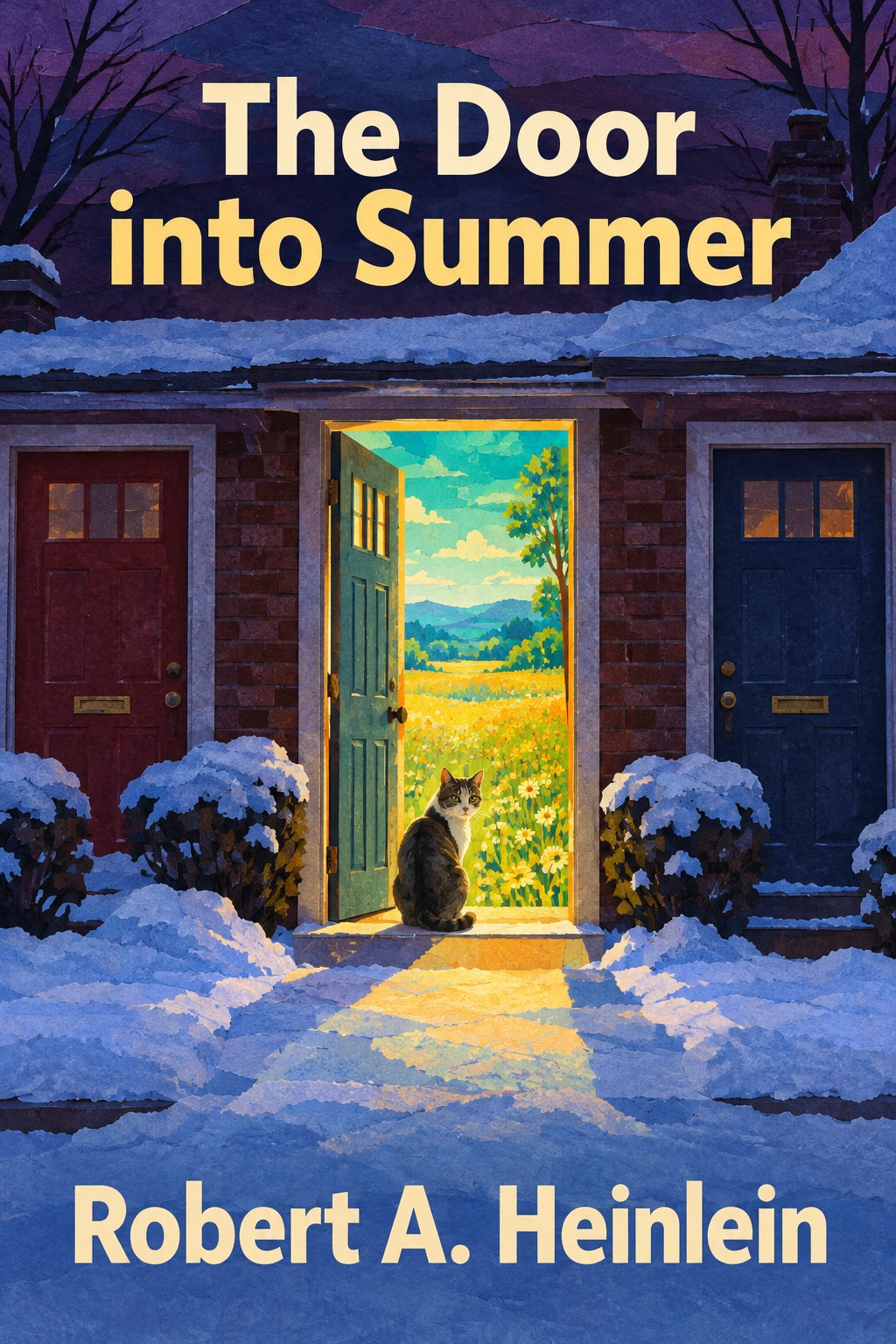
Heinlein’s novel The Door into Summer (1957) is gentler. An engineer is wronged, goes into cold sleep and uses time travel to set things right, and the story shows how a traveller’s choices ripple through the years. It is a good first Heinlein time-travel book because the mechanics are easy to follow and the tone is warm.
Films use the idea too, and are named here only as examples. In Back to the Future (1985), a song reaches the man who is later credited with writing it, by way of a visitor from the future. In Somewhere in Time (1980), a keepsake passes between two moments with no maker. Both are light on explanation, which is part of why they are fun.
Common misconceptions
- “It is the same as the grandfather paradox.” It is not. The grandfather paradox is a contradiction: you prevent your own birth, so you cannot be there to do it. A bootstrap loop contradicts nothing. Its puzzle is a missing origin.
- “Physics has proved it is impossible.” It has not. Physics has no proof that backward time travel is possible, and no proof that it is not. Many researchers suspect it is blocked, but that is still a suspicion.
- “The paradox shows time travel works.” Also no. A puzzle about a loop tells us what would follow if loops existed. It is not evidence that they do.
- “The thing in the loop is eternal.” Not necessarily. In fiction, the object often ages, wears out or is copied. The puzzle is about where its information came from, and that can be asked of a worn-out copy too.
Read next
- History of Science Fiction: the bigger story of how writers like Heinlein built the genre’s ideas.
- Grandfather paradox: the other famous time-travel puzzle, where the loop breaks itself.
- Time travel paradoxes: a map of all the main puzzles side by side.
- The Door into Summer: a friendly Heinlein novel to try if you want time travel in a story.