In five minutes
The multiverse is the idea that the universe we can observe may be only one of many. Multiverse theory is not a single theory. It is a name for several different proposals, and they disagree about what "another universe" even means.
Here are the four main versions, from the most modest to the most extreme:
- Faraway regions. Space may go on far beyond what we can see, and those regions would count as other "universes" in a loose sense.
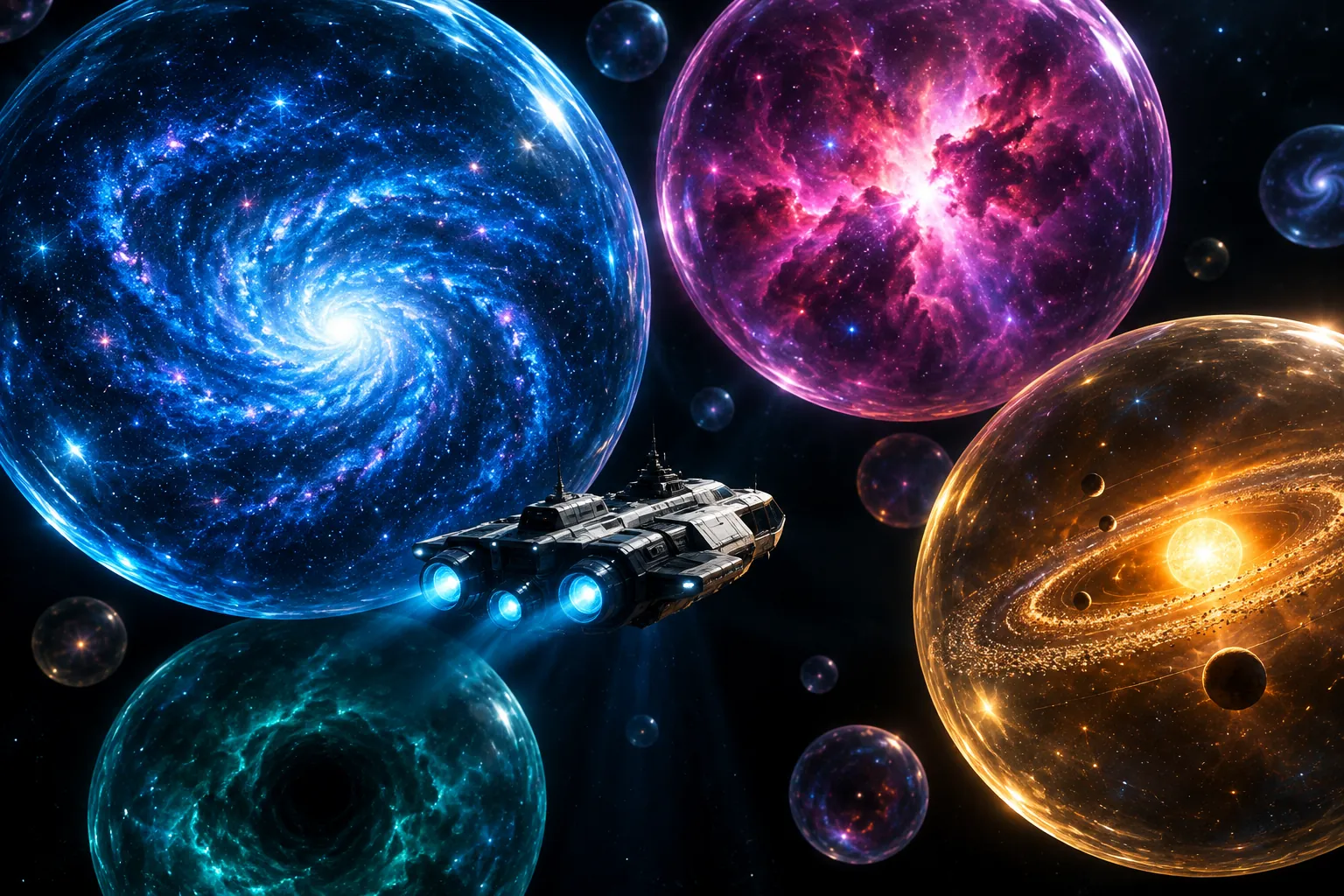
- Bubble universes. Our universe may be one bubble in a larger space that keeps producing new bubbles, each with its own physical constants.
- Branching quantum worlds. In the many-worlds reading of quantum mechanics, every quantum measurement splits reality into branches.
- Mathematical universes. Every consistent mathematical structure might be a real universe.
Two things to keep in mind. First, nobody has observed another universe. The multiverse is a hypothesis, and some of its versions are taken seriously by working physicists while others are mostly philosophy. Second, the versions are separate ideas. Saying "the multiverse" without saying which one is like saying "the animal".
Where the idea came from
The word "multiverse" was used outside physics for a long time before cosmologists adopted it. In the early 1960s the British writer Michael Moorcock brought it into science fiction, where it described a set of linked worlds crossed by his hero, the Eternal Champion. Physicists later borrowed the word for their own ideas.
Those ideas came from three different directions. In 1957 the physicist Hugh Everett III proposed what is now called the many-worlds interpretation of quantum mechanics. In 1981 Alan Guth proposed cosmic inflation, a burst of extremely fast expansion in the first fraction of a second. And in the late 1980s and 2000s, string theory and the puzzle of why physical constants have the values they do pushed some theorists to ask whether our universe is a lucky draw from many possibilities.
The real science
This section separates what is established from what is speculation.
Faraway regions: the safest version
The observable universe is the part whose light has had time to reach us since the Big Bang, about 13.8 billion years ago. Because space has expanded, its edge is now roughly 46 billion light-years away in every direction. Nothing says space stops there. If space is very large, or infinite, there are regions we can never see. This version of the multiverse is the least controversial, because it only says the universe is bigger than the part we can observe. Whether to call those regions "other universes" is partly a matter of words.
Bubble universes: inflation that never stops
Cosmic inflation is a well-studied idea that explains why the universe looks so smooth and flat on large scales, and its predictions for the cosmic microwave background match observations well. Inflation itself is not proven in every detail, but it is a mainstream theory. Some versions of it, developed by Alexander Vilenkin and Andrei Linde in the 1980s, go further. In "eternal inflation", inflation ends in some places, forming bubbles like ours, while it continues in the space between them. The result is an endless supply of bubbles. Each might have different physical constants. These bubbles are the multiverse of most physics headlines. The prediction follows from the theory, but we have no confirmed way to detect another bubble. Searches for the faint marks a collision with a neighbouring bubble could leave in the microwave background have not found a confirmed signal.
Many worlds: the quantum version
In quantum mechanics, a particle can be described by a wave that spreads over several possible outcomes. Everett asked what happens if nothing ever forces that wave to "collapse" into one outcome. His answer was that all the outcomes happen, each in its own branch of reality. The idea is a real interpretation taken seriously by physicists such as David Deutsch and Sean Carroll, but others prefer different interpretations. All of them make the same predictions in experiments, so far no experiment can tell them apart. Many worlds is also a different thing from bubble universes: its branches are not far away in space. They overlap with ours, but cannot interact with it.
The string landscape and the anthropic argument
String theory, an unproven attempt to unify gravity with quantum physics, allows an enormous number of possible universe set-ups. Estimates often quoted run to 10 to the power of 500, though such numbers are rough. Together with eternal inflation, this gives the "landscape" idea: every set-up could be realised somewhere. Then the anthropic argument says we find ourselves in a universe with the right constants for life because we could not exist in the others. In 1987 Steven Weinberg used reasoning like this to estimate how large the cosmological constant could be. Dark energy, found in 1998, turned out to be of roughly that kind of size, which supporters count as a point in favour. Critics reply that this is only one number and that a theory which can explain anything may explain nothing.
Mathematical universes
In 2003 the cosmologist Max Tegmark sorted the proposals into four levels. Level I is faraway regions, Level II is bubble universes, Level III is many worlds, and Level IV is the claim that every mathematical structure exists physically. Level IV is the most speculative. It is a philosophical position, not a prediction that can be tested.
Is it science?
This is the main dispute. Supporters say the multiverse follows from theories we already have, and that science sometimes has to accept consequences it cannot see directly, as with the interior of black holes. Critics such as George Ellis and Paul Steinhardt say that an idea that cannot be tested, even in principle, falls outside the core of science. Both sides include respected physicists, and the question is still open.
Where it shows up in fiction
Fiction got to the multiverse early, and it was often more daring than the physics. Jorge Luis Borges described branching time in his 1941 story "The Garden of Forking Paths", years before Everett. Philip K. Dick's The Man in the High Castle (1962) is an alternate history in which the Axis powers won the Second World War, and it lets characters glimpse our world. Michael Moorcock's Eternal Champion novels treat the multiverse as a set of worlds that heroes cross, ruled by the forces of Law and Chaos.
A more recent example is Blake Crouch's novel Dark Matter (2016), which turns many-worlds into a thriller about a man who steps into a life he did not choose. In film, the 2022 movie Everything Everywhere All at Once uses the idea for a story about a family, and comics and television have used it so often that "multiverse" is now a common storytelling device. In most stories, travel between universes is easy. In physics, it is not expected to be possible.
Common misconceptions
- "Scientists have proved the multiverse." They have not. Some theories predict it, but no other universe has been observed.
- "The multiverse is one theory." It is several different proposals with different foundations.
- "In another universe, there is another you who made different choices." That is true only under many worlds, and even there the branches come from quantum events, not from everyday decisions in the way films show them.
- "We could travel to another universe." No known physics allows it. Wormholes, if they exist, would at most connect places inside one spacetime.
- "Multiverse and parallel universe mean the same thing." They overlap, but the multiverse is the whole collection, and a parallel universe is one member of it.
Read next
- Parallel universe: a closer look at a single "other universe", and how fiction and physics use the term differently.
- Wormhole: why shortcuts through spacetime are not the same as doors to other universes.
- History of Science Fiction: the wider story of how the genre grew, and where multiverse stories fit in.