In five minutes
A space elevator is a proposed structure: a cable anchored to the ground at the equator and reaching far above geostationary orbit, with vehicles that climb it into space instead of riding a rocket. It is a real engineering idea, not only a story device, but nothing like it has been built. This page is part of our History of Science Fiction.
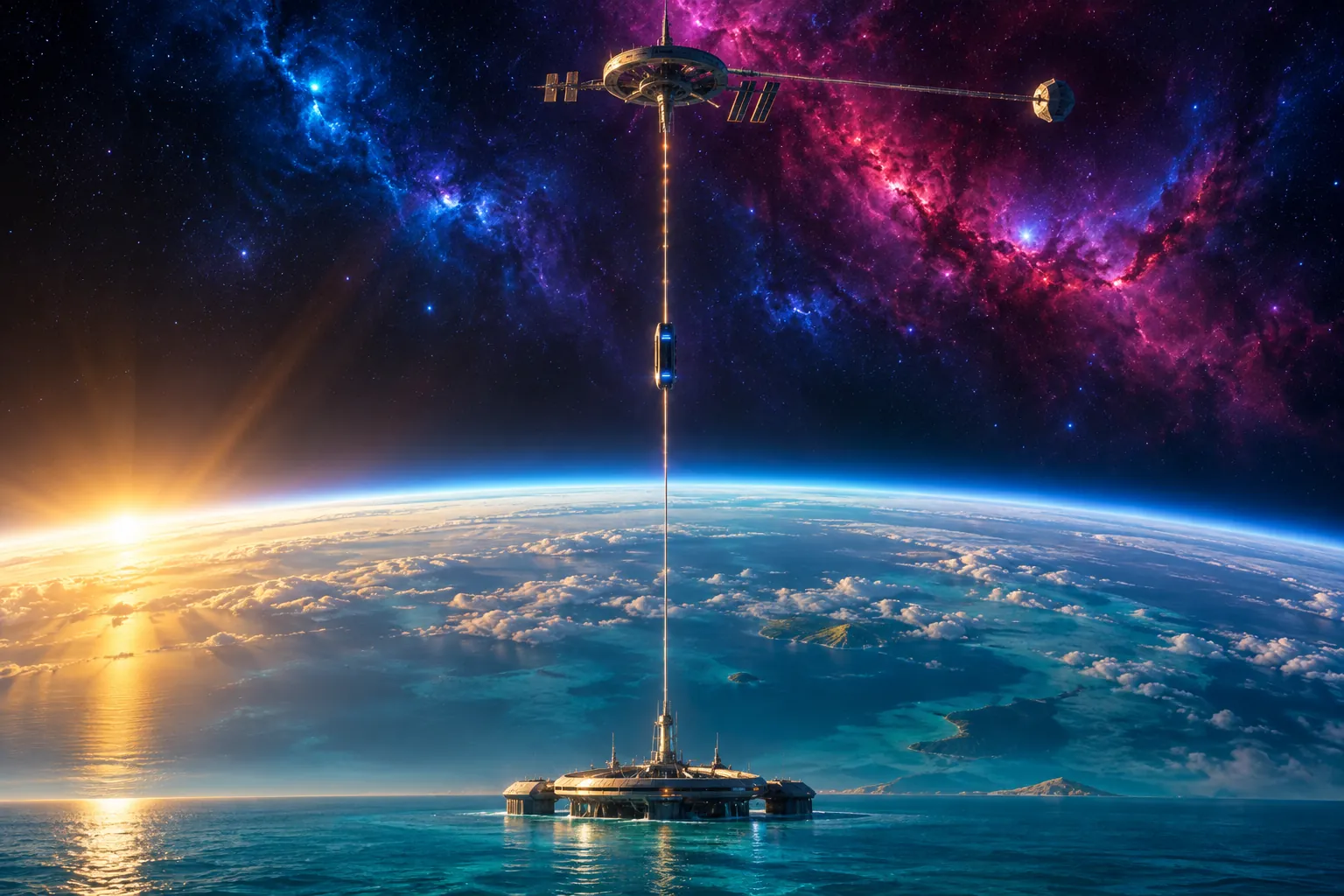
The trick is Earth's spin. About 35,786 kilometres above the equator, a satellite circles the planet once per day, so it stays over the same spot on the ground. That is geostationary orbit. Hang a cable down from that height and it can stay in place, held up by the same spin. Add a counterweight farther out to keep the cable taut, and you have a road to space.
The appeal is cost and calm. Rockets burn enormous amounts of fuel just to lift their own fuel. A climber would use electric power and rise steadily, so the price of sending a kilogram into orbit could fall sharply. The catch is that the cable must be unbelievably strong for its weight.
How a space elevator would work
Most designs share four parts.
- The anchor. A base on the equator, often imagined as a platform in a calm part of the ocean, so it can be moved to dodge storms.
- The tether. A very long ribbon or cable, thickest near geostationary height where it carries the most weight, and thinner near the ground.
- The climbers. Electric vehicles that grip the tether and crawl up and down, carrying cargo or people.
- The counterweight. A station or captured asteroid beyond geostationary orbit. Its outward pull keeps the whole line tight.
Why the equator? Geostationary orbit exists only above the equator, and the cable has to hang straight toward Earth's centre. Why does it stay up at all? Below geostationary height, gravity wins and pulls the cable down. Above it, the spin wants to fling things outward. The tether is pulled both ways and stretched like a guitar string.
The trip would be slow. A climber moving at 200 kilometres per hour would need about a week to reach geostationary height. That is why many plans picture stations along the way, and why the idea suits cargo better than a quick passenger trip.
Most plans also build from the top down. A spacecraft would carry the first thin cable to geostationary orbit and lower it toward the ground, then later climbers would add layers to make it thicker.
A short history of the idea
In 1895 the Russian scientist Konstantin Tsiolkovsky, inspired by the Eiffel Tower, imagined a tower rising from the ground to orbit height. A tower that tall would be crushed by its own weight, so the idea stayed a thought experiment.
The modern version came in 1960, when the Leningrad engineer Yuri Artsutanov described lowering a cable from a satellite down to Earth. Because the cable hangs rather than stands, it is stretched instead of squashed, and that is a far better way to use materials. His idea appeared in a Soviet newspaper and remained little known in the West for years. Researchers in the United States reached similar ideas in the 1960s and 1970s, including Jerome Pearson, who published a detailed study in 1975.
The idea reached a wide public in 1979, when Arthur C. Clarke published The Fountains of Paradise, a novel about building a space elevator. Clarke's book made the concept famous around the world, and engineers still cite it.
In 1991 the Japanese physicist Sumio Iijima drew attention to carbon nanotubes, tiny tubes of carbon atoms with remarkable strength. Hope that such a material could make a cable led to NASA-funded studies around 2000. In 2012 the Japanese construction company Obayashi announced a concept aiming at a space elevator by 2050, built on carbon nanotubes.
The real science
The physics is settled. Orbital mechanics, the balance of gravity and spin, and the taper of the cable are well understood, and no law of nature forbids a space elevator. The unsettled part is whether we can build one.
The material problem. A cable more than 35,000 kilometres long has to carry its own weight, and the stress is greatest high up. Steel is nowhere near good enough. A usable material needs a strength-to-weight ratio many times higher. Carbon nanotubes are the most talked-about candidate: single tubes are extremely strong in the lab. But the long fibres made so far are far weaker than single tubes and far shorter than the tens of thousands of kilometres needed. Graphene and other materials are also studied. Until one exists at that scale, the elevator remains a design on paper.
Hazards. The lower cable passes through weather, lightning and wind, and the atoms of oxygen high in the atmosphere can eat away at some materials. Higher up, the line crosses radiation belts and a busy region full of satellites and junk. A cable is a long target for debris, a risk closely tied to Kessler syndrome. Climbers moving along the tether can also set it swaying, so designers need ways to damp the motion.
Smaller steps. Because the Moon's gravity is about one sixth of Earth's, a lunar elevator might be made with strong fibres we can already produce. This idea has been studied, though no one has built one. On a smaller scale, a team at Shizuoka University in Japan tested a tiny climber moving along a tether between two small satellites released from the International Space Station in 2018. It showed the basic climbing idea works in orbit, which is a long way from a real elevator.
Estimates of when a space elevator could exist range from the middle of this century to never. A fair summary is that it is an engineering challenge, not an impossibility, but one that depends on a material breakthrough.
Where it shows up in fiction
Clarke's The Fountains of Paradise (1979) is the classic. An engineer named Vannemar Morgan plans to build a tower to orbit from a mountain on a fictional island modelled on Sri Lanka. The novel treats the project as a serious feat of engineering, with its politics and risks.
Kim Stanley Robinson's Mars trilogy, which begins with Red Mars (1992), has a space elevator on Mars. It becomes part of the struggle over who controls the planet. The idea is also popular in Japanese science fiction. The anime Mobile Suit Gundam 00 (2007) is built around orbital elevators that carry solar power to Earth, and they matter to the politics of the story.
These stories use the elevator in different ways. Some use it to show human ambition, some to show who has power over access to space. In almost all of them, it is both a ladder and a prize.
Common misconceptions
- It is not a tall tower. It does not stand on its own like a skyscraper. It hangs from above and is held tight by the counterweight.
- You would not feel weightless straight away. Gravity fades gradually with height. Only at geostationary height does the spin cancel it for something held by the cable.
- A break would not make the whole cable drop on the ground. What happens depends on where it snaps. The upper part would swing outward into space, and the lower part would fall, with much of it burning in the air. It would still be a disaster, which is why designers worry about debris.
- It is not just science fiction. Serious studies exist at NASA-funded institutes and at companies such as Obayashi. But it is not close to being built either.
Read next
Kessler syndrome explains the orbital junk problem that any space elevator would have to survive. Terraforming looks at what people might do on other worlds once reaching space gets cheaper.