Afrofuturism in five minutes
Afrofuturism is a movement in art, music, literature and film that imagines futures in which Black people exist, lead and invent. It also reaches backward: it asks what history looks like when people who were written out of it tell it themselves. It is not a single genre with strict rules. It is a way of using the tools of science fiction, such as spaceships, time travel and alien worlds, to talk about real questions of memory, race, power and freedom.
The word comes from the critic Mark Dery, who used it in his 1993 essay “Black to the Future”. He noticed a strange gap. African American history had in many ways been science fiction already: people were taken from their homes, given new names and pushed into an unknown world. Yet very few Black writers were publishing science fiction. Dery asked why, and he talked with three people who were answering the question in their own work: Samuel R. Delany, Greg Tate and Tricia Rose.
Since then the label has stretched far beyond that essay. Today it covers novels, jazz, funk, techno, hip-hop, fashion, comics and blockbuster films. If you want the wider picture of the genre first, start with our history of science fiction.
Where the idea came from
The ideas are older than the name. The jazz composer Sun Ra, born Herman Poole Blount in Birmingham, Alabama, in 1914, told audiences that he came from Saturn. He led his Arkestra in glittering space costumes and wrote music about other planets. In the film Space Is the Place, shot in 1972 and released in 1974, he offers Black Americans a new world in space. The performance was playful, but the point was serious: if the world you live in has no room for you, you can imagine another one.
In 1975 George Clinton’s Parliament released Mothership Connection, and their stage show included a spaceship that landed in front of the crowd. In 1979 Octavia E. Butler published Kindred, in which a modern woman is pulled back to a plantation in the early nineteenth-century South. Butler later won Hugo awards for her short fiction in the mid-1980s, and in 1995 she became the first science fiction writer to receive a MacArthur fellowship.
Dery’s essay appeared in 1993. In 1998 the scholar Alondra Nelson started an online discussion list called Afrofuturism, and the critic Kodwo Eshun published More Brilliant Than the Sun, a book about Black music and the future. In 2002 the journal Social Text devoted a special issue to the subject, edited by Nelson. The Detroit techno duo Drexciya, active in the 1990s, built a myth of an underwater nation descended from Africans thrown overboard from slave ships. That story is fiction, but it shows how the movement turns pain into invention.
The real science
Afrofuturism is not a scientific theory, and it makes no claims about physics. It is a cultural movement, so the question “is it real?” means something different here. What is real is the history around it and the people in it.
Black scientists, engineers and astronauts are a real part of the story. Mae Jemison became the first Black woman in space when she flew on the shuttle Endeavour in September 1992. A year later she appeared in an episode of Star Trek: The Next Generation, and she has said that seeing Nichelle Nichols on the original series inspired her. Afrofuturists often point to moments like this to show that the future they imagine is partly already here.
What is speculation is the fiction itself: Sun Ra’s Saturn, Drexciya’s ocean kingdom, the hidden high-tech nation in Black Panther. These are metaphors and thought experiments. They ask what technology would look like if it grew out of African cultures rather than being forced on them, and who gets to decide what counts as progress. The questions are real even when the planets are not.
Where it shows up in fiction
Books come first. Octavia Butler’s Kindred (1979) uses time travel to confront slavery, and her Parable of the Sower (1993) follows a teenage girl who builds a new belief system in a collapsing America. Samuel R. Delany, one of the first Black authors to become a major name in the field, wrote Nova (1968) and Dhalgren (1975). Nalo Hopkinson’s Brown Girl in the Ring (1998) blends Caribbean folklore with a near-future Toronto. Nnedi Okorafor’s Who Fears Death (2010) and Binti (2015) are set in Africa-centred futures. N. K. Jemisin won the Hugo Award for Best Novel three years in a row, from 2016 to 2018, for her Broken Earth trilogy, which begins with The Fifth Season.
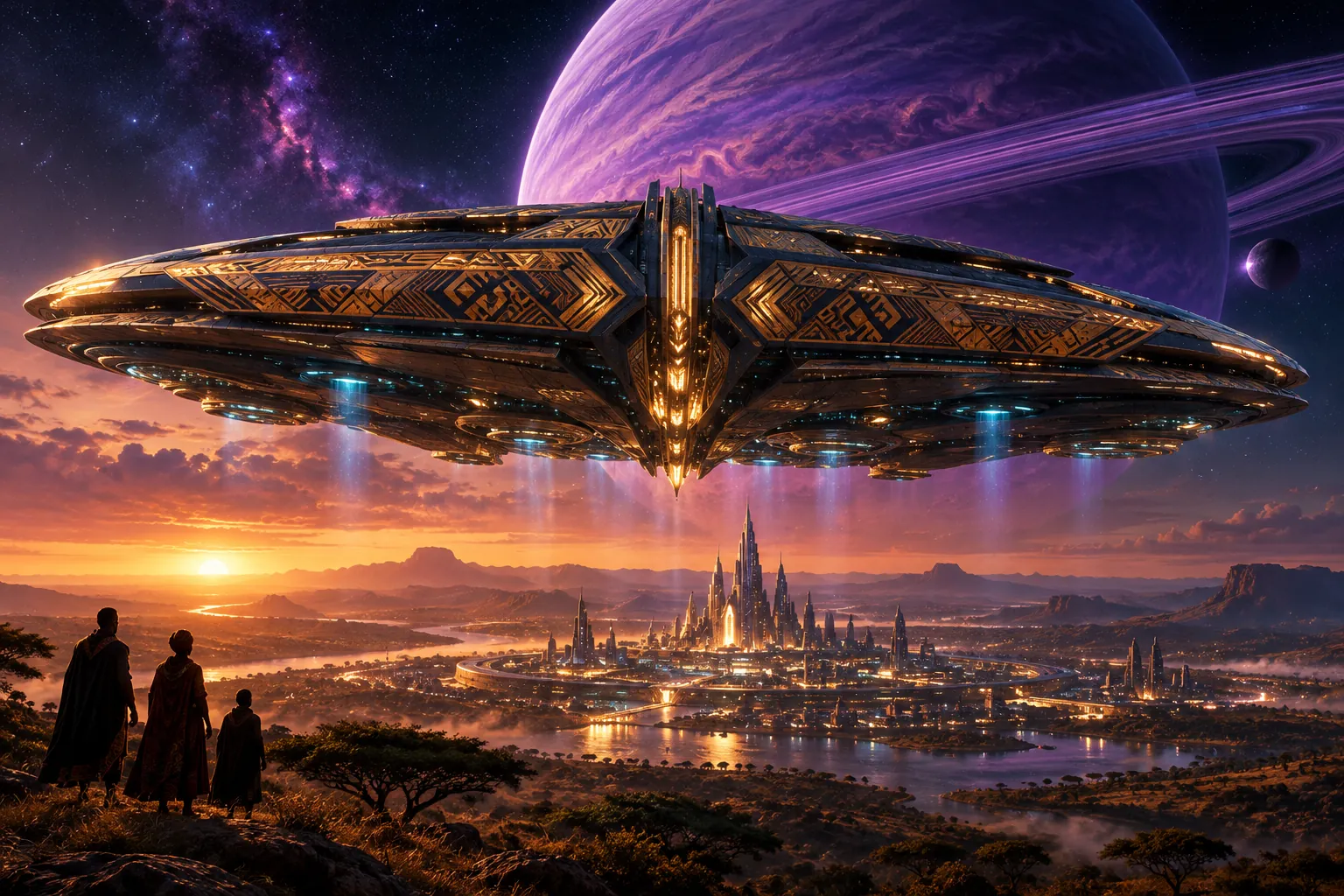
In music, look to Sun Ra, Parliament-Funkadelic, Drexciya and Janelle Monáe, whose 2018 album Dirty Computer came with a short film set in a future that polices identity. On screen, the best known example is Black Panther (2018), directed by Ryan Coogler. The hero first appeared in Marvel comics in 1966, created by Stan Lee and Jack Kirby, and the film’s Wakanda, a never-colonised African nation with advanced technology, made the idea visible to audiences around the world.
Why it matters
For a long time, mainstream science fiction imagined futures with very few Black characters in them. That absence sends a quiet message: the future belongs to someone else. Afrofuturism answers by putting Black people at the centre, not as sidekicks or victims, but as scientists, rulers, rebels, farmers and explorers. The effect is not only on the page. A young reader who sees a Black heroine steer a starship, or a Black musician take the stage as an alien ambassador, learns that the imagination is open to everyone.
It also gives artists a flexible language for hard subjects. A story about time travel can look at slavery without turning it into a lecture. A song about another planet can talk about leaving a place that does not welcome you. Because the settings are made up, they leave room for humour, glamour and joy alongside anger and grief, and that mix is one reason the work feels so alive.
Finally, Afrofuturism links art to technology. Many of its creators are interested in who builds machines, who owns data and whose stories get told by the systems we use every day. Those questions have become sharper in the age of algorithms, which is part of why the movement keeps finding new audiences.
Common misconceptions
“Afrofuturism is just Black Panther.” The film made it famous, but the tradition is at least half a century older, and much of it is music, poetry and visual art.
“It is only about space.” Many works stay on Earth. Kindred is set in the past, and Parable of the Sower in a broken near future. The future in Afrofuturism is as much a way of thinking as a place.
“It is the same as Africanfuturism.” In 2019 Nnedi Okorafor proposed the term Africanfuturism for science fiction rooted in African cultures and viewpoints, not in the diaspora’s relationship to the West. The two overlap, but she argues they are different, and many writers use both words with care.
“It is escapism.” Most Afrofuturist work does the opposite. It faces slavery, racism and surveillance directly, then asks what could come after.
How to start exploring
You do not need to read theory first. A simple path is to pick one entry point in each form. Begin with a book such as Kindred or Binti, which are both short enough to finish in a few evenings. Then listen to an album, for example Parliament’s Mothership Connection or Janelle Monáe’s Dirty Computer, and watch for how the costumes, covers and stories build a whole world around the songs. Finally, watch Black Panther with the ideas above in mind and notice how the design of Wakanda mixes technology with African-inspired patterns and traditions.
If you enjoy that, Ytasha Womack’s 2013 book Afrofuturism: The World of Black Sci-Fi and Fantasy Culture is a friendly survey that covers many more artists than this short guide can. Take your time, follow whatever grabs you, and treat the movement as a conversation you are welcome to join.
Read next
To see where Afrofuturism sits in the larger story of the genre, read our history of science fiction, which follows the field from its early roots to the present.