In five minutes
Liu Cixin is the Chinese author of The Three-Body Problem, and the person most responsible for the world noticing Chinese science fiction. He spent years working as a computer engineer at a power plant, and he still writes like someone who loves numbers: big distances, big time spans and cold logic. His best-known idea is the "dark forest": a bleak answer to the question of why we have not heard from aliens.
If you know him from the Netflix series or the Chinese TV adaptation, this page covers the man behind the story. It also shows which of his books to try first. This page belongs to our wider History of Science Fiction, where he stands as the best-known voice of modern Chinese sci-fi.
Who is Liu Cixin?
Liu was born on 23 June 1963 and grew up in Yangquan, a coal-mining city in Shanxi province. He trained in engineering and went on to work as a computer engineer at a power plant. He did not start as a full-time writer. He wrote in his spare time and sent stories to the Chinese magazine Science Fiction World, the main home of the genre in China.
That engineering background shows in his style. His characters are often ordinary scientists, soldiers or officials who face a problem much bigger than themselves. Plot usually follows from a physical or logical idea, and the idea is the star of the story. Critics sometimes say his people are thin. Fans reply that this is deliberate: the real subject is humanity as a whole, not one hero.
He has said in interviews that he sees himself as a writer of ideas first. He is often compared with Arthur C. Clarke, an author he has named as an influence, and the comparison fits: both write about awe at the size of the universe.
The main works
Remembrance of Earth's Past (the Three-Body trilogy)
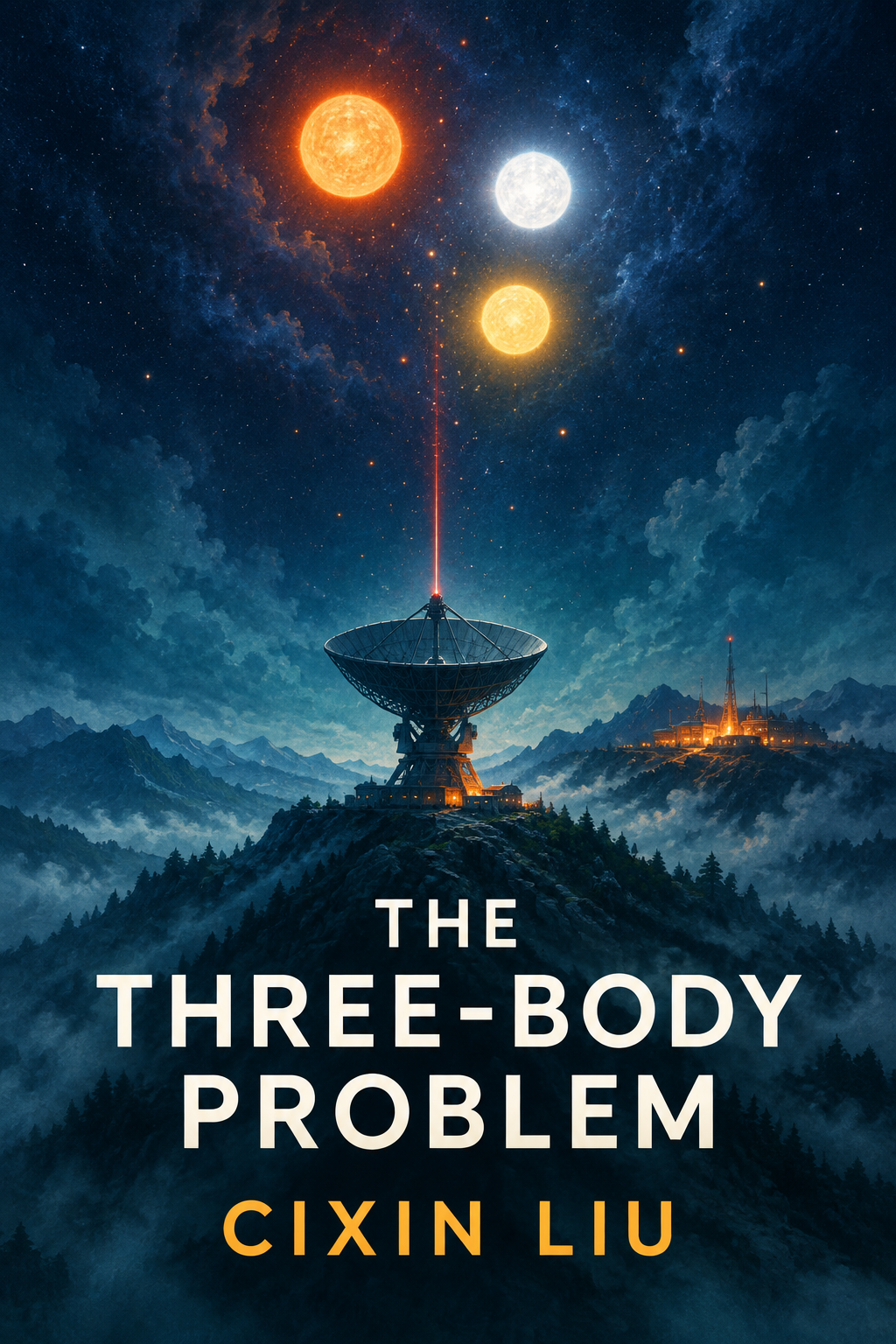
This is the series that made him famous. It began as a serial in Science Fiction World in 2006 and was published as a book in 2008. The three novels are The Three-Body Problem, The Dark Forest and Death's End. Together they follow humanity's contact with an alien civilisation over thousands of years. The first book starts in the Cultural Revolution and moves on to a virtual-reality game and a mystery among scientists. You can read our full guide to The Three-Body Problem for the plot and characters.
The English translation of the first book, by Ken Liu, came out in 2014. The second volume was translated by Joel Martinsen, and the third by Ken Liu again.
The Wandering Earth
This novella, from 2000, is the second work most people know. In it, the Sun is dying and humanity builds giant engines to push the entire planet out of the solar system. A Chinese film based on it was released in 2019 and was a major box-office success in China.
Other books and short stories
Liu has written many other works, including the novels Ball Lightning and Supernova Era, and short stories such as "The Village Teacher" and "Mountain". Many of the stories were collected in English in The Wandering Earth and Broken Stars (the latter edited by Ken Liu). If you want a short taste of his style before a thousand-page trilogy, a story collection is a good start.
The ideas he is known for
The dark forest
The idea gives the second novel its title. In a forest at night, every hunter stays silent, because a loud one is easily found and killed. Liu applies the same logic to the stars: if every civilisation is a possible threat, the safe move is to stay hidden and strike first. It is a fictional answer to the Fermi paradox, not a scientific finding. Our article on dark forest theory explains it step by step, with the novel's setting kept spoiler-light.
Scale as a source of feeling
His stories jump from a single room to the age of the universe within a few pages. The feeling he aims for is not terror or adventure but a quiet shock at how small people are, and how much they can still do.
Cold choices for the whole species
Many of his plots ask what a society would do if survival came before comfort or morality. The answers are often uncomfortable, and that is why readers argue about them.
The science behind his fiction
The title The Three-Body Problem comes from real physics. It is the problem of predicting how three objects move when each pulls on the others by gravity. In general no exact formula solves it, which makes such systems chaotic. Liu uses this as the engine of a world with three suns. The planet in the story is imagined, but the maths behind the title is real.
The dark forest, on the other hand, is a thought experiment. No evidence shows that any civilisation hides or attacks. It rests on stated assumptions, such as the idea that you can never be sure of another civilisation's intentions. Treat it as an argument in fiction, not a prediction.
Awards and recognition
In August 2015, The Three-Body Problem won the Hugo Award for Best Novel. Liu was the first Asian author to win it. In China he has won the Galaxy Award, the country's leading prize for science fiction, several times. The English translation of Death's End won the Locus Award for best science fiction novel in 2017.
Adaptations
His work has reached screens in several forms. The Wandering Earth became a Chinese blockbuster film in 2019. The trilogy's first book was adapted into a Chinese television series in 2023, and Netflix released an English-language series, 3 Body Problem, in March 2024. Each adaptation changes things. If you want the author's own version of events, read the books.
Common misconceptions
- "Liu Cixin is a Chinese government writer." He is a private author who worked as an engineer. Readers debate how to read the politics in his books, and he has given interviews with views that people have criticised and defended. The novels themselves are better judged on what is in the text.
- "The Three-Body Problem is only about aliens." It opens with a scene from China's Cultural Revolution, and much of the book is about what science and belief do to people.
- "The dark forest is real science." No. It is one fictional answer to a real question, the Fermi paradox.
- "You must read all three books to enjoy him." The first book works on its own, and his short stories are an easy way in.
Read next
- The Three-Body Problem: the plot, characters and themes of the book that started it all.
- Dark forest theory: the central idea of the second novel, and why it troubles readers.
- History of Science Fiction: where Liu fits in the long story of the genre.