In five minutes: what a time travel paradox is
A time travel paradox is a puzzle that appears when someone goes to the past and seems to break the chain of events that sent them there. The idea is old. H. G. Wells published The Time Machine in 1895, and writers have been tying themselves in knots over cause and effect ever since. This page belongs to our History of Science Fiction topic.
Three puzzles matter most. The grandfather paradox asks what happens if you stop your own birth. The bootstrap paradox asks where something came from if it has no beginning. The butterfly effect asks how far one small change in the past can spread. Each one tests a rule we normally take for granted: a cause comes before its effect, and every effect has a cause.
Time travel to the past has never been shown to be possible. The puzzles are still useful, because they force physicists and storytellers to say exactly what they mean by “changing” history.
The grandfather paradox: erasing yourself
The grandfather paradox is the best known. Imagine you travel back and stop your grandfather before he has any children. Then your parent is never born, and neither are you. But if you were never born, you could not have travelled back to stop him. The story eats its own tail: you can do it only if you cannot.
The paradox is about consistency. A past that has been changed and a present that remembers the old past cannot both be true in the same history. That is why it became the standard test for any time travel idea. If a theory allows the trip, it has to say what happens at this point.
There are two broad answers. One says the past cannot actually be changed, because something always gets in the way. The other says that changing the past starts a new branch of history, and your original world stays as it was. Both appear later on this page.
The bootstrap paradox: things with no beginning
The bootstrap paradox has no contradiction in the history at all, which makes it stranger. Picture a composer who brings an old score back in time and hands it to their younger self. The younger self copies it, publishes it and grows famous, then grows old and carries the same score back. Who wrote the music? The score exists, yet it was never composed.
The name comes from the old phrase about lifting yourself up by your own bootstraps, which cannot be done. Objects or information in a closed loop seem to lift themselves into existence. A close relative is the predestination paradox, where the trip to the past is itself the cause of the events that make the trip happen. Nothing is broken, but nobody can say where the loop starts.
The butterfly effect: small changes, large results
The butterfly effect is not strictly a paradox. It is a claim about sensitivity. The meteorologist Edward Lorenz found that in a complex system such as the weather, a tiny difference at the start can grow into a large difference later. The phrase became popular in the 1970s.
Applied to time travel, it means that stepping on one insect, or saying one sentence, could change the whole future. Ray Bradbury’s 1952 short story “A Sound of Thunder” uses this idea: a hunter on a trip to the age of the dinosaurs crushes a butterfly, and the present he returns to has changed in small but unsettling ways. Our butterfly effect article explains how the science and the story use differ.
The deeper question is how much of history is fixed and how much is chance. Nobody can run the experiment, which is why the idea works better as a storytelling tool than as a prediction.
How stories avoid the paradoxes
Writers have used four main designs. In the fixed past, whatever you do was always part of history, so your actions create the world you came from. In the branching timeline, changing the past creates a new branch, and your original world stays as it was. In the rewrite, the present changes on the spot and only the new version survives. In the observer model, you can visit the past but cannot touch anything.
Knowing which design a story uses helps you read it. Fixed-past stories tend to be about fate and acceptance, while rewrite stories tend to be about responsibility for what you changed. Many films and books mix designs, and the best ones keep their own rules consistent from start to finish.
Spotting where a story breaks its own rule is a good way to practise thinking about cause and effect.
The real science
Start with what has been measured. Time does not run at the same rate everywhere. Relativity says that clocks moving fast, or sitting deeper in a gravity field, tick more slowly than others. GPS satellite clocks must be corrected for this every day, by roughly 38 microseconds in total. So moving forward in time at a different speed is real, though the effect is tiny.
Travel to the past is a different matter. It has never been observed. In theory, general relativity allows some solutions with closed timelike curves, which are paths through spacetime that loop back to an earlier moment. The mathematician Kurt Gödel described one in a rotating universe in 1949. In 1988 Michael Morris, Kip Thorne and Ulvi Yurtsever argued that a traversable wormhole could in principle be turned into a time machine. These are mathematical possibilities. Nothing suggests our universe contains such structures, and they would probably need exotic matter that nobody has found.
Physicists have proposed several ways out of the paradoxes. The Russian physicist Igor Novikov and colleagues developed the self-consistency principle: only histories without contradictions can happen. If you try to stop your grandfather, something always prevents it, and the past you visit is the one that led to you. In 1991 David Deutsch used quantum mechanics to suggest that changing the past would lead to a different branch of history. In 1992 Stephen Hawking proposed the chronology protection conjecture, the idea that the laws of physics may always stop time machines from forming. None of these ideas is settled.
So keep three levels apart: measured fact (clocks run at different rates), mathematical possibility (closed timelike curves) and thought experiment (the grandfather paradox).
Where it shows up in fiction
Robert A. Heinlein wrote some of the most influential time loop stories. “By His Bootstraps” (1941) follows a man who meets several versions of himself inside one loop. Spoiler note: the next sentence gives away the twist of a short story. “—All You Zombies—” (1959) is about a single person who turns out to be their own family, and it is still the standard example of a bootstrap paradox.
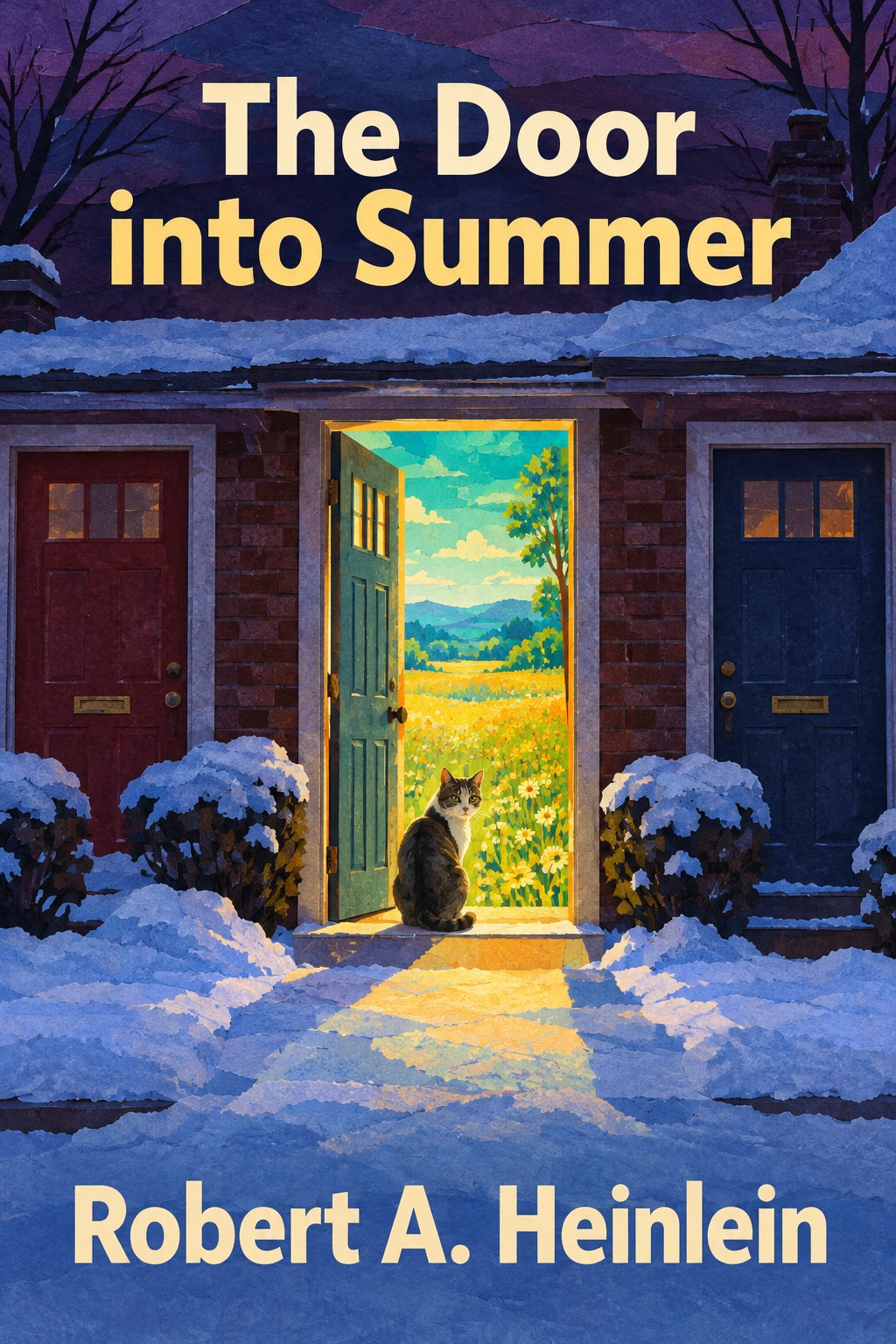
Heinlein’s novel The Door into Summer (1957) is a friendlier start. Its hero, the engineer Dan Davis, is betrayed, takes cold sleep for about thirty years, and later uses a time machine to set things right. The time travel runs on tidy rules, so reading it with the paradoxes in mind shows you where the author closes his loops.
Bradbury’s “A Sound of Thunder” (1952) is the classic butterfly effect story. Among films, Back to the Future plays with changing the way a person’s parents meet, and The Terminator with a loop in which people and things from the future cause events in the past. Both are mentioned by name only.
Common misconceptions
“Paradoxes prove time travel is impossible.” They show that time travel is hard to make consistent. Ideas such as the self-consistency principle try to remove the contradiction. Time travel to the past has been neither proved possible nor proved impossible.
“The butterfly effect means any change makes a huge difference.” The original idea is that small differences can grow in complex systems, not that they always do.
“The bootstrap paradox contradicts itself.” History stays consistent. The puzzle is only that nobody can explain where the object or idea began.
“Changing the past rewrites your memories at once.” That is a storytelling convention, not something physics describes.
Read next
For the classic contradiction, read Grandfather paradox. For things without an origin, try Bootstrap paradox. For the way small causes grow, see Butterfly effect. If you would rather enjoy the idea as a story, start with The Door into Summer, a time travel novel with tidy rules.