In five minutes
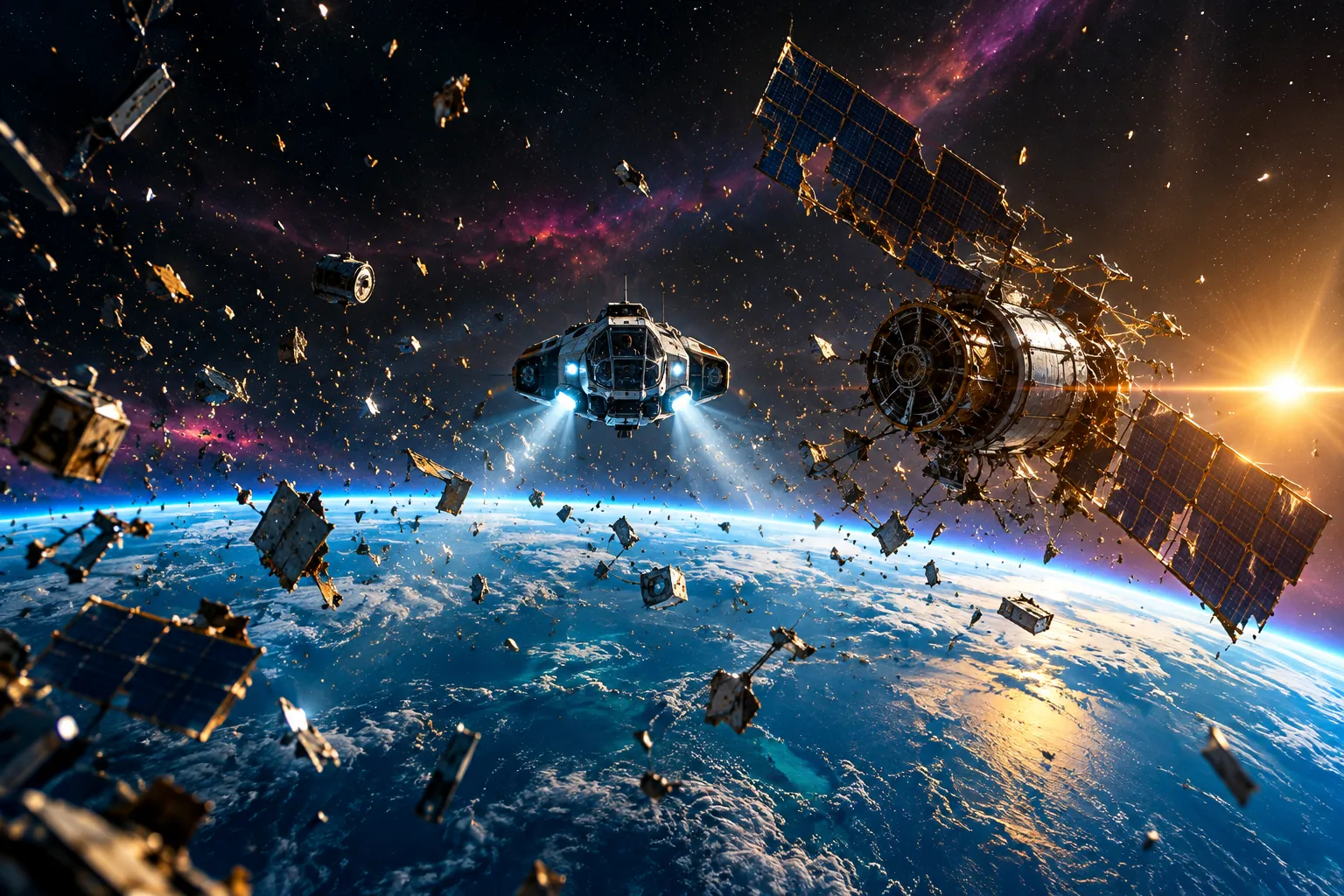
Kessler syndrome is a scenario in which collisions in Earth orbit create so much debris that the debris causes further collisions, again and again, faster than nature can clear it. Each crash makes fragments, and each fragment is a new bullet. Once the loop is running, it feeds itself.
The idea comes from a 1978 paper by NASA scientists Donald Kessler and Burton Cour-Palais, titled “Collision Frequency of Artificial Satellites: The Creation of a Debris Belt”. They calculated that once enough objects were in orbit, collisions among them could become the main source of new debris, outpacing anything added by new launches. The name “Kessler syndrome” was attached later by others. Kessler has stressed that this would be a slow process, not a single dramatic day.
It matters because modern life leans on satellites. Navigation, weather data, television and communications all depend on them. A badly polluted orbit would make it riskier and more expensive to launch and operate satellites there.
How the chain reaction works
Start with speed. An object in low Earth orbit, the region below about 2,000 kilometres, travels at roughly 7 to 8 kilometres per second. Two objects meeting at an angle can close on each other at more than 10 kilometres per second. At those speeds the energy is enormous. A small piece of metal can punch through spacecraft shielding, and even a fleck of paint chipped a window of the Space Shuttle in 1983.
Next, look at what a collision does. A satellite does not bounce off another one. Both objects shatter into many fragments that fly off in different directions and settle into different orbits. Most of those pieces are too small to track from the ground, yet still big enough to wreck a working satellite.
Finally, add time. Thin air at the edge of space drags on orbiting objects and slowly pulls them down until they burn up. Low down, below roughly 500 kilometres, debris usually falls back within a few years. Higher up the air is thinner still. At 800 kilometres and above, pieces can stay for decades or even centuries. That is why the altitude of a collision matters as much as its size.
Put the three together and you get a feedback loop. More debris raises the chance of collisions. Collisions create more debris. And at high altitude, the debris does not leave. Later modelling studies, including work at NASA, suggested that some busy altitudes could keep growing from collisions alone, even if no new satellites were launched.
The real science: what is measured and what is projected
Some parts of the story are solid measurement.
- Space agencies track tens of thousands of objects larger than about 10 centimetres, and keep a public catalogue of many of them.
- ESA models estimate around a million pieces between 1 and 10 centimetres, and well over a hundred million smaller than 1 centimetre. These are statistical estimates, because most pieces are too small to see from the ground.
- Real collisions and deliberate break-ups have added thousands of tracked fragments. Satellites now make regular avoidance manoeuvres to dodge debris.
Other parts are projection. Whether a runaway cascade will happen, in which orbits, and how fast, depends on assumptions about future launches, how many satellites fail, and how well old hardware is removed. Models from NASA and ESA broadly agree that without good disposal the number of objects keeps rising and collisions become more likely. None of them gives a date for a tipping point, and you should be wary of anyone who does.
Three events that made it real
2007: a missile test. In January 2007 China destroyed its old Fengyun-1C weather satellite with a missile at about 860 kilometres altitude. The test produced more than 3,000 tracked fragments. Because the orbit is high, a large share of them were still circling years later. It remains one of the worst single debris-creating events in history.
2009: an accidental collision. On 10 February 2009 the working US communications satellite Iridium 33 collided with Cosmos 2251, a dead Russian satellite, about 790 kilometres above Siberia. It was the first accidental collision between two intact satellites, and it created well over a thousand tracked pieces.
2021: another missile test. In November 2021 Russia destroyed its defunct satellite Cosmos 1408 at about 480 kilometres. More than 1,500 fragments were tracked. The crew of the International Space Station took shelter in their docked spacecraft for a time. Because the orbit is much lower, the pieces decay faster, which shows how altitude changes the long-term damage.
Where it shows up in fiction
Kessler syndrome is a favourite of writers because it is both frightening and quiet: the villain is a cloud of small things. The manga Planetes by Makoto Yukimura follows a crew in the 2070s whose job is to collect orbital debris. It treats junk in space as an everyday workplace problem, which is close to how real engineers talk about it. The 2013 film Gravity opens with a debris strike on a shuttle crew. It is gripping, though it squeezes several spacecraft into the same orbit, which real spacecraft do not share.
The idea also feeds the wider tradition covered in our guide to the history of science fiction, where the future often arrives as the unintended result of what we already built.
Common misconceptions
- “It is one sudden event that traps us on Earth.” No. The cascade would be gradual, and it would affect some altitudes far more than others.
- “It has already happened.” Not in the runaway sense. Orbits are more crowded and more hazardous than before, but the ISS, weather satellites and thousands of others still work, with regular avoidance manoeuvres.
- “Space is a minefield of debris clouds.” Space is huge. For any single satellite the chance of a hit is small. The danger comes from adding up many small risks over many years.
- “Debris would block us from space forever.” Low orbits clean themselves in time, and some high orbits might become unusable for a very long time. Rockets could still leave Earth, passing through the debris belt quickly.
What is being done
The main defence is not making more debris. International guidelines from the Inter-Agency Space Debris Coordination Committee have long asked operators to remove satellites from low orbit within 25 years of the end of their missions. In 2022 the US Federal Communications Commission adopted a stricter five-year rule for satellites it licenses in low Earth orbit. Tracking networks warn operators of close approaches so they can move out of the way.
The harder part is cleaning up what is already there. In 2021 the company Astroscale launched ELSA-d, a test of docking with a target in orbit. In 2024 its ADRAS-J mission, working with Japan's space agency JAXA, approached a spent Japanese rocket stage and studied it from close range. These are early demonstrations, and removing large dead objects is still expensive.
Read next
- Space elevator: a tether through the busiest orbits would have to survive the same debris problem.
- History of science fiction: see where orbital disaster stories fit in the wider genre.