In five minutes
The technological singularity is a hypothetical future moment when technology, most often artificial intelligence, improves itself so quickly that human forecasting stops working. The name borrows from mathematics and physics, where a singularity is a point at which a model breaks down. Nobody can say what happens beyond it, and that is exactly what the word is meant to say. The idea is one of the oldest in the history of science fiction, and engineers and novelists have argued over it for decades.
The core argument has three steps. First, suppose people build a machine that is better than they are at designing machines. That machine can design a better successor. Second, the successor can do the same, and if each round takes less time than the one before, progress speeds up instead of staying steady. Third, after a handful of rounds, the result could be an intelligence far beyond anything a human mind could follow. The mathematician I. J. Good called this an “intelligence explosion” in 1965.
It helps to pull apart three claims that often get mixed together. The first is that technology keeps speeding up, which has been observed in some fields, computing above all. The second is that machines will one day match or pass human intelligence, which is possible but unproven. The third is that this will set off runaway self-improvement, which is a hypothesis. The singularity needs all three, and only the first has solid evidence behind it.
Where the idea came from
The earliest hint is a remark linked to the mathematician John von Neumann. In a 1958 tribute, his colleague Stanislaw Ulam recalled a conversation about ever-accelerating technological change, and about an approaching point beyond which human affairs as we know them could not carry on in the same way.
The sharper version came from I. J. Good, a British mathematician who had worked as a codebreaker at Bletchley Park during the Second World War. In a 1965 paper he imagined an “ultraintelligent machine”, one that could surpass every intellectual activity of any person, however clever. Designing machines is an intellectual activity, he reasoned, so such a machine could design even better ones. He added that the first ultraintelligent machine would be the last invention people would ever need to make, as long as the machine stayed under control.
The name stuck thanks to Vernor Vinge, a mathematician and science fiction writer. He used the word in a magazine column in 1983, then wrote the essay “The Coming Technological Singularity” for a NASA-sponsored symposium in 1993. In it he predicted that within thirty years we would have the technical means to create superhuman intelligence, and that soon afterwards the human era would be over. He named several possible routes: computers that wake up, networks that become intelligent, closer links between people and machines, and biology that improves human minds. He also said he would be surprised if it happened before 2005 or after 2030.
Inventor and futurist Ray Kurzweil carried the idea to a mass audience with The Singularity Is Near (2005). He argues for a “law of accelerating returns”, in which information technologies improve exponentially. He forecast human-level AI around 2029 and the singularity around 2045, and in 2024 he published a follow-up, The Singularity Is Nearer, that keeps those dates. In between, philosopher Nick Bostrom's Superintelligence (2014) shifted the debate toward a practical question: if a much smarter machine ever appears, how do we make sure its goals match ours?
The real science
What is established is narrower than the headlines suggest. Computing power grew exponentially for decades. Gordon Moore noticed in 1965 that the number of components on a chip was doubling at a steady pace, and the trend, later pegged at roughly every two years, held for a long time. Since the mid-2000s, though, chips have stopped getting much faster in clock speed, and shrinking them further has become harder and more expensive.
AI has also had real milestones. IBM's Deep Blue beat the chess world champion Garry Kasparov in 1997, and DeepMind's AlphaGo beat the Go master Lee Sedol in 2016. Today's large language models write, code and answer questions across many topics. None of this is the same as a system that redesigns its own foundations and keeps improving without help.
The open questions are where the real argument lives. Is intelligence one thing that can be scaled up, or many different skills? Do improvements get easier as a system gets smarter, or harder, as the best ideas are used up first? Physical limits such as energy, hardware supply and training data could slow any explosion. Sceptics such as Paul Allen have argued for a “complexity brake”: the more we understand about the mind, the more complicated it turns out to be. Supporters answer that a system need not copy the brain to out-think it. Researchers who study AI disagree widely on when, or whether, machines will reach human-level ability, so any single date should be read as one forecast among many.
Some researchers also separate a “slow takeoff”, where capabilities rise over years or decades and society can adapt, from a “fast takeoff”, where the jump comes within days or weeks. Most of the safety debate is about preparing for the second case while hoping for the first.
Where it shows up in fiction
Vinge wrote the idea into his stories long before his essay. In Marooned in Realtime (1986), the people of the far future have vanished in an event that survivors can only guess at, and A Fire Upon the Deep (1992) imagines a galaxy where the level of intelligence possible depends on where you are. Both are good places to see how a novelist handles a point beyond which nothing can be predicted.
Charles Stross's Accelerando (2005) follows one family across three generations as the economy and human minds are reshaped faster and faster. It is closer to a comic, dizzying tour of the idea than a warning.
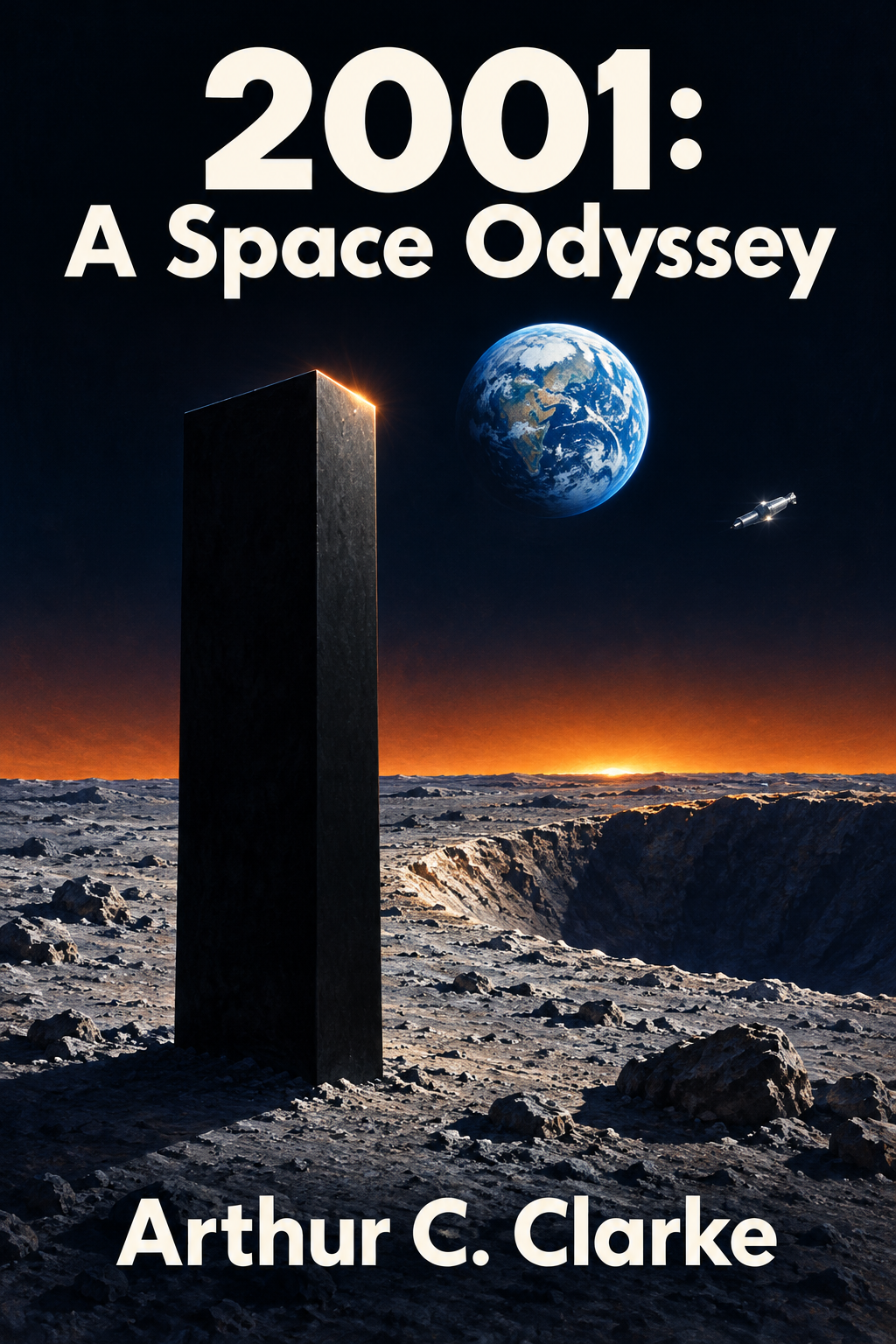
Arthur C. Clarke's 2001: A Space Odyssey is not about runaway self-improvement, but it set the template for machine minds in fiction. Its ship computer HAL 9000 shows how people fear a thinking machine whose goals drift away from the crew's, and the story's larger arc is about humanity being changed by a greater intelligence. You can read more on our page for 2001: A Space Odyssey. Isaac Asimov's short story “The Last Question” (1956) stretches a single ever-growing computer across billions of years. Films such as Her and Transcendence have also taken up the theme.
Common misconceptions
“The singularity means robots take over.” The word describes a limit to prediction, not a villain. A super-intelligent system could be helpful, harmful or simply indifferent, and the idea does not decide which. The risk that a system pursues a goal in a way nobody intended is explored in the thought experiment on the paperclip maximizer.
“It is scheduled for 2045.” That date is Kurzweil's forecast, not a scientific consensus. Vinge's own window, 2005 to 2030, has passed without the event, and he treated his date as a possibility rather than a promise.
“It is the same as artificial general intelligence.” Artificial general intelligence, or AGI, means a system that can do most intellectual tasks as well as a person. The singularity is a hypothetical aftermath, in which such a system improves itself beyond human understanding. You could have AGI without a singularity.
“It is the same as transhumanism.” The two overlap, because both imagine technology changing what humans are, but the singularity is a prediction about intelligence and speed, while transhumanism is a movement with goals about improving the human condition.
“It is linked to Roko's basilisk.” The basilisk is a thought experiment about a future AI and decision theory. It is not part of the argument for a singularity. See Roko's basilisk for what it does and does not claim.
“It works like a black hole.” The borrowing is a metaphor. In physics, a singularity is where density becomes infinite. Here it only marks the edge of what we can foresee.
Read next
- History of Science Fiction: the wider story of how writers imagined machines, space and the future.
- Transhumanism: the movement that wants to use technology to change human limits.
- Paperclip maximizer: a famous thought experiment about a powerful AI with the wrong goal.
- Roko's basilisk: a controversial thought experiment often confused with the singularity.
- 2001: A Space Odyssey: the novel that gave fiction its most famous thinking machine.