In five minutes
The Hugo Award is the best-known prize in science fiction, and it is chosen by fans, not by a jury. The voters are members of the World Science Fiction Convention, usually called Worldcon, which meets once a year in a different city. Winners are announced at a ceremony during the convention. The prize is named after Hugo Gernsback, the publisher who launched the magazine Amazing Stories in 1926 and helped turn science fiction into a genre with its own readers.
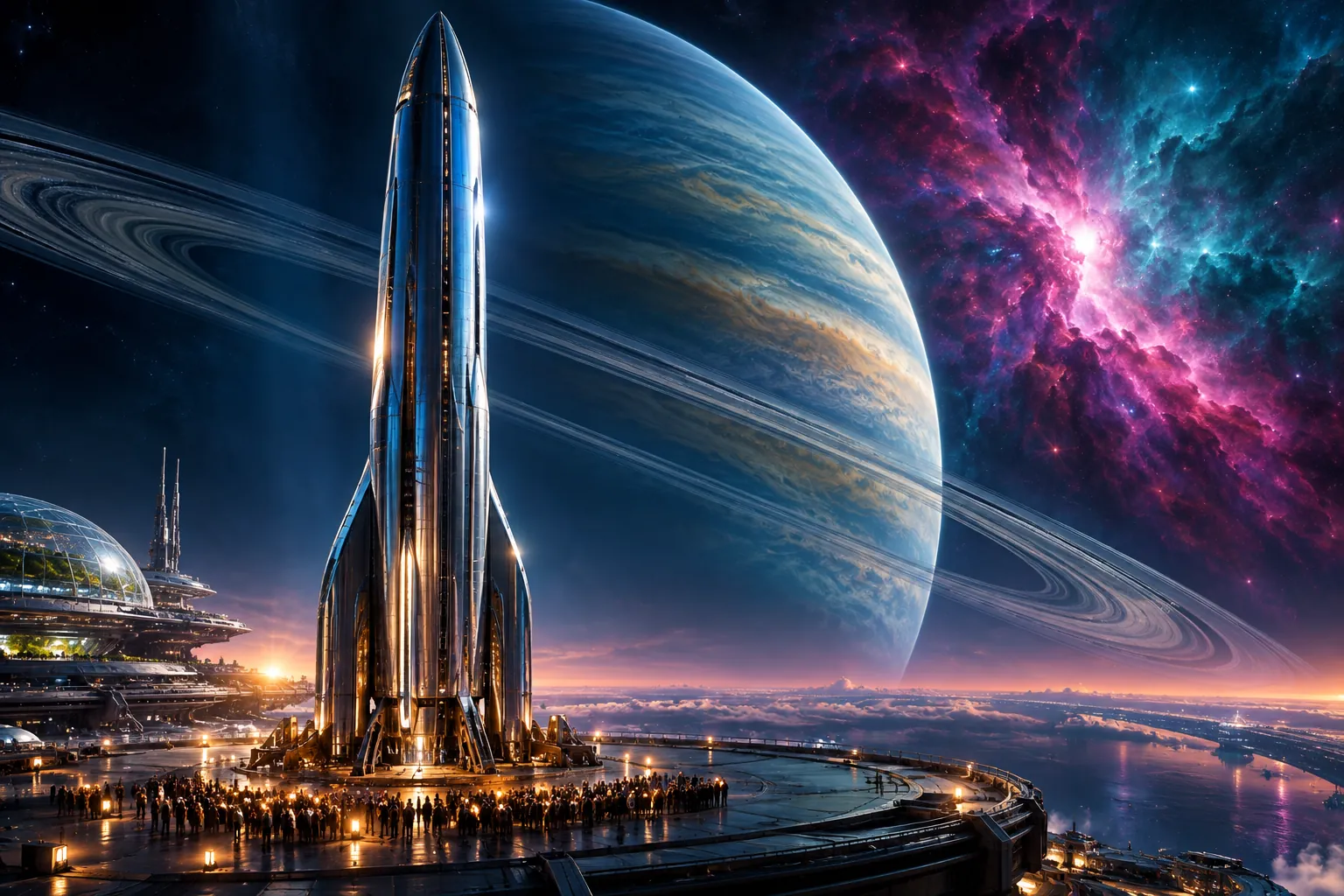
The award covers much more than novels. There are prizes for novellas, novelettes and short stories, for whole series, for films and television episodes, for comics, for editors and artists, and for fan writers and fanzines. The trophy is a rocket ship standing on a base. The rocket is the familiar part, while the base is designed again by each year's host convention, so no two years look quite the same.
Winners have included Dune, The Left Hand of Darkness, Neuromancer, Ender's Game and The Three-Body Problem. If you want a reading list of the books that science-fiction fans themselves chose to celebrate, the Hugo list is a good place to start. This page covers how the award began, how voting works, the famous winners, and how the Hugo differs from the Nebula and Japan's Seiun Award. It is one chapter of the larger story told in the history of science fiction.
How a Hugo is won
A Hugo is decided in three steps, and every step is open to ordinary fans who pay for a Worldcon membership.
Nominating. Members of the current Worldcon, the previous one and the next one can nominate. Each person may name up to five works in each category. A supporting membership, which does not require travelling to the convention, is enough to take part.
The final ballot. Since 2017 the nominations have been counted with a method called E Pluribus Hugo. It is designed so that a small group voting together cannot fill the whole list, and each category now has six finalists instead of five.
The final vote. Members rank the finalists in order of preference. The count is an instant runoff: the finalist with the fewest first choices drops out, and those ballots move to their next choice, until one work has a majority. "No Award" is always on the ballot. If enough voters feel that none of the finalists deserves a prize, nothing is given in that category.
The four fiction categories are separated by length. A novel is 40,000 words or more. A novella runs from 17,500 to 40,000 words, a novelette from 7,500 to 17,500, and a short story is under 7,500. Two related prizes are presented at the same ceremony but are not Hugos: the Astounding Award for Best New Writer, and the Lodestar Award for Best Young Adult Book.
A short history
Gernsback's magazine gave the genre a home in 1926, but the prize came later. The first Hugo Awards were presented in 1953 at the Worldcon in Philadelphia, with only a handful of categories. Alfred Bester's The Demolished Man won Best Novel. No awards were given in 1954. They came back in 1955 at the Worldcon in Cleveland and have been presented every year since.
The list of categories kept changing as the field grew. Robert A. Heinlein won Best Novel four times: for Double Star, Starship Troopers, Stranger in a Strange Land and The Moon Is a Harsh Mistress. In 1966 Dune shared the prize with Roger Zelazny's This Immortal, and the same year Isaac Asimov's Foundation stories won a one-time award for Best All-Time Series. In 1970 Ursula K. Le Guin's The Left Hand of Darkness won, and in 1985 William Gibson's Neuromancer did.
Since the 1990s, conventions may also give Retro Hugos for years in which no award was presented. At the 2004 Worldcon, Ray Bradbury's Fahrenheit 451 won a Retro Hugo for the books of 1953.
The award's biggest dispute came in 2015. Organised campaigns, known as Sad Puppies and Rabid Puppies, urged their followers to vote for fixed lists of works, and those lists dominated the nominations. Voters answered by choosing "No Award" in five categories that year. The community then reformed the nomination count, and E Pluribus Hugo was first used in 2017. A Best Series prize was first given that same year and became a permanent category in 2018. N. K. Jemisin won Best Novel three years in a row, from 2016 to 2018, for the Broken Earth trilogy.
Famous winners
The Hugo list works like a map of what science-fiction readers loved in each decade. A few winners that matter for readers today:
- Dune (Frank Herbert, 1966): desert planets, politics and ecology, shared with This Immortal.
- The Left Hand of Darkness (Ursula K. Le Guin, 1970): a diplomat on a winter world where people have no fixed gender. It also won the Nebula.
- Rendezvous with Rama (Arthur C. Clarke, 1974): explorers board a mysterious alien ship passing through the solar system.
- Neuromancer (William Gibson, 1985): the book that set the pattern for cyberpunk.
- Ender's Game (Orson Scott Card, 1986): a child is trained as a military commander in orbit.
- Hyperion (Dan Simmons, 1990): pilgrims tell their stories on the way to a dangerous shrine.
- The Three-Body Problem (Liu Cixin, translated by Ken Liu, 2015): the first novel translated from Chinese to win Best Novel.
Short fiction counts too. Daniel Keyes's short story "Flowers for Algernon" won a Hugo in 1960, six years before he expanded it into the novel.
Common misconceptions
"Experts choose the winners." They do not. Anyone who buys a Worldcon membership can vote, and the result shows what that group of fans preferred in that year. That is a strength, but it is not the same as a literary judgment.
"The Hugo and the Nebula are the same thing." They are separate awards with different voters. Some books have won both, such as The Left Hand of Darkness, Rendezvous with Rama, Neuromancer and Ender's Game, but many winners have won only one.
"It is only for novels, and only for American writers." The prize covers many forms. Works translated into English can win, as The Three-Body Problem showed. Worldcon itself travels, and in 2007 it was held in Yokohama, Japan.
"A Hugo means the best book of the year." It means the book won a vote among the people who took part. Finalists are often just as worth reading, and good books are sometimes missed.
Hugo, Nebula and Seiun
Three awards are often mentioned together. The Hugo is voted by fans who join Worldcon. The Nebula Award, given since 1966, is voted by the members of the Science Fiction and Fantasy Writers of America, so it reflects the opinion of working writers. The Seiun Award in Japan, given since 1970, is voted by fans at the national science-fiction convention and has separate categories for Japanese and translated works. Reading all three lists shows how readers, writers and different countries see the same genre.
Read next
Start with the Nebula Award to compare the writers' vote with the fans' vote. Then read the Seiun Award for the Japanese view, and the history of science fiction to see where Gernsback's magazine fits in the bigger picture.