In five minutes
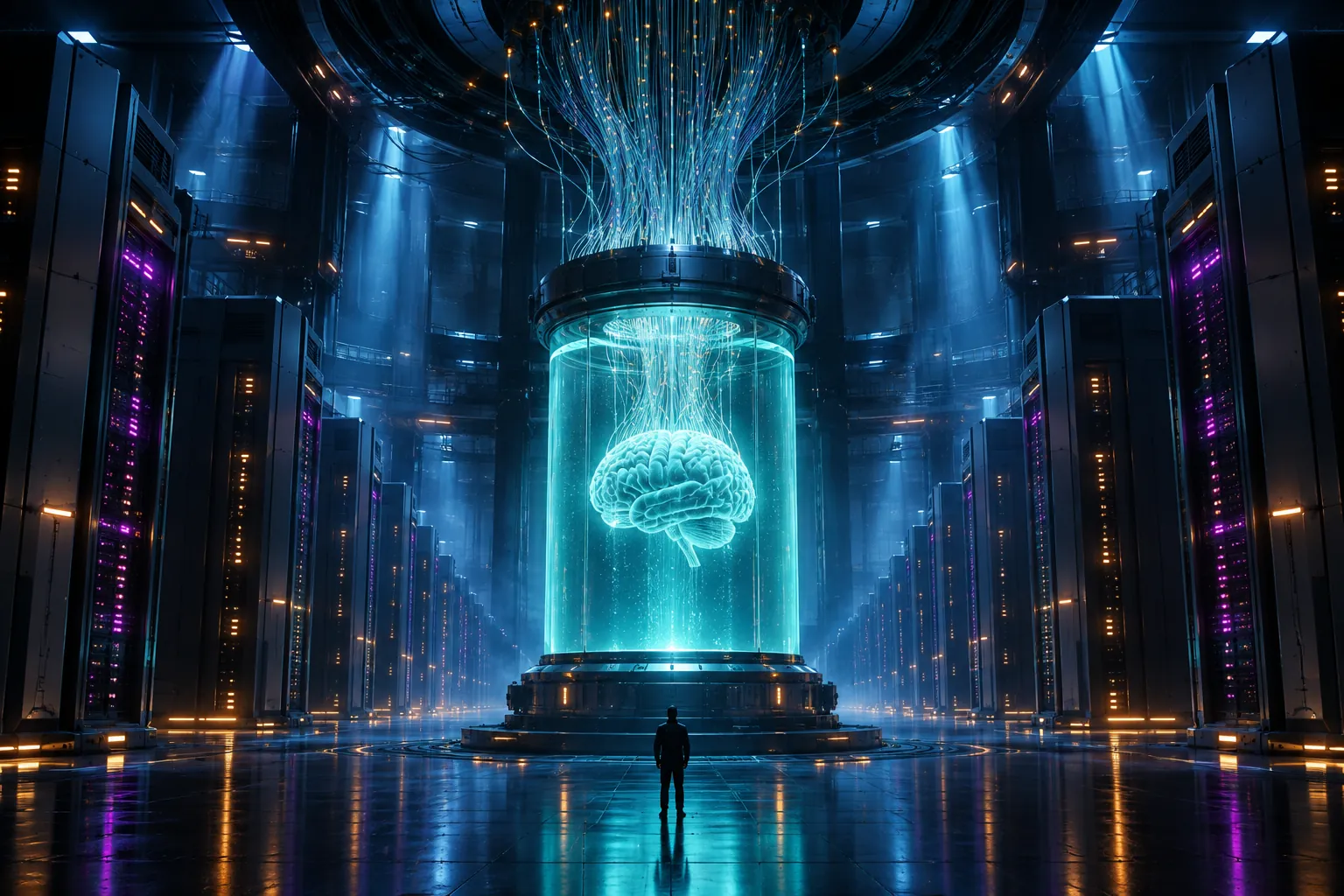
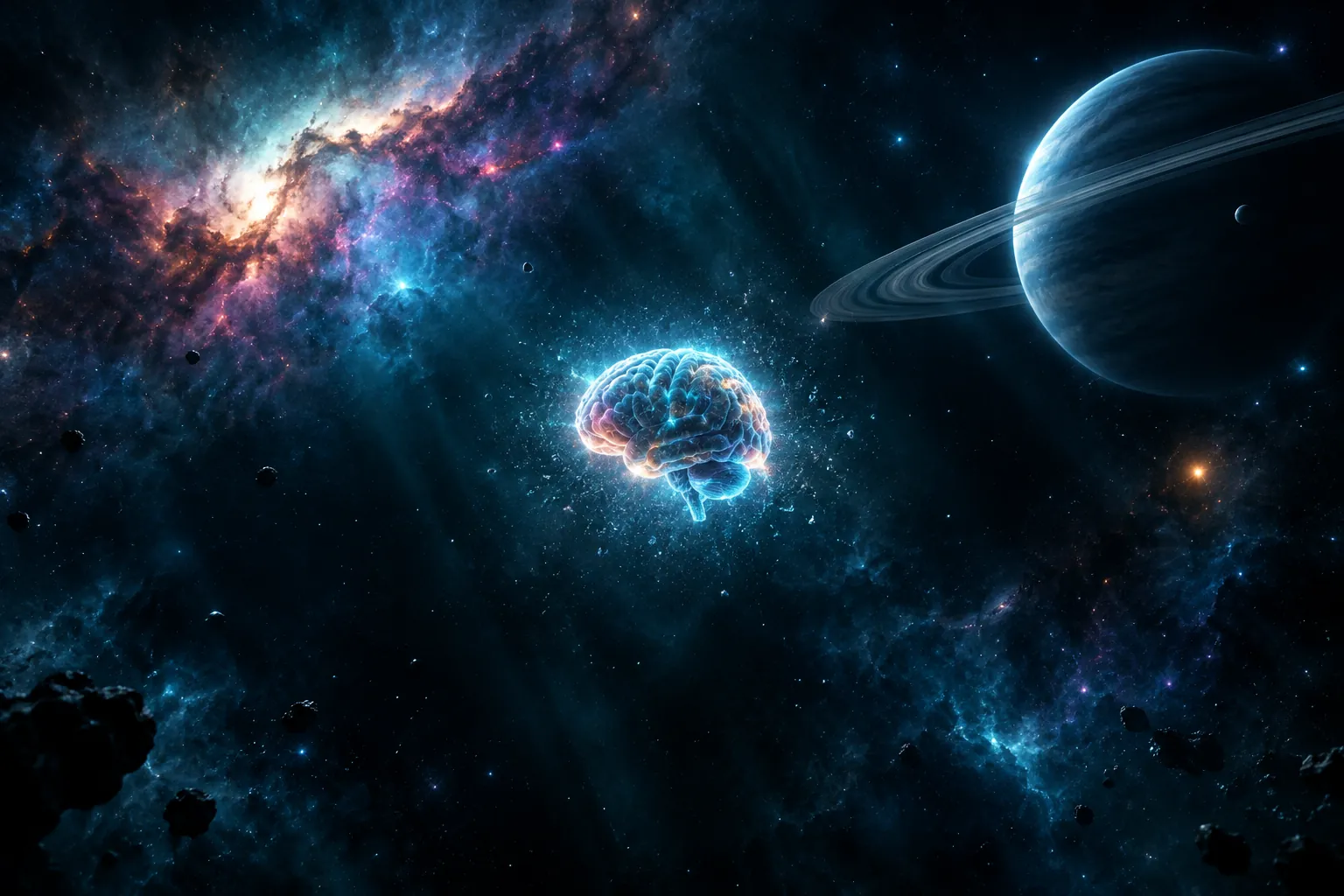
A Boltzmann brain is a thought experiment about a brain that pops into existence by pure chance, complete with memories of a life it never lived, and then disappears. The idea matters because cosmologists use it as a test. If a theory of the universe predicts that these accidental brains should vastly outnumber ordinary observers like you and me, something is wrong with the theory.
The logic runs in four steps. First, physics allows rare random fluctuations: given enough time, even a very unlikely arrangement of particles will eventually appear. Second, a fluctuation that assembles one brain is far less demanding than one that assembles a whole galaxy, let alone a whole universe. Third, if the universe lasts for an unimaginably long time, the cheap fluctuations happen far more often than the expensive ones. Fourth, that would make most conscious observers fleeting accidents, and the world they seem to remember would be an illusion.
Nobody claims that you are a Boltzmann brain. The point is the opposite: because that conclusion looks absurd, physicists treat any model that leads to it as suspect. It belongs to the same family of puzzles as the brain in a vat and the simulation hypothesis, but its source is thermodynamics rather than a deceiver or a computer.
Where the idea comes from: Boltzmann and entropy
The name honours Ludwig Boltzmann (1844–1906), the Austrian physicist who tied entropy to probability. In his picture, entropy counts how many microscopic arrangements look the same from the outside. A tidy, low-entropy state can be arranged in only a few ways. A messy, high-entropy state can be arranged in a huge number of ways. That is why heat flows from hot to cold and why a scrambled egg never unscrambles: the disordered outcomes are overwhelmingly more likely.
This raised a hard question. If the laws of physics work the same forwards and backwards in time, why was the early universe so orderly? Our past has very low entropy, and that is the reason time seems to have a direction. In the 1890s Boltzmann looked for an answer, and one option he considered was that the universe as a whole sits in a state of maximum disorder, with what we see being a rare fluctuation away from it, like a heap of sand that for a moment falls into a neat pattern.
The weakness is that fluctuations are not all equally rare. The probability falls extremely fast as the amount of order they create grows. So the smaller the fluctuation needed to explain what we see, the more likely it is, and that is where the trouble starts. Note that Boltzmann himself did not talk about brains. The accidental observer came later, from others applying his logic.
Why one brain beats a whole universe
The British astronomer Arthur Eddington raised this objection in 1931, and the American physicist Richard Feynman made it widely known in his physics lectures in the 1960s. If our ordered universe were a fluctuation, it would be a far bigger fluctuation than we need. All an observer requires is a brain, a small patch of surroundings and a set of memories. A fluctuation that makes only that is enormously more probable than one that makes a hundred billion galaxies.
Feynman added a neat test. If the order around us were just a fluctuation, the next thing we look at should most likely be disordered, because a fluctuation only has to be tidy where we happen to be looking. Yet whenever we dig up old rocks, read old records or point a telescope at distant stars, we find the same order we expected. That counts strongly against the idea that the universe is a fluctuation, and it points instead to a universe that started in a very low-entropy state.
The modern version: dark energy and a very long future
The old argument came back in a new form after 1998, when astronomers found that the expansion of the universe is speeding up. The simplest explanation is dark energy in the form of a constant energy density of empty space, the cosmological constant. If it really is constant, the far future looks like a cold, almost empty space called de Sitter space. Such a space has a horizon, and the horizon gives it a faint, steady temperature that never goes away.
In 2002 the physicists Lisa Dyson, Matthew Kleban and Leonard Susskind published a paper on the disturbing consequences of such a future. A space that lasts forever and keeps a thermal glow has unlimited time for rare fluctuations. Sooner or later, anything that is physically possible would show up, including observers. In the following years other cosmologists, such as Andreas Albrecht and Lorenzo Sorbo, pushed the argument further, and the nickname Boltzmann brain spread.
The worry is a simple count. Ordinary observers like us, who evolved on planets around stars, can exist only during a limited window of cosmic history, while stars shine. Accidental observers could keep appearing without end. If the universe lasts forever, the second group outnumbers the first by an unlimited margin, and a typical observer would be a Boltzmann brain. A theory that predicts that is in conflict with our ordinary experience.
The real science: what is established and what is speculation
Some parts are solid. Statistical mechanics works, and small random fluctuations have been measured in tiny laboratory systems. The universe really is expanding faster over time, and dark energy makes up roughly two thirds of its energy budget according to measurements such as those of the Planck satellite.
The rest is open. No one knows whether dark energy will stay constant for ever, or whether the vacuum itself could change long before any brain has time to fluctuate into being. No one knows whether a randomly formed brain would really be conscious, and counting observers in a universe that may be infinite is a difficult unsolved problem, often called the measure problem.
The physicist Sean Carroll gave a well-known reply in 2017 in a paper titled Why Boltzmann brains are bad. His argument is about reasoning. If a theory says you are probably a Boltzmann brain, then you cannot trust the memories and observations that led you to the theory. The theory undermines its own evidence, which he calls cognitive instability. The practical lesson is the same as before: a good cosmological model should not make accidental observers typical. That is why they matter as a constraint on theories and not as a claim about reality.
Where it shows up in fiction
There are few stories about Boltzmann brains in the strict sense, but many about the neighbouring questions. Greg Egan's novel Permutation City (1994) asks what a mind needs in order to go on existing, and it plays with the idea that a pattern of experience could be scattered across space and time. Philip K. Dick built whole novels, such as Ubik (1969), on the feeling that the world around a character might not be what it seems. Among films, The Matrix (1999) is the popular version of the deceived mind. Boltzmann brains add a twist that none of these have: no villain and no machine is needed, only chance and a lot of time. For the wider story of how science fiction has handled such questions, see the history of science fiction.
Common misconceptions
- "Physicists think we are Boltzmann brains." They do not. The argument is used to rule out cosmological models, not to describe us.
- "Boltzmann proposed it." He proposed that a fluctuation might explain the order we see. The brain version came later.
- "It is the simulation hypothesis in other words." The simulation hypothesis needs a builder, a computer. A Boltzmann brain needs only random motion over a very long time.
- "The brain would live a full life." A Boltzmann brain is a brief accident. Its memories would be false, and it would fade almost at once.
- "If it is possible it will definitely happen." It happens only if the universe lasts long enough and its physics allows it. Both are open questions.
Read next
- Simulation hypothesis: the argument that our world might be software, and how it differs from an accidental mind.
- Brain in a vat: the older thought experiment about being deceived about the world.
- History of science fiction: where these ideas fit in the longer story of the genre.