In five minutes: who was Arthur C. Clarke?
Arthur C. Clarke was a British writer who made space travel feel like a plain engineering problem and a deep mystery at the same time. He is one of the three names often called the "Big Three" of twentieth-century science fiction, with Isaac Asimov and Robert Heinlein. He is best known for 2001: A Space Odyssey, which he developed together with the film director Stanley Kubrick, but his reach went beyond fiction. In 1945, years before the first satellite flew, he published a technical article explaining how a small number of satellites in the right orbit could carry radio signals around the planet.
His stories share a mood. People meet something far larger than themselves, such as an alien machine, a visiting civilisation or a message left on the Moon, and the main feeling is wonder rather than fear. His prose is calm and clear, and his science is usually careful. This guide is part of our History of Science Fiction series.
Early life and the war years
Clarke was born on 16 December 1917 in Minehead, a seaside town in Somerset, England. He grew up on a farm, read American pulp magazines, and watched the night sky. As a teenager he joined the British Interplanetary Society, a small group of enthusiasts who argued, on paper, about how people might one day reach the Moon.
During the Second World War he served in the Royal Air Force and worked on radar, including a system that helped pilots land in bad weather. That job taught him how radio waves behave and how a long chain of machines can be made to work as one system. After the war he studied physics and mathematics at King's College London and then turned to writing full time.
The satellite idea of 1945
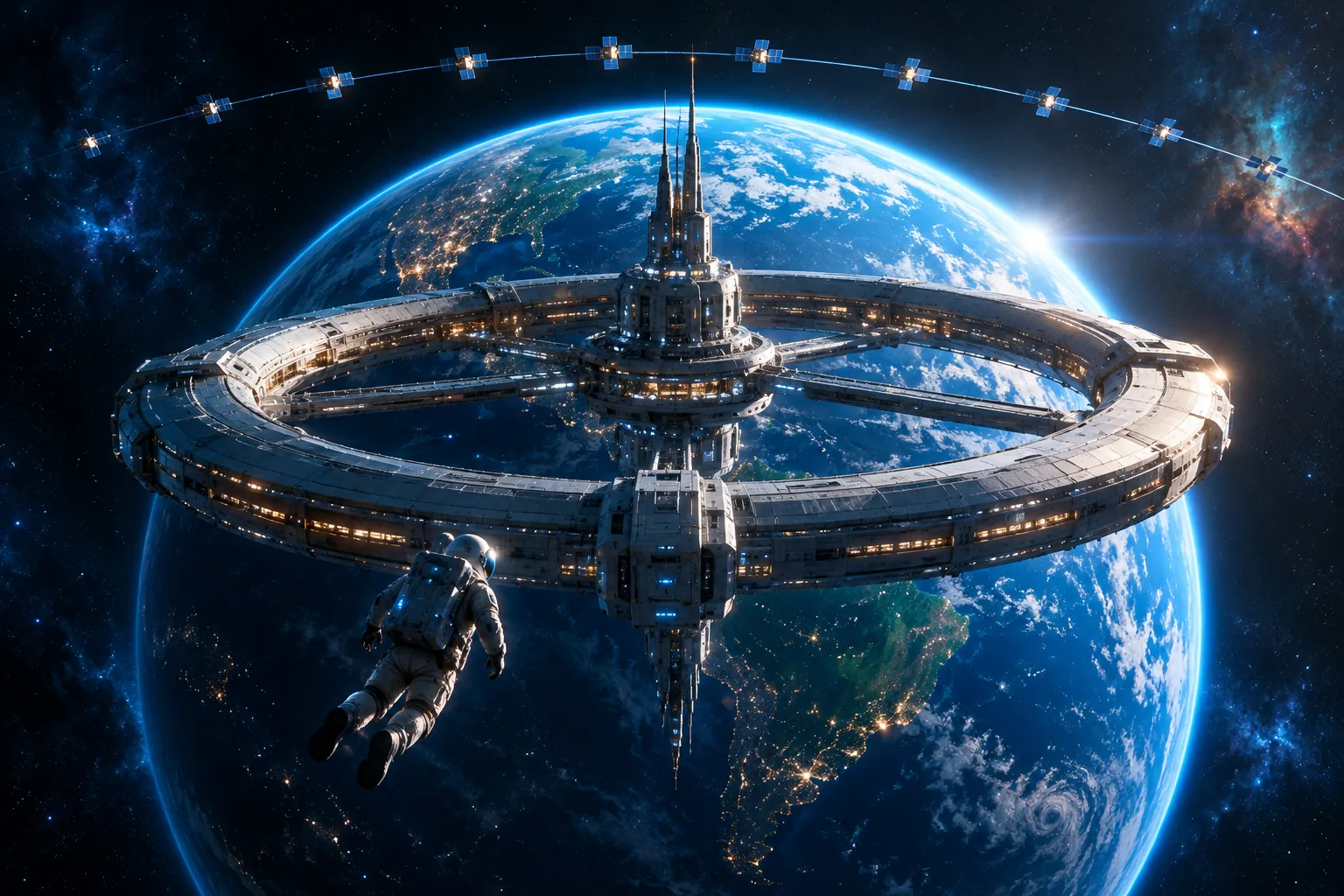
In October 1945 the magazine Wireless World printed Clarke's article "Extra-Terrestrial Relays". His argument was simple. A satellite circling the Earth at a height of about 35,786 kilometres above the equator takes exactly one day to go around, the same time the Earth takes to turn. So it appears to hang still in the sky. Three such stations, spaced around the globe, could cover almost the whole planet with radio and television.
Clarke imagined crewed stations that engineers would repair by hand, which turned out to be wrong, because real satellites are uncrewed. The core idea, however, was sound. Communication satellites in this orbit became ordinary in the 1960s and are still used for weather watching and broadcasting. The orbit is sometimes called the Clarke Belt in his honour. He did not build a satellite, and he did not patent the idea. What he did was explain it clearly, early and in print.
The main books
Childhood's End (1953) begins when huge ships appear over the world's cities, and the visitors, called the Overlords, bring peace. The novel asks what humanity would have to give up for a calm, comfortable future. It is often named as his best book, and we avoid spoilers here.
The City and the Stars (1956) is set a billion years ahead in Diaspar, a closed city where nothing changes, until a young man named Alvin wants to see what lies outside.
A Fall of Moondust (1961) is a rescue thriller set on the Moon, in which a tourist vehicle sinks into a sea of fine dust.
Rendezvous with Rama (1973) follows a crew who explore a giant, silent cylinder that passes through our solar system. It won the Hugo and Nebula awards, among others, and it is a good place to start. Later Rama sequels were written with Gentry Lee.
The Fountains of Paradise (1979) tells of an engineer who tries to build a space elevator, a cable that reaches from the ground to orbit. It also won the Hugo and Nebula awards. The setting is a fictional island closely modelled on Sri Lanka.
2001: A Space Odyssey
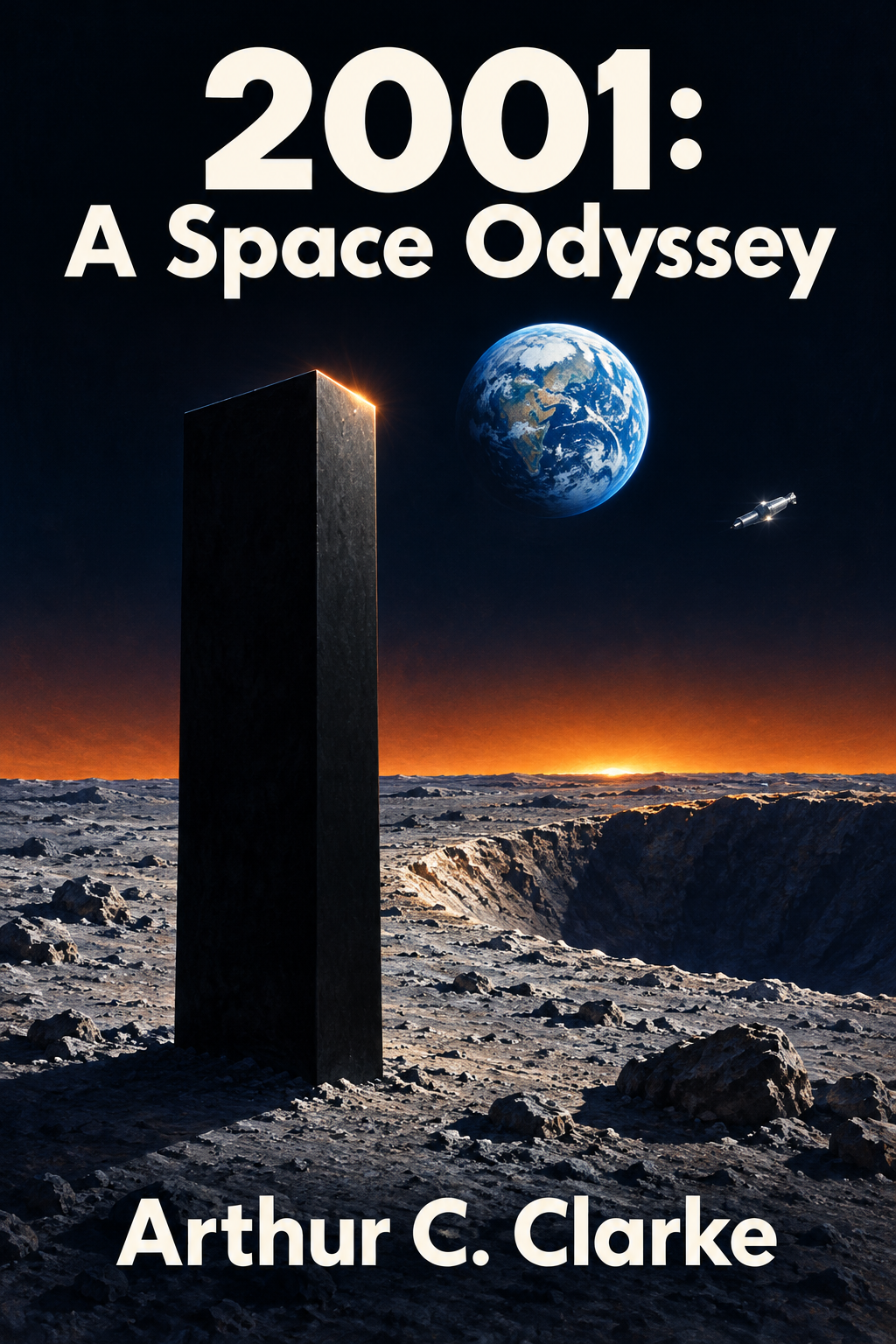
The story began with a short piece called "The Sentinel", which Clarke wrote in 1948. It imagines explorers on the Moon finding a strange object left by an older civilisation. In 1964 Kubrick asked him to turn that seed into a full film. The two men built the story together, and Clarke wrote the novel while the screenplay was being shaped. The film opened in 1968, and the novel followed in the same year.
The two versions are not identical. The film says little and leaves the viewer to think, while the book explains more about what happens to the astronaut Dave Bowman and who left the monolith. Clarke later wrote three sequels, beginning with 2010: Odyssey Two. For the full story and themes, read our 2001: A Space Odyssey study guide.
Life in Sri Lanka and later years
In 1956 Clarke moved to Ceylon, now Sri Lanka, and lived there for the rest of his life. He loved scuba diving and wrote books about the sea and its wrecks. He also became a familiar voice on television and radio, and he spoke about the Apollo missions as a commentator. In the early 1980s he hosted a documentary series about unexplained mysteries.
He received many honours, including the Kalinga Prize for popularising science in 1961 and a knighthood in 1998. Late in life he used a wheelchair because of post-polio syndrome. He died in Colombo on 19 March 2008, aged 90.
Clarke's three laws
In his essay collection Profiles of the Future, Clarke set out three "laws" about predicting technology. The best known is the third: any sufficiently advanced technology is indistinguishable from magic. The first says that when an elderly, distinguished scientist calls something possible, he is almost certainly right, and when he calls it impossible, he is very probably wrong. The second says that the only way to find the limits of the possible is to go beyond them into the impossible. They are rules of thumb, not scientific laws. Read more in Clarke's three laws.
Common misconceptions
- "Clarke invented the satellite." No. He described a particular useful orbit and what it could do. Rocket pioneers had already discussed orbiting objects.
- "The film came first, then the book." They were developed side by side. Kubrick's film reached cinemas before the finished novel was published, but both came from the same collaboration.
- "He predicted the future exactly." Clarke himself said that he was exploring possibilities. Some guesses were right, such as relay satellites, and others, such as crewed repair stations, were not.
- "HAL's name is a hidden joke about IBM." Each letter of HAL is one step before I, B and M in the alphabet, but Clarke said this was a coincidence.
Read next
Clarke's three laws explains each law with examples and shows how they are used today. 2001: A Space Odyssey is the best place to start with his fiction, and History of Science Fiction shows where Clarke fits among the other great writers of the field.